Business Analyst Resume
Explore Business Analyst Resume with ResumeBuild. Use this resume example as a reference for your own experience, skills, and qualifications.





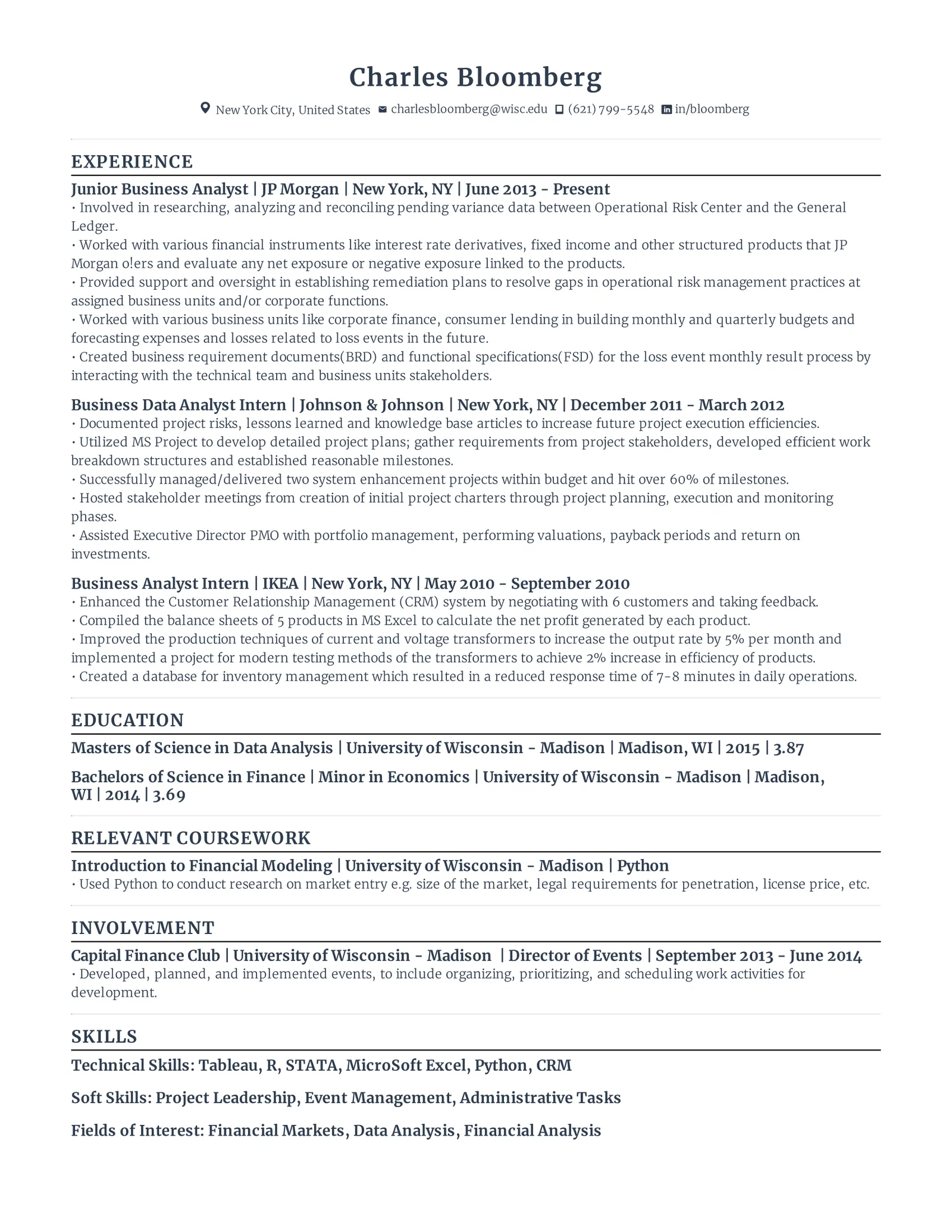
Below are two complete sample business analyst resumes: one for a career changer moving into a junior BA role, and one for an experienced business analyst. After the samples, the guide explains how to write each section, with extra summary and bullet examples you can adapt.
The people, employers and figures in the examples are fictional. Replace them with your own work and numbers you can explain in an interview.
Business analyst resume samples
Career changer or junior business analyst
Use this sample if you have done business analysis inside another job, such as operations, customer service or finance, but have not yet held the BA title. It uses a hybrid layout, so the BA project work appears before the full job history.
Start your own business analyst resume.
Summary
Claims operations lead moving into business analysis after five years at a regional insurer. Mapped the claims intake process in BPMN, wrote user stories for a CRM migration and coordinated user acceptance testing for a 12-person claims team. ECBA certified, with working SQL and Excel skills.
Skills
- Requirements: stakeholder interviews, user stories and acceptance criteria, as-is and to-be process mapping, UAT test scripts
- Tools: SQL (joins, aggregations), Excel (pivot tables, XLOOKUP), Jira, Confluence, Visio, Power BI (basic reports)
- Methods: Agile (Scrum), BPMN 2.0
Business analysis projects
Claims CRM migration, business-side analyst | Fieldstone Mutual Insurance | Mar 2025 – Jan 2026
- Interviewed 9 claims handlers and 2 supervisors about how a first notice of loss is recorded, then turned the findings into 34 user stories with acceptance criteria in Jira.
- Wrote and ran 60 UAT test scripts with the vendor's QA lead and logged 21 defects before go-live, including a duplicate-claim rule that would have blocked same-day resubmissions.
- Built a Confluence page of field definitions and training notes that the claims team used during the first month after launch.
Claims intake process redesign | Fieldstone Mutual Insurance | Jun 2024 – Nov 2024
- Mapped the as-is intake process in Visio and found three handoffs where claims waited for a manual email; proposed a shared Jira queue that reduced average intake time from 2.5 days to 1 day.
Work experience
Claims Operations Team Lead | Fieldstone Mutual Insurance, Columbus, OH | Apr 2023 – Present
- Lead a team of 12 claims handlers processing about 400 property claims a month.
- Wrote SQL queries against the claims database to produce a weekly backlog report, replacing a manual count that took 3 hours every Monday.
- Present monthly backlog and cycle-time trends to the claims manager and the underwriting lead.
Claims Handler | Fieldstone Mutual Insurance, Columbus, OH | Jul 2021 – Mar 2023
- Handled property claims from first notice to settlement and trained 5 new hires on the intake checklist.
Certifications
- Entry Certificate in Business Analysis (ECBA), IIBA, 2025
Education
- Bachelor of Business Administration, Marketing, The Ohio State University, 2021
What to notice in this sample:
- The projects section names the role Priya actually played ("business-side analyst") rather than claiming a BA job title she did not hold. The dates show the projects happened during her team lead job.
- Her operations numbers (12 handlers, 400 claims a month) give scale to the analysis work, which helps when the BA experience is recent.
- Each project bullet names a BA artifact: user stories, UAT scripts, a process map. Naming the artifact shows the method behind the result, and it uses the same terms BA job postings use.
Experienced business analyst
Use this sample if you have three or more years as a business analyst and can point to projects you led from requirements through launch. It uses a reverse-chronological layout because the work history is the strongest part.
Start your own business analyst resume.
Summary
Business analyst with eight years in banking and logistics, leading requirements for lending, payments and warehouse systems. Runs elicitation workshops with operations, compliance and engineering, then turns the results into BRDs, BPMN models and Jira backlogs that teams can build from. Past projects cut loan approval time from 9 business days to 4 and removed $310K a year in duplicate carrier payments. CBAP certified.
Skills
- Requirements and modeling: elicitation workshops, business requirements documents (BRDs), user stories, BPMN 2.0, UML use case and activity diagrams, gap analysis, UAT planning
- Tools: SQL (SQL Server, PostgreSQL), Excel, Jira, Confluence, Visio, Power BI, Tableau
- Methods: Agile (Scrum), Waterfall, Lean process improvement
Experience
Senior Business Analyst | Lone Star Community Bank, Dallas, TX | Feb 2022 – Present
- Led elicitation for a new loan origination system with 14 stakeholders across lending, credit risk and compliance; documented 180 requirements in a BRD that was signed off in six weeks.
- Modeled the as-is and to-be approval flow in BPMN and removed two duplicate credit checks; median approval time fell from 9 business days to 4 after launch.
- Wrote acceptance criteria for 220 user stories in Jira and ran three UAT cycles; the system had 11 production defects in its first 90 days, compared with 46 after the bank's previous lending system launch.
- Built a Power BI adoption dashboard for the rollout; 85% of loan officers were using the new workflow within three months.
- Run weekly priority reviews with the head of lending and the engineering lead, keeping every scope change in a single decision log. Coach two junior analysts on story writing.
Business Analyst | Meridian Freight Logistics, Fort Worth, TX | Jun 2018 – Jan 2022
- Gathered requirements from 6 warehouse sites to replace paper dock scheduling, wrote UML use cases and supported vendor configuration; average carrier wait time dropped by 35%.
- Used SQL to reconcile invoice data between the transportation management system and the accounting system, found duplicate carrier payments and designed a matching check that saves $310K a year.
- Documented 40 warehouse processes in Visio, which the company used to onboard two new sites.
Certifications
- Certified Business Analysis Professional (CBAP), IIBA, 2023
Education
- Bachelor of Science, Information Systems, The University of Texas at Dallas, 2018
What to notice in this sample:
- Every bullet names the artifact (BRD, BPMN model, user stories) and the result it led to. The reader sees both the BA method and the business effect.
- The defect figure is compared with a baseline (the previous launch). A number with a comparison is easier to believe than a number on its own.
- Coaching junior analysts appears as one short line. If you are applying for lead or senior roles, give mentoring, workshop facilitation and cross-team decisions their own bullets.
Choose the right format and section order
Use a reverse-chronological format if you already work as a business analyst or in a role with clear BA duties. Recruiters can see your most recent requirements work first.
Use a hybrid format if you are changing careers or graduating. It keeps a dated work history but moves your BA projects, internships or capstone work above it, as in Priya's resume.
Section order for an experienced business analyst:
- Header
- Summary
- Skills
- Experience
- Certifications
- Education
Section order for a career changer or graduate:
- Header
- Summary
- Skills
- Business analysis projects or internships
- Work experience
- Certifications
- Education (move it above work experience if you graduated within the last year)
Keep the layout to a single column with standard headings such as "Experience" and "Skills". Multi-column layouts, tables and text boxes can be harder for applicant tracking systems to read.
How a business analyst resume differs from a data analyst resume
The two roles share tools, so their resumes often look alike. The difference is what you produce. A business analyst works out what should change in a process or system and documents exactly what must be built. A data analyst answers questions from data and reports what it shows.
| Business analyst | Data analyst | |
|---|---|---|
| Main question | What should change, and what exactly must be built? | What does the data show, and why? |
| Typical deliverables | BRDs, user stories with acceptance criteria, process maps, UAT plans | Dashboards, reports, ad hoc analyses, reporting data models |
| Works most with | Business stakeholders, product owners, developers, testers | Business users who request analysis, analytics leads, data engineers |
| Tools to name | Jira, Confluence, Visio, SQL, Excel, Power BI or Tableau | SQL, Python or R, Excel, Power BI or Tableau |
| Outcomes to measure | Process time saved, cost reduced, adoption, defects avoided | Report time saved, forecast accuracy, decisions supported |
If your job mixes both, lead with the BA side when you apply for BA roles. Put the bullet about documenting requirements or redesigning a process above the bullet about building a dashboard, and describe the dashboard by the decision it supported.
If your work is mainly querying, modeling and reporting data, and you are applying for data analyst roles, reverse that order: lead with the analyses and what they showed.
How to write each section
Header
Include your name, the job title you are applying for, city and state, phone, email and LinkedIn URL. Use "Business Analyst" as the title even if your current job title is different, as long as you are applying for BA roles. Leave out your full street address, photo and date of birth.
Summary
Write two or three sentences that state your level and domain, the requirements work you do, and one result or credential. Avoid an objective statement about what you hope to gain. The summary should describe what you already bring.
Rewrite the summary for each posting so it uses the posting's language, for example "product owner" or "stakeholder", and its domain. The guide on how to tailor your resume covers this step in more detail.
Experience
Build each bullet from three parts: an action verb, the BA artifact or method you used, and the result.
Show your requirements work by naming it:
- Elicitation: interviews, workshops, observation or surveys, and who took part
- User stories: how many, with acceptance criteria, and in which tool
- Process maps: as-is and to-be models, the notation (BPMN, UML) and what changed
- BRDs and specifications: scope, number of requirements and who signed off
- Testing: UAT scripts, test cycles and defects found before release
Show stakeholder management by naming the groups you worked between, how many people were involved, and the decision you reached, such as sign-off, an agreed priority or a resolved conflict.
Quantify outcomes with the measures business analysts can usually trace:
- Process time saved: cycle time, approval time, handoffs removed
- Cost reduced: hours of manual work removed, duplicate payments stopped, licenses retired
- Adoption: share of users on the new process or system after a set period
- Defects avoided: issues caught in UAT, production defects compared with a previous release
Take numbers from system reports, Jira, time studies or the project close-out. If no reliable figure exists, describe the observable outcome instead, such as a document another team adopted or a sign-off reached without rework. Do not estimate a number you could not explain in an interview.
Skills
Group your skills so a recruiter can scan them: requirements and modeling, tools, and methods. List only tools you can discuss with an example. Use the posting's names for tools, so write "Power BI" if the posting says Power BI.
Show soft skills such as facilitation and negotiation in your experience bullets rather than in the skills list, where they cannot be proven.
Certifications
Give certifications their own section with the full name, the issuing body and the year. A certification in progress can be listed with its expected date, for example "ECBA, IIBA (exam scheduled for January 2027)".
Education
List the degree, field, institution and year. Recent graduates can add relevant coursework or a capstone project, such as a process redesign or a systems analysis course. With several years of experience, keep education to one line.
Business analyst resume summary examples
These cover two situations the full samples do not.
Recent graduate with an internship
Information Systems graduate (Arizona State University, May 2026) with a 10-week business analyst internship at a health insurer. Wrote user stories and acceptance criteria for a member portal update, mapped the prior-authorization request process in BPMN and wrote SQL queries to prepare UAT test data. Uses Jira, Confluence and Power BI.
If you had no internship, put your strongest capstone or class project in its place and name the artifact you produced.
Mid-level business analyst moving into healthcare
Business analyst with five years in insurance and payments systems, now focused on healthcare revenue cycle work. Led requirements for a claims-editing rules engine, translating payer policies into 140 testable business rules, and reduced claim denials caused by coding errors by 18%. Works in Agile teams using Jira and Confluence. CCBA certified.
When you change industries, name the industry you are targeting in the first sentence and choose a result that transfers to it, here rules-based claims work.
Experience bullet examples by outcome
Pick the bullet that matches the evidence you have, then replace the process, numbers and tools with your own.
Elicitation: Ran six elicitation workshops with finance, procurement and IT to define a supplier onboarding portal, consolidating 90 requests into a prioritized backlog of 42 user stories.
Process time saved: Mapped the invoice approval process in BPMN, removed a redundant manager sign-off for invoices under $5,000 and reduced average approval time from 6 days to 2.
Cost reduced: Analyzed 12 months of overtime data with SQL and recommended shift changes for two call-center queues, lowering overtime spend by $140K a year.
Adoption: Wrote process guides in Confluence and ran eight drop-in sessions after a CRM rollout; weekly active use reached 92% of the sales team within six weeks.
Defects avoided: Defined acceptance criteria and UAT scenarios for a payroll integration and caught 27 defects before release, including a tax-code mapping error that would have misstated withholding for 300 employees.
Requirements documentation: Wrote the BRD and data mapping for a policy administration upgrade, which underwriting, finance and compliance signed off without a second review cycle.
Stakeholder management: Resolved a dispute between warehouse operations and customer service over order cutoff times by presenting three options with their cost and service impact; leadership chose one in a single meeting.
No reliable metric: Created the team's first requirements traceability matrix in Excel, linking each user story to its test case; the QA lead adopted it as the standard for later releases.
Business analyst skills list
Choose the skills that appear in the posting and that your experience bullets can back up. If you need to prioritize, prove these three first: requirements elicitation and documentation, process modeling, and stakeholder communication. Tools support those skills but do not replace them.
Requirements and analysis
- Requirements elicitation (interviews, workshops, observation)
- User stories and acceptance criteria
- Business requirements documents (BRDs)
- Gap analysis and root cause analysis
- User acceptance testing (UAT)
- Requirements traceability
Modeling
- Process mapping in BPMN 2.0
- UML use case, activity and sequence diagrams
- Data flow diagrams
- Wireframes and mockups
Tools
- SQL
- Excel
- Jira
- Confluence
- Visio or Lucidchart
- Power BI or Tableau
Methods
- Agile (Scrum, Kanban)
- Waterfall
- Lean process improvement
Skills to show in your bullets
- Stakeholder management
- Workshop facilitation
- Negotiating scope and priorities
- Writing for technical and non-technical readers
- Presenting recommendations to decision-makers
For more on choosing between hard and soft skills, see the guide to resume skills.
Business analyst certifications
The International Institute of Business Analysis (IIBA) offers three core certifications, and the Project Management Institute (PMI) offers one. List the one you hold, or the next one you are working toward.
| Certification | Issued by | Best fit |
|---|---|---|
| ECBA (Entry Certificate in Business Analysis) | IIBA | New business analysts and career changers; no BA work experience required |
| CCBA (Certification of Capability in Business Analysis) | IIBA | Business analysts with a few years of experience |
| CBAP (Certified Business Analysis Professional) | IIBA | Senior business analysts with extensive experience |
| PMI-PBA (PMI Professional in Business Analysis) | PMI | Business analysts who work closely with project managers; requires BA experience |
Eligibility rules, such as required experience and training hours, change from time to time. Check the current requirements on the IIBA or PMI website before you apply.
Common business analyst resume mistakes
- Listing duties instead of results. "Responsible for gathering requirements" tells the reader nothing new. Name the artifact and what it achieved.
- Reading like a data analyst resume. If every bullet is about dashboards and queries, add the requirements, process and testing work behind them.
- Listing tools without proof. If Jira or BPMN appears in your skills, at least one bullet should show you using it.
- Using internal system names. Write "loan origination system" instead of an in-house name like "LOSv3", which a recruiter will not recognize.
- Overstating your role. Use "led" only for work you led. "Supported" and "coordinated" are accurate and still credible.
- Inventing or inflating numbers. Use figures you can trace to a report or explain in an interview, or describe the outcome without a number.
- Sending one resume to every posting. Adjust the summary, skills order and top bullets for each job description.
Next steps
Once your resume is done, a cover letter can explain context the resume cannot, such as why you are moving into business analysis. These cover letter tips cover how to tailor it to each employer.
Build your business analyst resume in Resume Build from guided prompts and export it as a PDF.