Facilities Engineer Resume
Two ready-to-use facilities engineer resume examples plus a section-by-section writing guide, skills lists, summary templates, and quantified bullet points built for 2026 job postings.





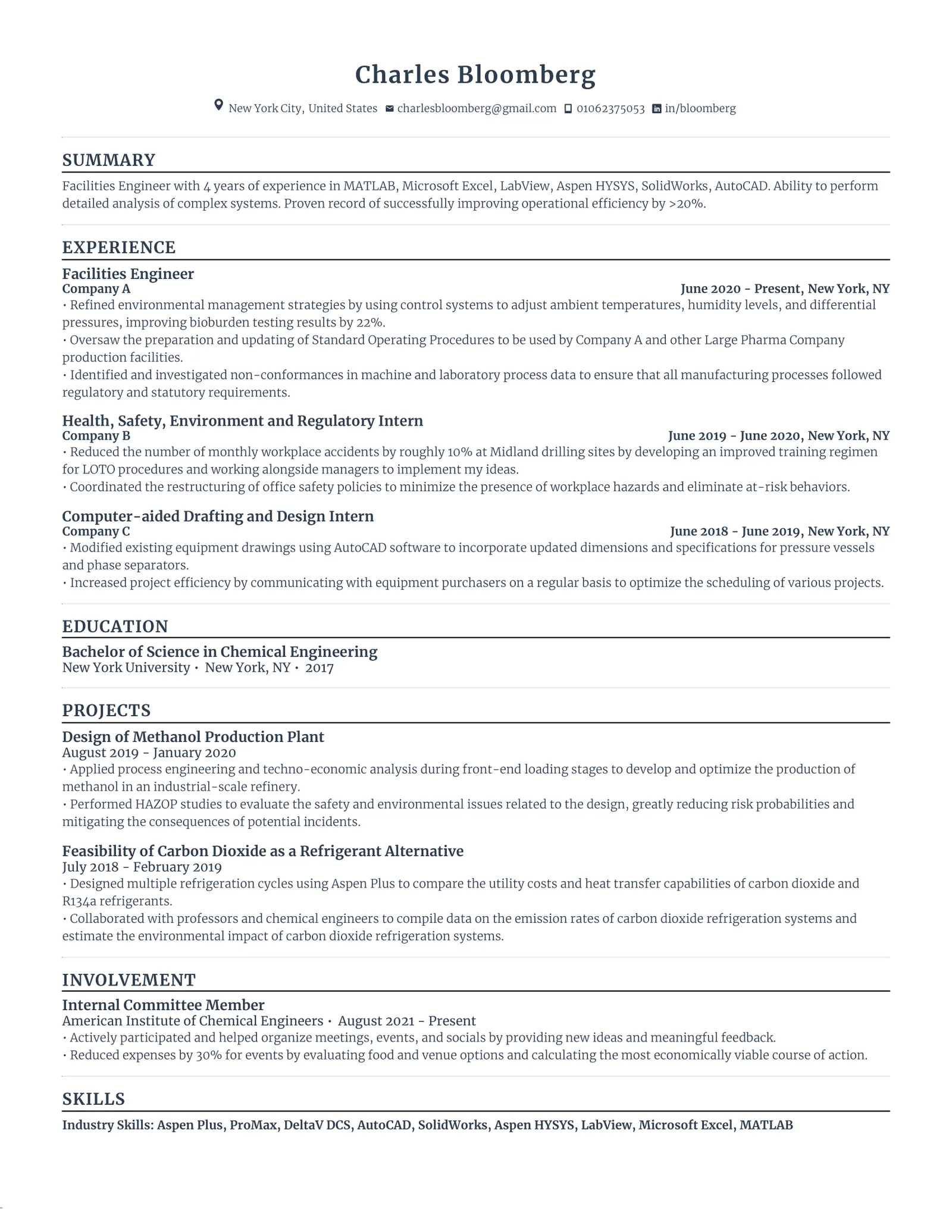
Hiring managers for facilities engineering roles spend less than ten seconds on a first scan, so your resume needs to surface HVAC systems, preventive maintenance programs, regulatory compliance, and cost-reduction wins before they scroll. A facilities engineer resume should be a tightly structured one-to-two-page document that proves you can keep complex built environments running safely, efficiently, and within budget. Use the examples and writing guide below to build yours from scratch or sharpen what you already have.
Entry-Level Facilities Engineer Resume Example
This example is built for candidates within zero to three years of experience who are moving from a mechanical or civil engineering degree into a corporate or industrial facilities role. It leads with a strong objective statement instead of a summary, front-loads relevant internship and capstone project work, and uses a skills-first layout to compensate for limited professional history. It is also the format to follow when writing a facilities engineer resume with no direct experience.
Make this resume your own with ResumeBuild.
PROFESSIONAL SUMMARY
Entry-level Facilities Engineer with a proven ability to support and enhance infrastructure through detailed analysis and effective management. Excels in optimizing utility usage and ensuring compliance with industry standards.
PROFESSIONAL Experience
Facilities Engineer | Company A
August 2023 — Present, Phoenix, USA
- Assisted in managing facilities projects by monitoring and updating facility plans for 100,000 sq ft of office space using AutoCAD and SAP Plant Maintenance.
- Developed predictive maintenance strategies that increased equipment uptime by 15% and reduced repair costs by 10% over a period of 6 months.
- Conducted routine inspections and audits to ensure compliance with OSHA safety standards, resulting in a 98% pass rate during health and safety audits.
- Collaborated with cross-functional teams to streamline energy consumption, achieving a 12% reduction in utility costs through the implementation of energy-efficient solutions.
- Executed daily facility operations tasks, including HVAC system management and inventory control, ensuring seamless functionality across diverse systems.
Junior Facilities Engineer | Company B
June 2022 — July 2023, Seattle, USA
- Supported senior engineers in the execution of facility upgrade projects, contributing to the successful completion of a $2 million infrastructure improvement project within budget and time constraints.
- Implemented a preventative maintenance schedule that improved asset lifespan by 20%, utilizing CMMS (Computerized Maintenance Management Systems).
- Analyzed and provided solutions for technical issues, achieving a 30% faster resolution time by utilizing root cause analysis techniques.
- Prepared comprehensive reports and documentation for management with a focus on system efficiency and cost-effectiveness, leading to optimized resource allocation.
Facilities Technician | Company C
January 2021 — May 2022, Portland, USA
- Conducted maintenance activities on HVAC systems across 20+ client sites, resulting in a client satisfaction improvement score of 25% within a year.
- Assisted in the development and implementation of energy-saving initiatives that reduced electricity usage by 8% across multiple facilities.
- Supported inventory management by performing regular checks and coordinating the procurement of necessary supplies, ensuring 100% stock availability at all times.
Maintenance Assistant | Company D
June 2020 — December 2020, Greenville, USA
- Provided essential support in the maintenance of mechanical systems for over 15 commercial properties, boosting system reliability by 18%.
- Participated in a project that updated outdated lighting systems to LED, leading to a 5% reduction in energy costs and improved illumination quality.
- Ensured compliance with environmental regulations during all maintenance tasks, which contributed to the company's Green Certification renewal for an additional year.
Education
Bachelor of Science in Mechanical Engineering | Arizona State University
May 2020
Expert-Level Skills
AutoCAD, SAP Plant Maintenance, CMMS, HVAC Systems, Predictive Maintenance, Energy Management, OSHA Compliance, Root Cause Analysis, Project Coordination, Cross-functional Collaboration, Effective Communication, Problem-solving
Entry-level facilities engineer resume example
Senior Facilities Engineer Resume Example
This example targets candidates with eight or more years running multi-site facilities programs, managing contractors, and driving capital improvement projects. The professional summary quantifies portfolio size and cost savings immediately, the work experience section uses a leadership-first hierarchy, and certifications such as CFM and PMP are given prominent placement. Pharmaceutical, data center, and manufacturing facilities engineers will find the structure adaptable to regulated-environment requirements.
Make this resume your own with ResumeBuild.
PROFESSIONAL SUMMARY
Accomplished Facilities Engineer with extensive expertise in managing operations for data center and pharmaceutical environments. Proven track record of optimizing facility performance and ensuring regulatory compliance.
PROFESSIONAL Experience
Senior Facilities Engineer | Company A
March 2022 — Present, Durham, USA
- Spearheaded maintenance operations for a 1.2 million square foot data center, achieving a 99.999% uptime across all infrastructures within a year using predictive maintenance techniques.
- Implemented energy efficiency measures resulting in a 15% reduction in operational costs by leveraging advanced HVAC systems and renewable energy sources.
- Led a team of 15 facilities technicians, ensuring safety protocols and compliance with ISO standards, which improved operational efficiency by 20%.
- Automated facility management processes using a CMMS system, reducing reactive maintenance tasks by 30% and improving response times by 40%.
- Conducted and documented 50+ root cause analysis sessions annually, enhancing system reliability and decreasing unplanned outages by 25%.
Facilities Engineer | Company B
January 2018 — February 2022, Cambridge, USA
- Developed and maintained GxP compliant facilities to support the production of mRNA vaccines, achieving zero non-compliance incidents in two consecutive FDA audits.
- Optimized cleanroom environments by redesigning airflow systems, improving particle control efficiency by 35% and lowering contamination risks.
- Managed a $5 million annual maintenance budget effectively, executing 200+ preventive maintenance tasks yearly to diminish downtime.
- Collaborated with cross-functional teams to integrate facility upgrades with ongoing production processes, facilitating a 20% increase in production capacity.
Facilities Project Engineer | Company C
June 2015 — December 2017, Cleveland, USA
- Oversaw facility expansion projects leading to a 50% increase in laboratory space within budget and on schedule for a growing pharmaceutical enterprise.
- Designed and deployed emergency power systems across three critical facilities, boosting the reliability of power supply systems by 40%.
- Initiated sustainability programs and successfully reduced carbon emissions by 10% via the integration of green building technologies and processes.
Junior Facilities Engineer | Company D
August 2013 — May 2015, Raleigh, USA
- Assisted in day-to-day facility maintenance of a biopharma research center, resolving 250+ service requests annually to support uninterrupted research activities.
- Monitored building automation systems and implemented corrective actions, reducing utilities consumption by 12% over a period of two years.
- Executed testing and validation of HVAC and plumbing systems, ensuring adherence to industry compliance standards with a 98% first-pass approval rate.
Education
Bachelor of Science in Mechanical Engineering | Massachusetts Institute of Technology
May 2013
Expert-Level Skills
GxP Compliance, CMMS, Predictive Maintenance, HVAC Systems, Renewable Energy Integration, Cleanroom Optimization, Root Cause Analysis, Project Management, Cross-Functional Collaboration, Leadership, Problem-Solving
Senior facilities engineer resume example
What to Include in a Facilities Engineer Resume
Contact Information
Place your full name, city and state, a professional email address, your phone number, and a LinkedIn URL at the very top. If you maintain a portfolio or a GitHub with maintenance tracking scripts, link to it here. Omit your full street address unless the posting specifically requests it. Facilities engineering roles are often site-specific, so confirming your location or willingness to relocate in the contact block or summary prevents early screening rejections.
Professional Summary
Write three to four sentences that answer four questions: how many years of experience you have, what types of facilities you have managed (commercial office, manufacturing plant, data center, hospital, university campus), what your most measurable accomplishment is, and what role you are targeting. Avoid adjectives like "dynamic" or "results-oriented" and replace them with numbers. A strong opening line for a facilities engineer resume sounds like "Facilities engineer with nine years managing 1.2M sq ft of Class A commercial space across six sites" rather than a vague claim about passion for buildings.
Work Experience
List positions in reverse chronological order with employer name, your title, city, and dates. Under each role, write four to eight bullet points that begin with an action verb and include at least one metric. Common metrics in facilities engineering include square footage managed, annual maintenance budget controlled, energy reduction percentage, uptime percentage for critical systems, number of contractors or technicians supervised, and capital project dollar values. Avoid describing job duties in abstract terms. Replace "responsible for HVAC maintenance" with "Managed preventive and corrective maintenance program for 48 HVAC units across 320,000 sq ft, achieving 99.1 percent system uptime." If you have a facilities engineer job description PDF from a previous employer, use it to pull out systems you managed but may have forgotten to document.
Skills
Facilities engineering job postings are heavy with specific technical terms that applicant tracking systems scan for before a human sees your resume. Build two short lists: hard technical skills drawn from your actual toolkit and the posting requirements, and soft skills that reflect the cross-functional nature of the role. Facilities engineers regularly coordinate with C-suite executives, janitorial vendors, safety officers, and city inspectors in the same week, so interpersonal and project management abilities are genuinely valued by hiring managers, not just filler.
Education
List your highest degree first with the institution, degree name, field of study, and graduation year. Facilities engineering roles commonly require a bachelor's degree in mechanical, civil, electrical, or building systems engineering. If your degree is in a different discipline, add a line noting relevant coursework such as thermodynamics, fluid mechanics, HVAC design, or structural analysis. Entry-level candidates should expand this section with GPA (if above 3.2), relevant projects, and any internship completed through the program.
Certifications
This section can be the deciding factor between two otherwise equal candidates. Facilities-specific credentials that carry real weight with hiring managers include Certified Facility Manager (CFM) from IFMA, Facility Management Professional (FMP), Certified Energy Manager (CEM), LEED AP, EPA 608 Refrigerant Handling, and OSHA 30. PMP or CAPM credentials are valuable for roles with heavy capital project loads. List the certifying body, credential name, and expiration or renewal date. If you are in progress on a credential, note the expected completion date rather than omitting it.
Facilities Engineer Resume Summary Examples
Entry-Level: Mechanical engineering graduate with hands-on experience in HVAC system commissioning and energy audits through a 500-hour internship at a 180,000 sq ft university campus facilities department. Skilled in AutoCAD, CMMS data entry, and ASHRAE 90.1 compliance checks. Seeking a junior facilities engineer role where I can grow a preventive maintenance program from the ground up.
Experienced: Facilities engineer with eleven years maintaining critical systems across healthcare and pharmaceutical manufacturing environments totaling 850,000 sq ft. Delivered $2.1M in energy cost reductions over four years through LED retrofits, BAS optimization, and demand-response contracting. Certified Facility Manager (CFM) with deep experience in regulatory compliance including JCAHO, FDA 21 CFR Part 11, and GMP cleanroom standards.
Specialty (Data Center Facilities): Facilities engineer specializing in mission-critical data center infrastructure with eight years managing Tier III and Tier IV facilities across three hyperscale campuses. Achieved 99.999 percent power uptime over a 36-month period by redesigning preventive maintenance schedules for 14 UPS systems and 22 precision cooling units. Expert in DCIM platforms, generator load-bank testing, and NFPA 70E electrical safety compliance.
Facilities Engineer Skills for Your Resume
Hard and Technical Skills
- HVAC systems operation, maintenance, and commissioning
- Building Automation Systems (BAS/BMS): Siemens Desigo, Honeywell EBI, Johnson Controls Metasys
- Computerized Maintenance Management Systems (CMMS): Maximo, ServiceNow, eMaint
- Preventive and predictive maintenance program development
- Electrical systems: single-line diagrams, switchgear, UPS, ATS
- Plumbing and mechanical systems including chilled water and steam distribution
- Capital project management and construction administration
- Energy auditing and ASHRAE Level I/II energy assessment
- AutoCAD and Revit for as-built drawing management
- OSHA safety regulations and permit-to-work systems
- Vendor and contractor management including RFP, scope of work, and contract oversight
- Regulatory compliance: NFPA, JCAHO, EPA, local building codes
- Emergency preparedness and business continuity planning
- Life safety systems: fire suppression, emergency lighting, access control
Soft Skills
- Cross-functional stakeholder communication
- Prioritization under emergency or competing-demand conditions
- Vendor negotiation and relationship management
- Written documentation and technical report writing
- Team leadership and trade technician supervision
- Problem-solving with root cause analysis methodology
- Budget forecasting and financial accountability
- Training and knowledge transfer to maintenance staff
Facilities Engineer Resume Bullet Point Examples
Every bullet should follow this formula: Action Verb + Task or System + Scope + Quantified Result. Here are eight copy-ready examples you can adapt with your own numbers:
- Managed preventive maintenance program for 62 pieces of critical mechanical equipment across a 400,000 sq ft mixed-use corporate campus, reducing unplanned downtime by 34 percent year over year.
- Led a $1.8M chiller plant replacement project from design through commissioning, completing four weeks ahead of schedule and 6 percent under budget.
- Negotiated service contracts with eight vendors covering janitorial, landscaping, elevator, and fire protection services, achieving $210,000 in annual cost savings through competitive rebidding.
- Implemented a CMMS-based work order system in Maximo for a 12-person maintenance team, cutting administrative processing time by 40 percent and improving response SLA compliance from 71 percent to 96 percent.
- Conducted energy audits on lighting, compressed air, and HVAC systems at three manufacturing sites, identifying $480,000 in annual savings; secured utility rebates covering 30 percent of project capital costs.
- Coordinated tenant improvement projects for 23 office suites totaling 95,000 sq ft, managing GC relationships, permit applications, and move-in inspections with zero schedule conflicts during lease transitions.
- Developed and delivered OSHA 10 safety training for 28 in-house maintenance technicians, resulting in zero recordable incidents over an 18-month period.
- Designed and implemented a water treatment program for cooling tower systems in compliance with ASHRAE 188 Legionella risk management guidelines, eliminating two prior compliance citations.
Tips for a Standout Facilities Engineer Resume
Tailor the skills section to the posting, not your entire career. Facilities engineering spans commercial real estate, healthcare, pharma, data centers, education, and manufacturing. Each sector uses different compliance frameworks and preferred certifications. Pull the exact language from the job posting and mirror it in your skills section and bullet points so ATS systems register a strong keyword match before a human reads your resume.
Lead every bullet with a strong action verb specific to the trade. Words like commissioned, retrofitted, benchmarked, remediated, decommissioned, and procured immediately signal facilities expertise. Generic verbs like "managed" and "oversaw" can stay, but they should appear alongside these technical verbs rather than replace them.
Include the square footage and system counts you managed. Hiring managers use these numbers to assess scope-fit instantly. A candidate who managed a 50,000 sq ft single-floor office is a different hire from one who managed a 2M sq ft multi-building campus. Do not assume the reader will infer scope from your employer's name.
Save your resume as a PDF unless the posting specifies otherwise. A facilities engineer resume PDF preserves formatting across all operating systems and prevents ATS parsers from scrambling your bullet alignment. Name the file in a professional format such as FirstName-LastName-FacilitiesEngineer-Resume.pdf. If an older ATS system specifically requests a Word file, keep both versions ready.
Certifications belong near the top for experienced candidates. If you hold a CFM, CEM, or LEED AP, put your certifications section immediately after your summary or in the header alongside your name. These credentials are expensive and difficult to obtain and they serve as immediate trust signals for senior roles.
Show progression when it exists. If you moved from facilities technician to facilities engineer to senior facilities engineer at the same company, list each title as a separate entry under the same employer with its own date range and bullets. Promotion within a company is one of the strongest signals of reliability and competence in a field where institutional knowledge of building systems is genuinely valuable.
Facilities engineers in the United States typically earn between $65,000 and $115,000 annually depending on industry, geographic market, and years of experience, with senior and lead roles in high-cost metros or regulated industries such as pharmaceuticals and data centers often exceeding that range.
Facilities Engineer Resume FAQ
What format works best for a facilities engineer resume?
A reverse-chronological format works best for most facilities engineers because it lets hiring managers quickly assess the scope and complexity of the facilities you have managed at each employer. A functional or hybrid format is only worth considering for entry-level candidates or those transitioning from a related trade such as HVAC technician or construction management.
How long should a facilities engineer resume be?
A facilities engineer resume should be one page for candidates with fewer than five years of experience and two pages for candidates with five or more years. Going beyond two pages is rarely justified. If you are struggling to fit your experience onto two pages, cut job duties from roles older than ten years down to two or three bullets.
What skills should I put on a facilities engineer resume?
Facilities engineer resume skills should combine system-specific technical knowledge such as HVAC, BAS, CMMS, and electrical systems with compliance and project management competencies. Always check the job posting for the exact systems and platforms listed and mirror that language in your skills section. Soft skills like contractor negotiation and stakeholder communication round out the list.
How do I write a facilities engineer resume with no experience?
A facilities engineer resume with no direct experience should lead with a strong objective statement, expand the education section to include relevant coursework and capstone projects, and treat internships and co-op placements as full work experience entries with quantified accomplishments. Certifications like OSHA 10, EPA 608, or an IFMA FMP candidate designation show initiative and domain commitment.
What should the objective or summary say on a facilities engineer resume?
A facilities engineer resume objective should state the specific type of facilities role and environment you are targeting, the most relevant technical skill or credential you bring, and one concrete example of impact even if it comes from coursework or an internship. Keep it to two or three sentences. Experienced candidates should write a summary instead, leading with years of experience and portfolio size.
What does a facilities engineer do and how should that appear on a resume?
A facilities engineer is responsible for the operation, maintenance, repair, and improvement of a building's physical systems including mechanical, electrical, plumbing, fire protection, and life safety infrastructure. On a resume, these responsibilities should appear as quantified bullet points tied to outcomes such as uptime rates, cost savings, compliance results, and project completions rather than as a generic list of duties.
What is the typical salary for a facilities engineer?
Facilities engineer salary in the United States typically ranges from $65,000 to $115,000 per year based on data from major job boards and the Bureau of Labor Statistics for related occupations, with total compensation higher in regulated industries such as pharmaceuticals, semiconductor manufacturing, and mission-critical data centers. Geographic market, certifications such as CFM or CEM, and portfolio size all influence where a candidate lands within that range.