Graduate Student Researcher Resume Examples & Templates
A comprehensive guide to writing a graduate student researcher resume, covering every section from summary to skills, with worked examples and ATS-optimization tips for grad students at all levels.





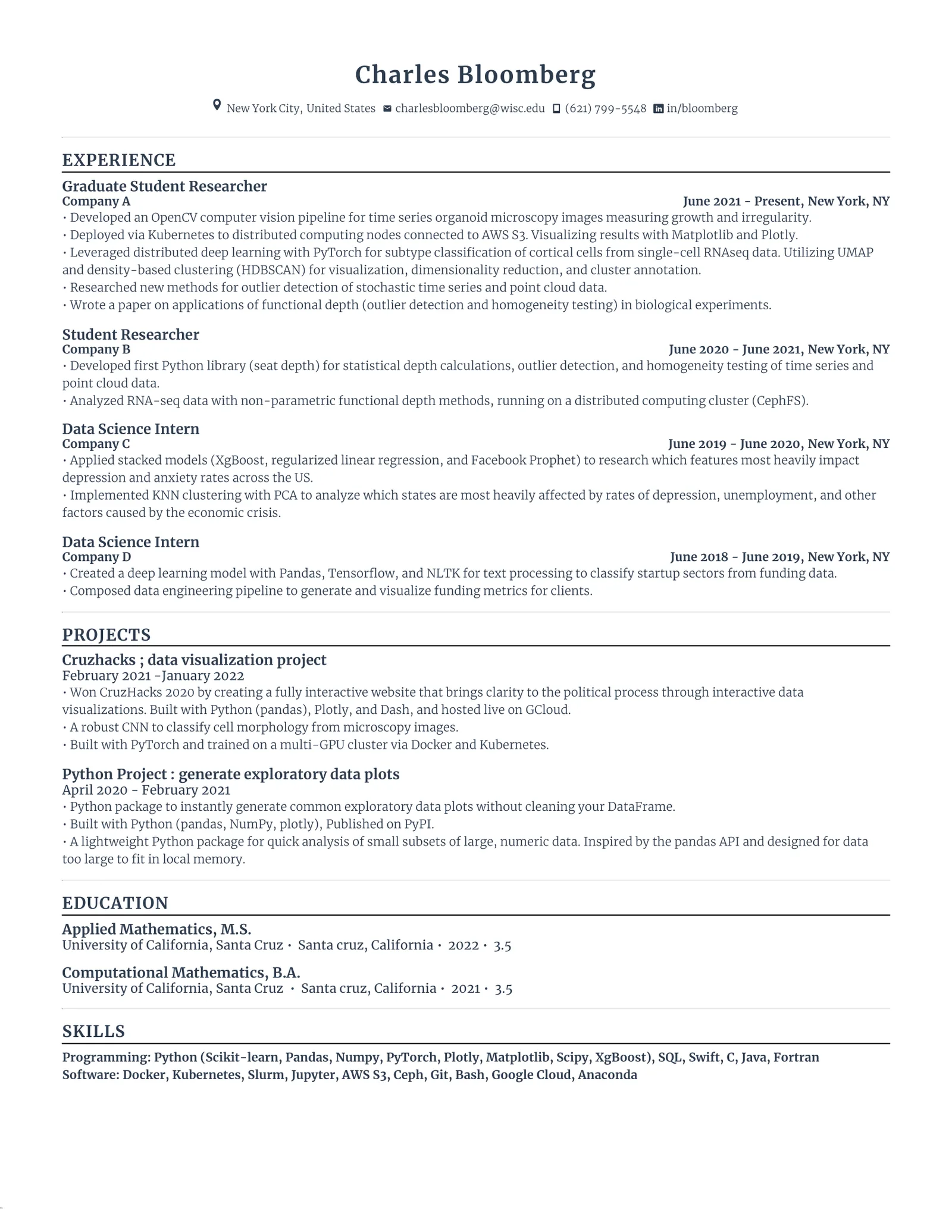
How to Write a Graduate Student Researcher Resume That Gets Noticed
A strong graduate student researcher resume sits at the intersection of academic credibility and professional clarity. Whether you are applying for a funded research assistantship, a lab position at a national institute, an industry R&D role, or preparing a grad school resume template for a fellowship application, the document must do two things simultaneously: demonstrate rigorous scholarly capability and communicate real-world impact. Hiring committees and principal investigators scan dozens of applications; your resume needs to surface the right keywords for ATS filters while convincing a human reader that you can design experiments, manage data pipelines, and contribute to publishable outcomes. This guide walks you through every section, with concrete phrasing, metrics guidance, and worked examples tailored to graduate researchers at every stage — from a junior graduate student researcher resume built around coursework and volunteer lab hours to a mid-level document anchored by publications and grant contributions.
Make this resume your own with ResumeBuild.
PROFESSIONAL SUMMARY
Detail-oriented Graduate Student Researcher with hands-on experience in experimental design, quantitative data analysis, and peer-reviewed scientific writing. Adept at leveraging statistical software and laboratory instrumentation to produce reproducible, high-impact research outcomes.
PROFESSIONAL Experience
Graduate Student Researcher | Company A
August 2022 — Present, Madison, USA
- Designed and executed 3 independent longitudinal studies examining cellular stress response pathways, collecting over 2,400 data points across 18-month observation windows using flow cytometry and Western blot analysis.
- Engineered reproducible data pipelines in Python and R to process and visualize datasets exceeding 50,000 rows, reducing manual analysis time by approximately 40% and improving inter-rater reliability scores by 22%.
- Collaborated with a 6-member interdisciplinary research team to co-author 2 manuscripts submitted to peer-reviewed journals, contributing literature review sections spanning 80+ cited sources.
- Maintained a 98% protocol compliance rate across 200+ laboratory sessions, adhering to institutional biosafety level BSL-2 standards and NIH grant reporting requirements.
- Presented findings at 3 regional academic conferences, delivering 15-minute oral presentations and poster sessions to audiences of 150–400 faculty, researchers, and graduate peers.
Undergraduate Research Assistant | Company B
January 2020 — May 2022, Baltimore, USA
- Assisted principal investigator in administering 120+ participant behavioral surveys using REDCap, achieving a data entry accuracy rate of 99.6% across a 24-month clinical observational study.
- Produced comprehensive literature syntheses covering 60+ peer-reviewed articles per quarter to support grant proposal development, contributing directly to a successfully funded $180,000 NIH R15 application.
- Optimized ELISA and PCR laboratory protocols by standardizing reagent preparation procedures, reducing average assay completion time from 6 hours to 4.2 hours across 75+ experimental runs.
- Tracked and managed specimen inventory of 1,500+ biological samples using a laboratory information management system (LIMS), ensuring 100% chain-of-custody compliance over 18 months.
Research Intern | Company C
May 2019 — December 2019, Austin, USA
- Processed and quality-controlled genomic sequencing datasets from 8 client projects using FASTQ/FASTA pipelines and BLAST alignment tools, flagging and resolving 300+ data anomalies over a 7-month engagement.
- Formulated standardized internal SOPs for 5 routine molecular biology workflows, reducing onboarding time for new interns by an estimated 30% and improving cross-technician reproducibility.
- Researched and summarized competitive landscape reports across 12 biomarker discovery platforms, informing strategic R&D investment decisions reviewed by senior leadership.
Laboratory Technician Assistant | Company D
June 2018 — April 2019, Columbus, USA
- Maintained and calibrated 10+ analytical instruments including spectrophotometers, centrifuges, and pH meters on a weekly basis, achieving a 0% equipment downtime rate over a 10-month period.
- Developed detailed experimental logbooks documenting 400+ individual assay runs, ensuring full reproducibility and regulatory traceability in compliance with GLP (Good Laboratory Practice) standards.
- Assisted senior researchers in preparing 15 technical progress reports submitted to external clients, compiling quantitative results and generating data visualizations using GraphPad Prism and Microsoft Excel.
Education
M.S. in Molecular Biology | University of Wisconsin-Madison
Expected May 2024
Expert-Level Skills
Experimental Design, Quantitative Data Analysis, PCR & qPCR, Western Blotting, ELISA, Flow Cytometry, LIMS, REDCap, Python, R (ggplot2, dplyr), SPSS, GraphPad Prism, BLAST, FASTQ/FASTA Pipelines, NIH Grant Writing, GLP Compliance, BSL-2 Protocols, Peer-Reviewed Scientific Writing, Statistical Modeling, Literature Review, Critical Thinking, Cross-Functional Collaboration
Entry-level graduate student researcher resume emphasizing coursework, lab rotations, and transferable methodology skills.
Choosing the Right Format for a Graduate Student Researcher Resume
Most graduate researchers should use a reverse-chronological format — it keeps your most recent and most relevant work at the top, which is where ATS systems and human reviewers focus first. A functional or hybrid format is only worth considering if you are pivoting from a completely unrelated field, which is rare in research contexts. Keep the document to one page if you have fewer than five years of combined research experience; two pages are acceptable once you have multiple publications, grants, or conference presentations. If you are preparing a research CV template Word document for an academic position or a sample CV for Masters application PDF, the rules shift — CVs have no page limit and should include every publication, poster, and professional affiliation. For industry and government lab applications, stick to the one-to-two-page resume format.
Font choice matters for ATS parsing. Use clean sans-serif or serif fonts such as Calibri, Georgia, or Arial at 10–12 pt. Avoid tables, text boxes, headers/footers containing critical contact information, and graphics — all of these confuse ATS parsers. Save and submit as a PDF unless the job posting explicitly requests a Word file; a graduate student researcher resume PDF preserves your formatting across all devices.
What Sections to Include on a Graduate Student Researcher Resume
Contact Information and Header
Include your full name, professional email (university email is fine while enrolled), phone number, LinkedIn URL, and — if relevant — a link to your Google Scholar profile, GitHub repository, or lab website. If you have published work, a Google Scholar link signals credibility immediately. Omit your full mailing address; city and state are sufficient.
Resume Summary or Objective
A two-to-three sentence graduate student researcher resume objective or summary at the top of the page acts as your elevator pitch. Use it to name your research domain, your core methodology, and your career direction. Avoid vague openers like "Hardworking student seeking opportunities." Instead, write something like: "Ph.D. candidate in computational neuroscience with 3 years of experience designing fMRI paradigms and analyzing high-dimensional neural datasets using Python and MATLAB. Contributed to two peer-reviewed publications in Nature Neuroscience and secured $12,000 in NSF Graduate Research Fellowship supplemental funding. Seeking a research scientist role applying machine learning to neuroimaging data." That summary names the field, quantifies experience, cites a credibility signal (publication venue), and states a clear goal — all in three sentences.
Research Experience
This is the most important section. List each position with the lab or institution name, your title (Graduate Research Assistant, Research Associate, etc.), dates, and three to six bullet points. Each bullet should follow the Action → Method → Outcome structure. For example: "Designed and executed a longitudinal cohort study (n=240) examining cortisol reactivity in adolescents with ADHD, producing a dataset now used across four collaborative labs." Quantify wherever possible — sample sizes, dataset dimensions, processing speed improvements, grant dollar amounts, publication counts, or conference acceptance rates. If you used specific tools — R, SPSS, STATA, CRISPR protocols, NMR spectroscopy, REDCap, ATLAS.ti — name them inside the bullet rather than only in a skills section, because ATS systems search the full document.
Skills Section
Divide skills into clear subcategories so both ATS and human readers can scan quickly. Typical subcategories for a graduate researcher include: Research Methods (e.g., randomized controlled trials, ethnographic fieldwork, meta-analysis, PCR, Western blot), Data & Statistical Tools (e.g., Python, R, MATLAB, SAS, SPSS, Stata, NVivo, ATLAS.ti), Laboratory Techniques (e.g., cell culture, gel electrophoresis, immunohistochemistry), and Soft Skills (e.g., grant writing, scientific communication, cross-functional collaboration, IRB protocol management). Do not list soft skills in isolation — pair them with evidence in your experience bullets.
Education
For a graduate researcher, education is a primary credential. List your degree program, institution, expected or conferred graduation date, GPA (if 3.5 or above), dissertation or thesis title (if finalized or in progress), and your advisor's name if they are well-known in the field. Include relevant coursework only if you are early in your program and have limited research experience — a CV for graduate students with no experience can lean on advanced coursework in statistics, research design, or domain-specific methods to demonstrate preparation. List honors such as departmental fellowships, teaching assistantships, and academic awards here or in a separate Awards section.
Publications, Presentations, and Grants
If you have peer-reviewed publications, list them in APA or APA-adjacent format and bold your name. Preprints on arXiv or bioRxiv are acceptable — label them clearly. Conference posters and oral presentations belong in a Presentations subsection. Grants and fellowships (NSF GRFP, NIH F31, university fellowships) deserve their own line with dollar amounts — this is one of the most powerful differentiators on a graduate researcher resume and is often omitted by candidates who underestimate its value to hiring managers.
Make this resume your own with ResumeBuild.
PROFESSIONAL SUMMARY
Detail-oriented Graduate Student Researcher with 5+ years of experience in experimental design, data analysis, and peer-reviewed publication across computational biology and bioinformatics domains. Proven ability to manage multi-phase research projects from hypothesis formulation through dissemination, leveraging advanced statistical modeling and high-throughput sequencing methodologies.
PROFESSIONAL Experience
Graduate Student Researcher | Company A
August 2021 — Present, Cambridge, USA
- Engineered a novel RNA-seq pipeline using Python and Snakemake to process over 2.4 TB of transcriptomic data across 18 experimental conditions, reducing preprocessing runtime by 42% compared to legacy workflows.
- Designed and executed 6 independent CRISPR-Cas9 knockout experiments across 3 mammalian cell lines, achieving consistent gene editing efficiencies of 78–91% validated via Sanger sequencing and Western blot analysis.
- Produced 3 first-author manuscripts submitted to high-impact journals including Nature Communications and Cell Reports, synthesizing findings from 24 months of longitudinal experimental data.
- Collaborated with a cross-functional team of 8 researchers and 2 principal investigators to secure a $450,000 NIH R01 grant renewal by contributing 40% of the preliminary data and writing two core sections of the application.
- Optimized single-cell RNA sequencing (scRNA-seq) clustering algorithms using Seurat v4 and Scanpy, improving cell-type annotation accuracy by 31% across datasets containing over 85,000 individual cells.
Research Assistant II | Company B
May 2019 — July 2021, Baltimore, USA
- Maintained a 200-sample biobank repository by implementing a standardized cryopreservation and cataloging protocol using REDCap, reducing sample retrieval errors by 67% over a 14-month period.
- Implemented multivariate regression and principal component analysis (PCA) in R to analyze epidemiological datasets comprising 12,000+ patient records, directly informing 2 published co-authored studies.
- Assisted in the development of a microfluidics-based cell sorting assay that increased throughput by 3.5x compared to conventional FACS methods, processing up to 500,000 cells per hour.
- Tracked experimental variables across 15 concurrent assay protocols using electronic lab notebooks (eLN) and LIMS software, ensuring 100% data traceability and GLP compliance throughout a 2-year research cycle.
Undergraduate Research Intern | Company C
January 2018 — April 2019, Austin, USA
- Processed over 300 protein extraction samples using SDS-PAGE and ELISA protocols, contributing quantitative binding affinity data to an internal drug target validation project spanning 9 months.
- Researched and formulated a revised cell culture media composition that improved HEK293T cell viability by 22% over 8 experimental passages, reducing reagent costs by approximately $4,200 annually.
- Wrote and presented a 40-page literature review on epigenetic biomarkers in oncology to a panel of 12 senior scientists, directly shaping the lab's 3-year strategic research roadmap.
Laboratory Technician | Company D
June 2016 — December 2017, Denver, USA
- Conducted routine quality control testing on 150+ environmental water samples per week using ICP-MS and spectrophotometric methods, maintaining a 99.3% assay accuracy rate across 18 consecutive months.
- Developed a standardized sample intake and chain-of-custody documentation workflow that reduced processing turnaround time by 35%, handling a daily intake volume of up to 80 samples.
- Directed calibration and preventive maintenance schedules for 12 analytical instruments including GC-MS and HPLC systems, achieving zero unplanned instrument downtime over a 12-month operational period.
Education
Ph.D. Candidate, Molecular and Cellular Biology | Massachusetts Institute of Technology
2021 — Present
Expert-Level Skills
RNA-seq, scRNA-seq, CRISPR-Cas9, Western Blotting, ELISA, SDS-PAGE, FACS/Flow Cytometry, ICP-MS, HPLC, GC-MS, Python, R, Snakemake, Seurat v4, Scanpy, Bioconductor, MATLAB, REDCap, LIMS, eLN, Statistical Modeling, PCA, Multivariate Regression, NIH Grant Writing, GLP/GMP Compliance, Experimental Design, Peer-Reviewed Publication, Data Visualization, Critical Thinking, Cross-functional Collaboration, Scientific Communication
Mid-level graduate student researcher resume highlighting publications, grant contributions, and cross-institutional collaborations.
How to Tailor Your Graduate Student Researcher Resume for Each Application
Generic resumes lose to tailored ones every time. Before submitting, pull the exact language from the job posting and mirror it in your resume — if the posting says "quantitative data analysis" and your resume says "statistical modeling," an ATS may not equate the two. Map your three strongest research experiences directly to the three core requirements listed in the posting. If applying to an industry role (biotech, pharma, consulting, tech), lead with impact and deliverables; if applying to an academic lab or postdoc, lead with methodological rigor and publications. For a academic CV template submission, expand every section fully; for a one-page industry resume, compress ruthlessly and cut anything older than five years that does not directly support the target role.
Quantifying Achievements on a Graduate Student Researcher Resume
Numbers transform weak bullets into compelling evidence. Here are concrete ways to quantify research work that candidates often overlook: report sample sizes and statistical power; cite the impact factor or quartile ranking of journals where your work was published; state the dollar value of grants you wrote or contributed to; note the number of students or junior researchers you mentored; describe throughput improvements (e.g., "automated data cleaning pipeline reduced processing time by 60%"); and reference citation counts for published work. Even if you cannot share proprietary data, you can describe scale — "analyzed 1.2 TB of genomic sequencing data" conveys scope without disclosing sensitive information.
Common Mistakes on a Graduate Student Researcher Resume
- Using academic CV conventions on an industry resume. Listing every course, every TA assignment, and every departmental committee buries your most relevant achievements. Industry readers want impact, not exhaustive chronology.
- Omitting tools and software from experience bullets. Listing Python only in the skills section means ATS misses it when scanning your experience section. Embed tool names naturally in bullets.
- Passive, vague language. "Responsible for data collection" is weak. "Collected and validated behavioral data from 180 participants across three field sites using REDCap, maintaining 99.4% data integrity" is strong.
- Ignoring transferable skills when applying outside academia. Project management, stakeholder communication, budget oversight, and cross-functional collaboration are all embedded in research work — name them explicitly for non-academic audiences.
- Sending a Word file when a PDF was not prohibited. Always send a graduate student researcher resume PDF to preserve formatting unless instructed otherwise.
- No summary statement. Skipping the summary forces the reader to reverse-engineer your narrative. A tight three-sentence summary does that work for them and immediately signals fit.
Frequently Asked Questions
What is the difference between a graduate student researcher resume and an academic CV?
A resume is a concise, targeted document (one to two pages) designed for a specific role, emphasizing skills and impact. An academic CV is an exhaustive record of your scholarly career — all publications, presentations, grants, teaching, and service — with no page limit. Use a resume for industry, government, and non-profit applications; use a CV for faculty positions, postdocs, and most graduate fellowship applications. Many candidates maintain both documents simultaneously and update them in parallel.
How do I write a graduate student researcher resume with no experience?
Focus on lab rotations, independent study projects, advanced coursework, and any volunteer research involvement. Describe the methods you learned, the tools you used, and any preliminary findings — even a course-based research project where you designed a study, collected data, and presented results demonstrates core competencies. Include a strong objective statement that names your research area and the skills you bring. Relevant certifications such as CITI human subjects training, GCP certification, or software-specific credentials (e.g., SAS Base Programmer) also add credibility when experience is thin.
Should I include a graduate student researcher resume objective or a summary?
A summary is generally stronger for candidates with any research experience because it leads with what you offer rather than what you want. Reserve a pure objective statement for situations where your goal is very specific and not obvious from your experience — for example, a biology PhD applying to a data science role might use an objective to frame the pivot explicitly. In most cases, a two-to-three sentence summary that names your domain, your methods, and your career direction will outperform a generic objective.
How should I list publications on a graduate student researcher resume?
Use a consistent citation format (APA is standard in most fields) and bold your name so it stands out. List peer-reviewed journal articles first, then conference papers, then preprints — label preprints clearly. If you have more than three publications, create a dedicated Publications section; if you have one or two, you can include them at the bottom of your Research Experience section or under Education. Always include the journal name, year, and volume/page numbers if published; for preprints, include the repository name and DOI.
What skills should a graduate student researcher include on their resume?
Prioritize skills that appear in the job posting and that you can substantiate with experience bullets. Core categories include: statistical and data analysis tools (R, Python, SPSS, MATLAB, SAS), domain-specific laboratory or field techniques, research design methodologies (experimental design, survey design, qualitative coding), data management platforms (REDCap, Qualtrics, LIMS), and scientific communication skills (grant writing, manuscript preparation, IRB protocol writing). Soft skills like mentorship, cross-functional collaboration, and project management are valuable but should be demonstrated in bullets rather than listed in isolation.
Is a one-page resume appropriate for a graduate student researcher?
Yes, for most industry, government, and non-profit applications, one page is the standard if you have fewer than five years of research experience. Two pages are acceptable — and sometimes expected — once you have multiple publications, significant grant involvement, or extensive teaching and mentorship history. For academic positions and fellowship applications, switch to a full CV format where length is not a constraint. The key is that every line on the page earns its place; remove anything that does not directly support your candidacy for the specific role.
Can I use a grad school resume template or research CV template Word file as a starting point?
Yes, templates are a useful starting point for structure and formatting, but customize every section to reflect your actual experience and the specific role. Avoid templates that use tables or text boxes for layout — these break ATS parsing. A clean, single-column or simple two-column layout in Word or Google Docs, exported as a PDF, is the most reliable approach. If you are preparing a sample CV for Masters application PDF, look for academic CV templates from university career centers, which are typically formatted to academic conventions and ATS-safe.