Hardware Engineering Intern Resume Examples & Templates
A comprehensive guide to writing a hardware engineering intern resume, covering formatting, skills, experience sections, ATS optimization, and worked examples for students and entry-level candidates.





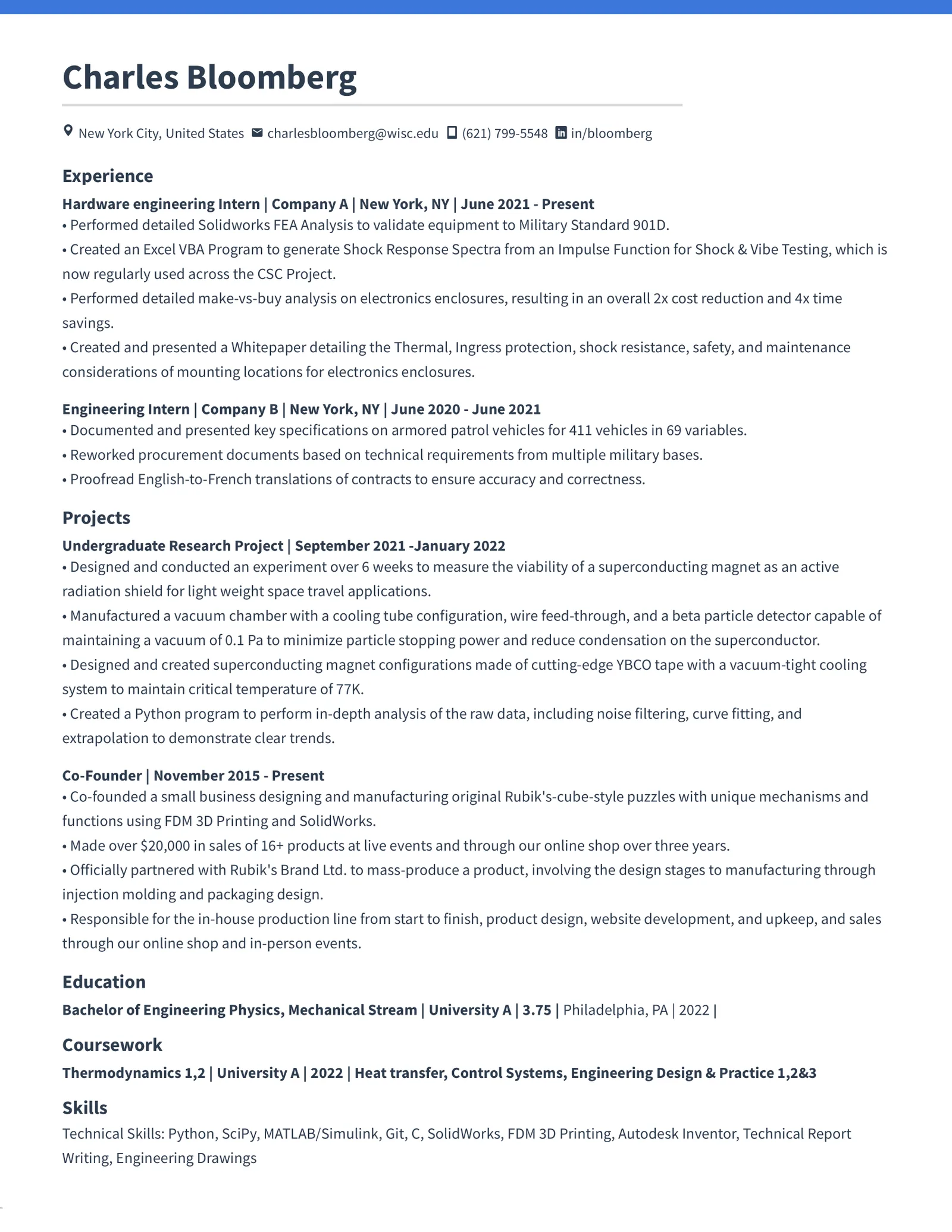
How to Write a Hardware Engineering Intern Resume That Gets Interviews
Landing a hardware engineering internship at companies like Apple, NVIDIA, Intel, or a fast-growing startup means competing against hundreds of other engineering students — many with similar GPAs and coursework. Your hardware engineering intern resume is the single document that decides whether a recruiter spends 30 seconds or 30 minutes on your application. Done right, it communicates that you can contribute from day one: you understand circuit fundamentals, you've touched real hardware, and you work well in cross-functional teams. Done poorly, it disappears into an ATS black hole before a human ever reads it.
This guide walks you through every section of a hardware engineering intern resume — from writing a sharp objective statement to quantifying lab projects, listing the right technical skills, and formatting for both ATS software and human reviewers. Whether you're searching for advice on a hardware engineering intern resume with no experience, trying to figure out which skills to highlight, or looking for worked examples to model yours after, you'll find concrete, actionable guidance here.
Make this resume your own with ResumeBuild.
PROFESSIONAL SUMMARY
Detail-oriented Electrical Engineering student with hands-on experience in PCB design, circuit analysis, and embedded systems development. Passionate about translating theoretical knowledge into functional hardware solutions across analog and digital domains.
PROFESSIONAL Experience
Hardware Engineering Intern | Company A
May 2024 — Present, Dallas, USA
- Designed and validated 4-layer PCB layouts using Altium Designer for a low-power embedded sensor module, reducing board footprint by 22% while maintaining full signal integrity across 12 high-speed differential pairs.
- Engineered bench-level hardware validation test plans covering 15+ functional blocks, executing oscilloscope and logic analyzer measurements to verify rise/fall times, clock jitter, and voltage rail stability within ±2% tolerance.
- Assisted senior engineers in schematic capture and BOM management for 3 prototype iterations of a mixed-signal power management IC evaluation board, accelerating design review cycles by approximately 30%.
- Implemented JTAG and SWD debugging workflows on ARM Cortex-M4 microcontrollers to isolate firmware-hardware interface faults, resolving 8 critical signal timing discrepancies across 2 product development sprints.
- Collaborated with cross-functional teams across mechanical, firmware, and manufacturing to complete DFM reviews on 2 board revisions, identifying 11 component placement conflicts before tape-out submission.
Electrical Engineering Intern | Company B
June 2023 — August 2023, San Diego, USA
- Developed automated Python test scripts interfacing with bench instruments via VISA/SCPI protocols to execute 200+ parametric measurements on RF front-end modules, cutting manual test time by over 40%.
- Researched and characterized impedance matching network performance across a 600 MHz–6 GHz frequency range using a Keysight VNA, producing S-parameter data sets that informed 3 antenna design revisions.
- Maintained detailed lab notebooks and hardware test reports documenting component-level failure analysis for 25 device samples, directly supporting root cause analysis and corrective action implementation.
- Optimized power consumption profiles for a Snapdragon-adjacent peripheral circuit by analyzing dynamic current draw under 6 distinct load conditions, contributing to a 15% reduction in average idle-state power.
Undergraduate Research Assistant – Embedded Systems Lab | Company C
January 2023 — May 2023, Austin, USA
- Built and characterized a custom 16-channel data acquisition system using STM32 microcontrollers and SPI/I2C peripheral sensors, achieving 12-bit ADC resolution at a 10 kHz sampling rate across all channels.
- Produced hardware documentation including block diagrams, pin mapping tables, and timing diagrams for 3 prototype revisions, enabling seamless knowledge transfer to 4 subsequent lab members.
- Tracked component procurement and inventory across 40+ unique part numbers using an internal ERP system, maintaining 98% BOM accuracy throughout a 5-month research project lifecycle.
Electronics Repair Technician (Part-Time) | Company D
August 2022 — December 2022, Austin, USA
- Diagnosed and repaired analog and digital circuit faults across 60+ consumer electronics units per month using multimeters, oscilloscopes, and thermal imaging cameras to isolate component-level failures.
- Replaced surface-mount components including 0402 passives and QFN ICs using hot-air rework stations and soldering irons, maintaining a rework success rate exceeding 92% across all serviced boards.
- Formulated a standardized fault-triage checklist adopted shop-wide, reducing average diagnostic turnaround time from 45 minutes to under 20 minutes per device across a team of 3 technicians.
Education
Bachelor of Science in Electrical Engineering | The University of Texas at Austin
May 2025
Expert-Level Skills
Altium Designer, KiCad, LTspice, MATLAB, Simulink, Python (VISA/SCPI automation), C/C++ (embedded), STM32, ARM Cortex-M, JTAG/SWD debugging, Oscilloscope & Logic Analyzer operation, Keysight VNA, PCB layout & schematic capture, Signal Integrity analysis, Power Electronics, Mixed-Signal Design, BOM Management, DFM Review, SPI/I2C/UART protocols, Soldering & SMD Rework, FPGA (Verilog basics), Attention to Detail, Cross-functional Collaboration, Technical Documentation
A strong entry-level hardware engineering intern resume leading with a targeted objective, relevant coursework, and hands-on project experience.
Understanding the Hardware Engineering Intern Job Market
Hardware engineering internships sit at the intersection of electrical engineering, computer engineering, and systems design. Roles typically fall into a few clusters: PCB/circuit design, FPGA and digital logic, signal integrity and power integrity, test and validation, and embedded systems. Knowing which cluster a specific posting targets lets you tailor your resume precisely rather than sending a generic document.
Demand is strong. The U.S. Bureau of Labor Statistics projects steady growth in electrical and electronics engineering roles, and the explosion of AI accelerator chips, EV power electronics, and IoT devices has created a surge in internship postings at both large semiconductor firms and venture-backed startups. Recruiters on forums like r/ECE and r/cscareerquestions (popular sources for hardware engineering intern resume Reddit discussions) consistently note that candidates who show real hardware experience — even from a university lab or personal project — stand out dramatically over those who list only coursework.
Typical internship duration is 10–16 weeks, and conversion rates to full-time offers at top firms run 50–70% for strong performers. That means your resume isn't just getting you a summer job — it's potentially the first step toward a full-time hardware engineering career.
How to Format a Hardware Engineering Intern Resume
Format is not decoration — it is communication strategy. A poorly formatted resume signals disorganization, which is a red flag for an engineering role that demands precision.
One Page, No Exceptions for Interns
As an intern or recent graduate, you should fit everything on a single page. Recruiters at large companies like Qualcomm or Texas Instruments screen hundreds of applications; a two-page resume from a student reads as poor judgment about what matters. Use 0.5–0.75 inch margins and a 10–11pt font (Calibri, Garamond, or Arial work well) to maximize space without sacrificing readability.
Reverse-Chronological Order
List your most recent experience first within each section. For most hardware engineering students, that means your most recent internship or co-op at the top of the experience section, followed by older roles, then significant academic projects. If you have no internship experience yet, lead with projects and coursework — covered in detail below.
ATS-Friendly Structure
Most large employers use Applicant Tracking Systems (ATS) like Workday, Greenhouse, or Taleo to parse resumes before a human reviews them. To pass ATS screening for a hardware engineering intern role:
- Use a clean single-column or simple two-column layout — avoid tables, text boxes, and graphics.
- Save your file as a .docx or PDF (check the job posting; some ATS systems struggle with PDFs).
- Mirror exact keywords from the job description: if the posting says "Cadence Allegro," don't write "PCB layout tool" — write "Cadence Allegro."
- Spell out acronyms at least once: "Field-Programmable Gate Array (FPGA)" before using "FPGA" alone.
- Use standard section headers: "Education," "Experience," "Skills," "Projects" — not creative alternatives like "My Journey" or "What I've Built."
Visual Hierarchy
Bold your job titles and company names. Use consistent date formatting (e.g., May 2024 – Aug 2024) aligned to the right margin. Keep bullet points to 1–2 lines each. White space is your friend — a dense wall of text is harder to scan than well-spaced bullets.
What Sections to Include on a Hardware Engineering Intern Resume
The optimal section order for a hardware engineering intern resume is: Contact Information → Objective/Summary → Education → Technical Skills → Experience → Projects → Certifications/Awards (optional). Here's why this order works: recruiters want to know your degree program and graduation date early (to confirm eligibility), then your skills (to confirm technical fit), then your experience and projects (to confirm depth).
Contact Information
Include your full name (large, bold), professional email ([email protected], not "xXhardwareking99@"), phone number, LinkedIn URL, and optionally a GitHub or personal portfolio link if it contains hardware projects (KiCad files, FPGA code, oscilloscope screenshots). Location is optional — city and state suffice; a full street address is outdated.
Objective Statement vs. Summary
For a hardware engineering intern resume objective, keep it to 2–3 sentences that answer: who you are, what you bring, and what you want. Avoid generic openers like "Seeking a challenging position." Instead, be specific:
"Electrical engineering junior at Georgia Tech with hands-on experience in PCB design using KiCad and signal integrity analysis. Seeking a summer 2025 hardware engineering internship at a semiconductor company where I can apply my FPGA prototyping and mixed-signal circuit skills to real product development."
This objective names your school, your tools, your target role type, and the value you bring — all in two sentences. That's what a strong hardware engineering intern resume objective looks like.
Education
For current students and recent graduates, Education often belongs above Experience. Include:
- Degree and major (e.g., B.S. Electrical Engineering)
- University name and expected graduation date
- GPA — include if 3.0 or above; omit if below. For competitive roles at top firms, 3.3+ is the informal threshold.
- Relevant coursework — list 4–6 courses directly applicable to the role: Digital Logic Design, Analog Circuit Design, Embedded Systems, Signal Processing, Power Electronics, VLSI Design.
- Honors/Awards — Dean's List, scholarships, IEEE membership, relevant competitions (e.g., IEEE Hardware Hackathon finalist).
Technical Skills
This is one of the most important sections on a hardware engineering intern resume skills list. Organize by category for easy scanning:
- Hardware Design Tools: KiCad, Altium Designer, Cadence Allegro, Eagle PCB, LTspice, Multisim, PSPICE
- HDL & FPGA: VHDL, Verilog, SystemVerilog, Xilinx Vivado, Intel Quartus, ModelSim
- Programming: Python (for test automation, data analysis), MATLAB, C/C++ (for embedded firmware), LabVIEW
- Test & Measurement Equipment: Oscilloscopes (Tektronix, Keysight), logic analyzers, spectrum analyzers, multimeters, function generators, network analyzers (VNA)
- Protocols & Interfaces: I2C, SPI, UART, USB, PCIe, Ethernet, CAN bus, JTAG
- Simulation & Analysis: ANSYS HFSS (signal integrity), Cadence Virtuoso (analog IC), MATLAB/Simulink
- Fabrication: Soldering (through-hole and SMD), PCB assembly, 3D printing for enclosures
Only list tools you can actually discuss in an interview. Listing "Cadence Virtuoso" and then drawing a blank when asked about it will end your chances immediately.
Make this resume your own with ResumeBuild.
PROFESSIONAL SUMMARY
Detail-oriented Electrical Engineering student with hands-on experience in PCB design, circuit analysis, and embedded systems development. Passionate about hardware design and eager to contribute technical skills in a fast-paced engineering environment.
PROFESSIONAL Experience
Hardware Engineering Intern | Company A
May 2024 — Present, Dallas, USA
- Assisted in the design and validation of analog and mixed-signal PCB layouts using Altium Designer, reducing design iteration cycles by 20% through early-stage DRC compliance checks across 3 active product lines.
- Engineered bench-level hardware test procedures for 15+ prototype boards using oscilloscopes, multimeters, and logic analyzers, identifying and documenting 12 critical signal integrity issues prior to mass production.
- Collaborated with senior hardware engineers on schematic capture and component selection for a low-power microcontroller-based embedded system, evaluating over 40 candidate components against BOM cost and thermal constraints.
- Optimized power delivery network simulations in LTspice, modeling 6 different DC-DC converter topologies and reducing simulated voltage ripple by 18% on a 3.3V rail design.
- Produced detailed technical documentation including test reports, component datasheets summaries, and hardware revision logs for 3 concurrent engineering projects, ensuring traceability across all design stages.
Undergraduate Research Assistant – Hardware Systems Lab | Company B
August 2023 — April 2024, Hillsboro, USA
- Designed and assembled a 4-layer PCB prototype for an FPGA-based data acquisition system using KiCad, achieving a 95% first-pass assembly success rate across 8 fabricated boards.
- Implemented UART and SPI communication protocols on STM32 microcontrollers using C firmware, enabling reliable 1 Mbps data transfer between 3 peripheral sensor modules and a central processing unit.
- Researched and benchmarked 10+ ARM Cortex-M series microcontrollers for embedded system suitability, producing a 12-page comparative analysis report used to finalize component selection for a departmental research grant.
- Maintained laboratory inventory of 200+ electronic components and calibrated 5 pieces of test equipment including function generators and spectrum analyzers on a bi-weekly schedule.
Electronics Lab Assistant | Company C
January 2023 — July 2023, Austin, USA
- Built and tested 30+ through-hole and SMD soldered assemblies for client prototype orders, maintaining a defect rate below 2% across all completed units using IPC-A-610 quality standards.
- Tracked and logged component inventory across 5 product lines using Excel-based BOM management sheets, reducing part shortage incidents by 35% over a 6-month period.
- Assisted in root-cause failure analysis on 8 returned PCB assemblies, utilizing thermal imaging and continuity testing to identify solder joint failures and incorrect component placements.
Technical Volunteer – Robotics Club Hardware Team | Company D
September 2022 — December 2022, Austin, USA
- Developed wiring harnesses and motor driver circuit assemblies for 2 competition-grade autonomous robots, reducing overall assembly time by 25% through standardized cable routing procedures.
- Directed hardware debugging sessions for a team of 6 members, resolving 10+ PWM signal timing conflicts between servo controllers and an Arduino Mega microcontroller during a 3-month build cycle.
- Completed integration testing of sensor arrays including ultrasonic, IR, and encoder modules across 4 robot configurations, validating signal accuracy within ±2% tolerance thresholds.
Education
Bachelor of Science in Electrical Engineering | University of Texas at Austin
May 2025
Expert-Level Skills
PCB Design (Altium Designer, KiCad), Schematic Capture, LTspice Simulation, Embedded Systems (STM32, Arduino), FPGA Prototyping, UART/SPI/I2C Protocols, C/C++ Firmware Development, Signal Integrity Analysis, Oscilloscope & Logic Analyzer Operation, BOM Management, IPC-A-610 Standards, DC-DC Converter Design, Power Delivery Networks, Soldering (SMD & Through-Hole), MATLAB, Attention to Detail, Cross-functional Collaboration, Technical Documentation
A hardware engineering intern resume with no prior work experience, compensating with strong project descriptions, relevant coursework, and a targeted skills section.
How to Write the Experience Section for a Hardware Engineering Internship Resume
The experience section is where most candidates either win or lose the recruiter's attention. The goal is to show what you did, how you did it, and what the result was — not just a list of responsibilities.
The CAR Formula for Bullet Points
Use Challenge → Action → Result for every bullet. Start with a strong action verb, include the specific tool or method, and end with a measurable outcome where possible.
Weak: "Helped with PCB design for a power supply board."
Strong: "Designed a 4-layer 12V/5A buck converter PCB in Altium Designer, reducing power supply ripple by 23% compared to the previous single-layer prototype."
The strong version tells the recruiter your tool (Altium), your scope (4-layer, 12V/5A), and your impact (23% ripple reduction). That's the level of specificity that earns callbacks.
How to Quantify Hardware Engineering Achievements
Hardware lends itself naturally to quantification — lean into it:
- Performance improvements: "Reduced clock-to-output propagation delay by 15 ns by optimizing FPGA routing constraints in Xilinx Vivado."
- Cost savings: "Identified a BOM substitution that reduced per-unit component cost by $4.20 without impacting signal integrity."
- Test coverage: "Wrote Python scripts to automate bench testing of 200+ units, cutting manual test time from 4 hours to 45 minutes per batch."
- Design scale: "Laid out a 6-layer, 300-component PCB for a Bluetooth Low Energy sensor node, achieving FCC Part 15 compliance on first submission."
- Reliability: "Debugged intermittent I2C communication failures affecting 12% of production units; root-caused to a missing pull-up resistor and resolved with a one-line schematic change."
Writing Experience When You Have No Internship History
A common concern on threads about hardware engineering intern resume with no experience is: "What do I put if I've never had a hardware job?" The answer is: your projects ARE your experience. Treat significant academic or personal hardware projects exactly like work experience entries — give them a title, a "company" (e.g., "Georgia Tech ECE Senior Design" or "Personal Project"), dates, and 3–4 CAR-format bullets. A well-described senior design project or a self-built FPGA retro gaming console demonstrates more real hardware competence than a vague internship description.
Make this resume your own with ResumeBuild.
PROFESSIONAL SUMMARY
Detail-oriented Electrical Engineering student with hands-on experience in FPGA-based digital design, HDL development, and embedded hardware systems. Proven ability to contribute to full hardware design cycles from RTL development through simulation, synthesis, and validation in fast-paced engineering environments.
PROFESSIONAL Experience
Hardware Engineering Intern | Company A
May 2024 — Present, Dallas, USA
- Designed and implemented RTL logic blocks in VHDL targeting Xilinx Artix-7 FPGAs, reducing critical path delay by 18% through pipeline restructuring across 6 distinct functional modules.
- Developed and executed over 40 functional simulation testbenches using ModelSim, achieving 97% code coverage and identifying 12 timing violations prior to synthesis handoff.
- Collaborated with a 5-engineer verification team to integrate AXI4-Lite bus interfaces into a custom SoC peripheral design, ensuring compliance with ARM AMBA protocol specifications.
- Optimized LUT and flip-flop resource utilization on a Spartan-7 device by 22% through logic restructuring and constraint-driven synthesis using Vivado Design Suite.
- Produced comprehensive design documentation including block diagrams, timing diagrams, and register maps for 3 IP cores delivered to senior engineers for tape-out review.
Hardware Design Intern | Company B
June 2023 — August 2023, Santa Clara, USA
- Engineered a Verilog-based UART communication controller verified across 5 baud rate configurations from 9600 to 115200 bps, integrated into an Intel Cyclone V FPGA development platform.
- Assisted in schematic capture and PCB layout reviews using Altium Designer for 4-layer mixed-signal boards, flagging 7 design rule violations before fabrication submission.
- Implemented a finite state machine (FSM) for a custom SPI master controller in SystemVerilog, validated through co-simulation with a C-based software model over 10,000 transaction cycles.
- Researched and benchmarked 3 FPGA vendor toolchains — Vivado, Quartus Prime, and Libero SoC — producing a comparative analysis report distributed to a 12-member design team.
Undergraduate Research Assistant – Digital Systems Lab | Company C
September 2022 — May 2023, Raleigh, USA
- Built a real-time signal processing pipeline on a Basys 3 FPGA board using VHDL, implementing a 16-tap FIR filter operating at a 50 MHz clock domain with verified frequency response output.
- Maintained a Git-based version control repository for a team of 4 researchers, managing over 30 commits and enforcing HDL coding standards across all project branches.
- Tracked hardware bring-up and debug sessions using a Rigol DS1054Z oscilloscope and Saleae logic analyzer, resolving 9 signal integrity issues across 2 prototype board revisions.
Electronics Lab Technician (Part-Time) | Company D
January 2022 — August 2022, Durham, USA
- Assembled and tested 150+ through-hole and SMD prototype PCBs per month using IPC-A-610 soldering standards, maintaining a defect rate below 2% across all production batches.
- Processed incoming component inventory for over 200 unique part numbers using an ERP tracking system, ensuring BOM accuracy for 6 active hardware development projects.
- Provided technical support for bench-level debugging sessions using DMMs, function generators, and power supplies, contributing to a 30% reduction in prototype rework cycle time.
Education
Bachelor of Science in Electrical Engineering | North Carolina State University
May 2025
Expert-Level Skills
VHDL, Verilog, SystemVerilog, FPGA Design, RTL Development, Xilinx Vivado, Intel Quartus Prime, ModelSim, Simulation & Verification, Testbench Development, AXI4 / AXI-Lite Protocol, SPI, UART, I2C, Finite State Machines (FSM), Digital Logic Design, Altium Designer, PCB Schematic Review, Signal Integrity Analysis, Oscilloscope & Logic Analyzer Proficiency, Git Version Control, MATLAB, Python (for hardware scripting), IPC-A-610, Attention to Detail, Cross-functional Collaboration, Technical Documentation
A hardware design intern resume emphasizing FPGA development, Verilog, and digital logic coursework for candidates targeting semiconductor and digital hardware roles.
How to Write the Projects Section
Projects are the secret weapon of a strong entry level engineering resume in hardware. Include 2–4 projects that demonstrate breadth (analog + digital, or hardware + firmware) or depth in the specific area the target role requires. For each project, include:
- Project name and one-line description (e.g., "4-Channel Oscilloscope Add-On Board — KiCad, STM32, SPI")
- Your specific role if it was a team project
- Tools and components used
- Key technical achievement or outcome
- Link to GitHub or portfolio if the work is documented
Strong project topics for a hardware design resume include: custom PCB design with a microcontroller, FPGA-based signal processing, motor driver circuits, RF front-end design, battery management systems, and sensor interface boards. These map directly to real internship tasks at companies designing consumer electronics, automotive systems, or semiconductor test equipment.
Tailoring Your Resume to Specific Hardware Engineering Roles
A generic hardware engineering resume that lists every tool you've ever touched is less effective than a targeted one that mirrors the language of a specific job description. Here's how to tailor efficiently:
- Identify the top 5 keywords in the job description (e.g., "signal integrity," "Altium Designer," "DDR4," "power sequencing," "schematic capture") and ensure each appears naturally in your resume.
- Reorder your skills section so the most relevant skills appear first — ATS systems and human readers both weight early mentions more heavily.
- Adjust your objective statement to name the company and role type: "…seeking a hardware engineering internship at [Company] to contribute to [specific product area]."
- Promote the most relevant project to the top of your Projects section if it directly matches the role's focus area.
This tailoring takes 15–20 minutes per application and meaningfully increases your callback rate. Discussions on hardware engineering resume Reddit threads consistently show that tailored applications outperform spray-and-pray approaches by a wide margin.
Common Mistakes on Hardware Engineering Intern Resumes
Even strong candidates make these errors — avoid them:
- Listing tools without context: "Used Altium Designer" tells a recruiter nothing. "Designed a 4-layer PCB in Altium Designer for a 48V motor driver" tells them everything.
- Passive language: "Was responsible for testing" → "Designed and executed functional test plans for 50+ prototype boards."
- Omitting units and specs: Hardware is a quantitative field. Always include voltage levels, frequencies, component counts, layer counts, and other specs where relevant.
- Including irrelevant coursework: Listing "English Composition" or "Calculus I" wastes space. Only include courses that directly demonstrate hardware competence.
- Outdated or wrong file format: Always check whether the employer's ATS prefers PDF or DOCX. When in doubt, submit both if the portal allows it.
- No GitHub or portfolio link: Hardware projects with photos, schematics, and BOM files on GitHub or a personal site are enormously compelling to technical hiring managers.
- Typos and inconsistencies: An engineer who writes "Altium Desinger" on their resume raises doubts about their attention to detail on actual hardware. Proofread three times.
Make this resume your own with ResumeBuild.
PROFESSIONAL SUMMARY
Detail-oriented Hardware Engineering Intern with hands-on experience in PCB design, embedded systems, and circuit validation across fast-paced engineering environments. Proven ability to contribute to cross-functional teams on high-impact hardware development cycles, from schematic capture through prototype bring-up and verification testing.
PROFESSIONAL Experience
Hardware Engineering Intern | Company A
May 2024 — Present, Dallas, USA
- Designed and validated 4-layer PCBs using Altium Designer for a mixed-signal power management IC evaluation platform, reducing prototype iteration cycles by 30% through early DRC/ERC compliance checks.
- Engineered bench-level characterization test plans for 6 analog voltage regulator ICs, utilizing Keysight oscilloscopes, DMMs, and electronic loads to capture load transient and efficiency curves across 0–5A operating ranges.
- Collaborated with a 5-person hardware team to integrate JTAG and SWD debug interfaces into an ARM Cortex-M4 embedded development board, enabling real-time firmware flashing and register-level debugging via OpenOCD.
- Optimized signal integrity on high-speed differential pairs (USB 3.0, I2C, SPI) by applying controlled impedance routing and proper termination strategies, achieving less than 5% deviation from target 90-ohm differential impedance.
- Produced over 12 detailed test reports documenting component-level failure analysis, schematic review findings, and BOM cost reduction recommendations, directly supporting 2 tape-out decisions.
Hardware Engineering Intern | Company B
June 2023 — August 2023, San Diego, USA
- Assisted in the bring-up and functional verification of a 5G RF front-end module prototype, executing over 200 structured test cases using vector network analyzers (VNA) and spectrum analyzers to validate S-parameter performance from 600 MHz to 6 GHz.
- Developed Python-based automated test scripts interfacing with GPIB/VISA instrument drivers to reduce manual bench measurement time by 40% across 3 concurrent hardware validation projects.
- Maintained and updated schematic capture libraries in Cadence OrCAD for 35+ passive and active components, ensuring footprint accuracy and datasheet compliance ahead of a major PCB respin.
- Researched and benchmarked 8 competing RF switch ICs for insertion loss, isolation, and power handling, delivering a comparative analysis that informed final component selection for a next-generation modem reference design.
Electrical Engineering Intern | Company C
January 2023 — May 2023, Raleigh, USA
- Built and debugged prototype motor driver circuits using discrete MOSFETs and gate driver ICs, resolving 3 critical shoot-through failure modes identified during thermal stress testing at 85°C ambient conditions.
- Implemented I2C and UART communication protocols between a STM32 microcontroller and peripheral sensor modules, achieving stable 400 kHz fast-mode I2C data throughput across a 12-inch PCB trace run.
- Tracked component procurement and lead times for a 200-line BOM using Octopart and DigiKey, flagging 14 end-of-life parts and sourcing qualified alternates to maintain project schedule integrity.
Electronics Lab Assistant | Company D
August 2022 — December 2022, Columbus, USA
- Processed and assembled 50+ through-hole and SMD prototype boards per week using soldering irons, hot air rework stations, and stereo microscopes, maintaining a first-pass assembly yield of over 92%.
- Directed incoming inspection procedures for passive components (resistors, capacitors, inductors) using LCR meters, verifying tolerance compliance across batches of 500+ units per lot.
- Provided technical documentation support by drafting 8 assembly work instructions and test procedure SOPs, reducing new technician onboarding time by approximately 25%.
Education
Bachelor of Science in Electrical Engineering | Georgia Institute of Technology
May 2025
Expert-Level Skills
PCB Design (Altium Designer, Cadence OrCAD), Schematic Capture, Signal Integrity Analysis, Embedded Systems (ARM Cortex-M, STM32), JTAG/SWD Debugging, Mixed-Signal Circuit Design, Power Electronics, RF & Analog Circuit Validation, SPICE Simulation (LTspice), Python (GPIB/VISA Automation), I2C, SPI, UART, USB 3.0, VNA & Spectrum Analyzer Operation, Oscilloscope & DMM Proficiency, BOM Management, DFM/DFT Principles, Failure Mode Analysis, Attention to Detail, Cross-Functional Collaboration, Technical Documentation
A resume for a returning hardware engineering intern or co-op student with multiple semesters of experience, showing progression and increasing technical responsibility.
Certifications, Awards, and Extracurriculars Worth Including
Relevant additions that strengthen a hardware engineering intern resume include:
- IEEE Student Membership — signals professional engagement
- Relevant online certifications: Coursera/edX courses in FPGA design, PCB design (e.g., Altium's official training), or embedded systems from ARM Education
- Competition results: IEEE Hardware Hackathon, HKN (Eta Kappa Nu) honor society, robotics competitions (FIRST, VEX), or formula SAE electrical team
- Open-source contributions: If you've contributed to KiCad libraries, open-source FPGA projects, or hardware design repositories, list them
- Research assistant roles: University lab work — even unpaid — counts as real experience if you worked with hardware
Frequently Asked Questions
What skills should I list on a hardware engineering intern resume?
Focus on the tools and competencies directly relevant to the role you're targeting. Core hardware engineering intern resume skills include PCB design tools (Altium Designer, KiCad, Cadence Allegro), HDL languages (Verilog, VHDL, SystemVerilog), simulation tools (LTspice, PSPICE, MATLAB), test equipment (oscilloscopes, logic analyzers, multimeters), communication protocols (I2C, SPI, UART, PCIe), and programming languages used in hardware contexts (Python for test automation, C/C++ for embedded firmware). Always prioritize skills that appear in the specific job description over a comprehensive but unfocused list.
How do I write a hardware engineering intern resume with no experience?
Treat your academic projects as professional experience. Create detailed project entries with the same structure as work experience: project name, tools used, your specific contributions, and measurable outcomes. A well-documented senior design project, an FPGA lab assignment you went beyond the requirements on, or a self-built PCB project demonstrates real hardware competence. Also emphasize relevant coursework, lab skills (soldering, oscilloscope use, PCB assembly), and any research assistant work. A strong objective statement that clearly communicates your technical foundation and enthusiasm can compensate significantly for a thin work history.
Should I include a GPA on my hardware engineering intern resume?
Yes, if your GPA is 3.0 or above — include it. Many large semiconductor and hardware companies (Intel, Qualcomm, Texas Instruments) use GPA as an initial screening filter, and omitting it when it's strong looks like you're hiding something. If your overall GPA is below 3.0 but your major GPA (GPA in engineering courses only) is above 3.0, list your major GPA and label it clearly. If both are below 3.0, omit GPA and compensate with strong project descriptions and relevant skills.
How long should a hardware engineering intern resume be?
One page, always, for intern and entry-level candidates. Hiring managers at companies like Apple Hardware or NVIDIA routinely receive 500+ applications for a single internship role. A two-page resume from a student signals poor prioritization. Use tight formatting, concise bullet points, and ruthless editing to fit everything meaningful onto one page. The only exception is if you have multiple co-op rotations or significant research publications — in which case a carefully curated two-page resume may be appropriate, but one page is still preferred.
What's the best format for a hardware engineering intern resume to pass ATS?
Use a clean, single-column layout with standard section headers. Save as PDF or DOCX depending on what the job posting specifies. Mirror exact keywords from the job description — if the posting says "Cadence Allegro," use that exact phrase. Spell out acronyms on first use (e.g., "Field-Programmable Gate Array (FPGA)"). Avoid tables, text boxes, headers/footers with important information, and graphics — ATS parsers frequently misread these elements and may drop critical information from your profile.
How do I write a hardware engineering intern resume objective that stands out?
A strong hardware engineering intern resume objective is specific, not generic. Include your degree program and school, the specific technical skills you bring, and the type of role or company you're targeting. For example: "Computer engineering sophomore at UT Austin with experience in Verilog-based FPGA design and hands-on PCB prototyping using KiCad. Seeking a summer 2025 hardware engineering internship in the semiconductor or consumer electronics industry to apply digital logic design and embedded systems skills to real product challenges." This is far more compelling than "Seeking a challenging internship to grow my skills" — which tells the recruiter nothing useful.
Should I include personal hardware projects on my resume?
Absolutely — personal hardware projects are one of the strongest differentiators on a hardware engineering intern resume, especially for candidates with limited work history. A self-designed PCB, a custom FPGA implementation, a home-built oscilloscope, or a battery management system you built for a personal EV conversion project all demonstrate initiative, real hands-on skill, and genuine passion for hardware. Document these projects thoroughly: list the tools used, the technical challenges you solved, and any measurable outcomes. Linking to a GitHub repository with schematics, BOM files, and photos makes the project even more credible to a technical hiring manager.