Lawyer Resume
Explore Lawyer Resume with ResumeBuild. Use this resume example as a reference for your own experience, skills, and qualifications.





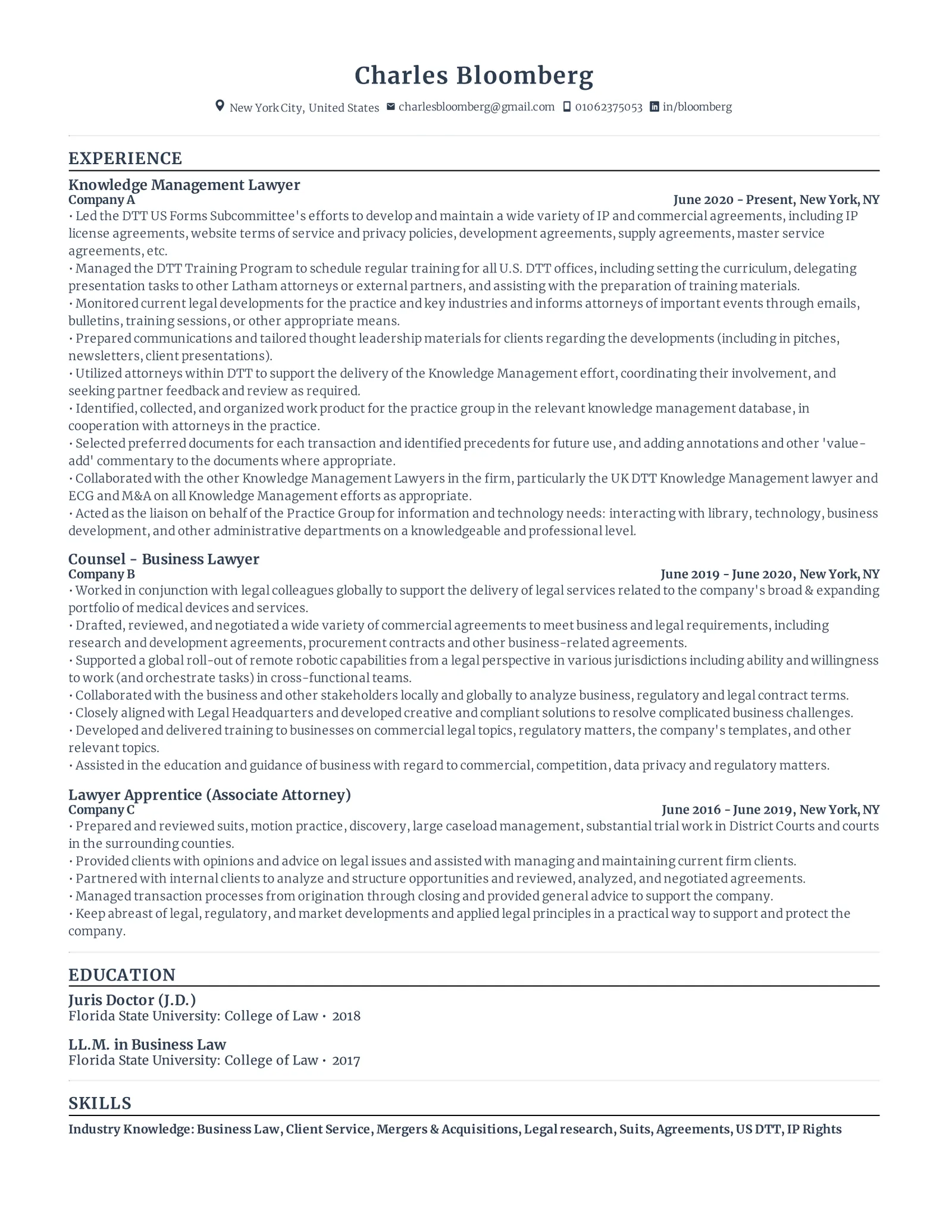
A good lawyer resume is a one-page, single-column document in a standard 11- or 12-point font. It puts your bar admissions, your J.D. and its honors, and specific legal work near the top: the matters you handled, your role, and their size or outcome. Senior attorneys with long matter lists can use two pages.
Below are two complete samples, one for a junior corporate associate and one for an experienced litigation attorney. After them, each section is explained in the order it appears. All people, firms, judges and matters in the examples are fictional.
Two attorney resume examples
Junior associate resume example
Start from this layout if you are in law school or have less than about five years of practice. Education comes before experience because your school, grades and journal work are still the strongest credentials you have.
Build your own version with ResumeBuild.
Bar Admission
New York (2025)
Education
Boston University School of Law, Boston, MA
J.D., magna cum laude, May 2024
- GPA: 3.68 (top 15%)
- Boston University Law Review, Articles Editor
- Transactional law competition team, regional semifinalist
- Select coursework: Mergers and Acquisitions; Securities Regulation; Corporate Finance
University of Wisconsin–Madison, Madison, WI
B.A. in Economics, May 2021
Experience
Hollis Grant LLP, New York, NY
Corporate Associate, September 2024 – Present
- Run due diligence workstreams on 6 private equity acquisitions with purchase prices from $40 million to $310 million; summarize findings in issues memos for the deal partner
- Draft disclosure schedules, ancillary agreements and officer certificates for signed transactions, and turn comments from opposing counsel within agreed deadlines
- Manage closing checklists and signature packets for 3 sign-and-close deals, coordinating with lenders' counsel and local counsel in 4 states
- Prepare Form D filings and state securities notices for 9 venture financings for emerging-company clients
- Billed 2,050 hours in 2025, including 120 pro bono hours drafting bylaws and grant agreements for two community nonprofits
Summer Associate, May – August 2023
- Researched Delaware case law on earnout disputes and wrote a 15-page memo for a client negotiation
- Prepared a first markup of a stock purchase agreement under a senior associate's review
Massachusetts Superior Court, Business Litigation Session, Boston, MA
Judicial Intern to the Hon. Ellen M. Carver, Summer 2022
- Researched and wrote bench memoranda on motions to dismiss and preliminary injunctions in commercial cases
- Observed hearings and summarized the parties' arguments for the judge's chambers
Skills
- Transactional: due diligence, disclosure schedules, ancillary documents, closing management, Form D filings
- Research and technology: Westlaw, LexisNexis, iManage, virtual data rooms
- Languages: Tamil (fluent, spoken); Spanish (professional reading)
The billable hours line sits inside the current job instead of a separate section. Include a line like it only if your hours met your firm's target.
The summer associate role is listed under the same firm, so the reader can see that the full-time offer followed it. The judicial internship stays while Priya is two years out of law school because it shows legal writing. By her fifth year it can shrink to one line or come off.
If you are still in law school, keep the same order. Give your expected J.D. date, put summer jobs, clinics, externships and research assistant work under Experience, and replace the admission line with the exam you plan to take, such as "New York Bar Exam: scheduled July 2027."
Experienced litigation attorney resume example
Use this layout for a lateral move or a senior role. Experience comes first, a short summary opens the page, and a representative matters section shows the cases that define your practice.
Build your own version with ResumeBuild.
Summary
Commercial litigator with 13 years of experience, including a federal clerkship in the Northern District of Illinois. First-chaired 2 bench trials and argued 18 dispositive motions in state and federal court. Lead a docket of business disputes with claimed damages from $5 million to $200 million for manufacturers, distributors and logistics companies.
Bar and Court Admissions
Illinois (2013) • U.S. District Court, N.D. Illinois (2014) • U.S. Court of Appeals, Seventh Circuit (2016)
Experience
Harlow & Pierce LLP, Chicago, IL
Counsel, Commercial Litigation, March 2021 – Present
- Lead strategy on 15 to 20 active commercial disputes at a time, with claimed damages from $5 million to $200 million
- First-chaired 2 bench trials in the Circuit Court of Cook County (breach of contract and trade secrets); obtained judgment for the client in both
- Argued 18 dispositive motions in federal and state court; obtained full or partial dismissal or summary judgment in 13
- Supervise teams of up to 6 associates and 10 contract reviewers on productions of more than 1 million documents in Relativity
Brennan Walsh LLP, Chicago, IL
Associate, Litigation, September 2014 – February 2021
- Second-chaired a 9-day federal jury trial in a supply contract dispute; cross-examined 5 witnesses; the jury returned a defense verdict
- Took or defended more than 40 depositions, including expert depositions on damages and engineering issues
- Drafted the summary judgment brief that disposed of a $60 million breach of warranty claim before trial
- Represented pro bono clients in two prisoner civil rights cases; negotiated settlements in both
U.S. District Court for the Northern District of Illinois, Chicago, IL
Law Clerk to the Hon. Ruth A. Delgado, August 2013 – August 2014
- Drafted bench memoranda and draft opinions on motions to dismiss, summary judgment and class certification
- Prepared the judge for oral arguments, status hearings and two civil jury trials
Representative Matters
- Defended a national logistics company in an $85 million breach of contract action; obtained dismissal of the fraud counts and settled the remaining claims before trial
- Represented a medical device distributor in a trade secrets action against a former executive; obtained a preliminary injunction and a judgment after a 4-day bench trial
- Represented a food producer in a commercial arbitration over a supply agreement; obtained a $12 million award
Education
University of Michigan Law School, Ann Arbor, MI
J.D., cum laude, May 2013
- Michigan Law Review, Notes Editor
University of Illinois Urbana-Champaign, Urbana, IL
B.A. in History, May 2010
Skills
- Litigation: motion practice, depositions, bench and jury trials, arbitration, eDiscovery strategy
- Research and technology: Westlaw, LexisNexis, Relativity
With a representative matters section, this sample runs onto a second page, which is acceptable at 13 years of practice. The GPA is gone because the trial and motion record carries more weight than law school grades. The law review line stays because journal membership remains a recognized credential.
Length, font and section order
Legal recruiters often skim a resume quickly before deciding whether to read it closely. A conservative, single-column layout lets them find your admissions, school and most recent role at a glance.
One page or two pages for attorneys
Keep it to one page if you are a law student or have practiced for less than about 10 years. Two pages are acceptable for senior associates, counsel, partners and general counsel candidates whose matter lists would otherwise be cut.
Before you add a second page, cut anything that is not recent or relevant to the job you want. A page and a quarter looks like a formatting mistake. Keep every remaining line strictly accurate, because an interviewer can ask about any of it.
Font, margins and layout
- Use Times New Roman, Garamond, Calibri or Arial at 11 or 12 point.
- Keep margins at 0.5 inches or wider on all sides.
- Use bold, italics and underlining the same way in every section.
- Put the firm, title and dates on the left so the reader moves down the page instead of jumping to dates on the far right.
- Leave space between jobs and sections, and keep the layout to one column. Text boxes, tables and graphics can make the order harder to follow, and some application software may not read them reliably.
- Save and send a PDF unless the employer asks for a Word file.
Section order by experience level
For law students and attorneys with less than about five years of practice:
- Name and contact information
- Bar admission
- Education
- Experience
- Skills, languages and publications
For attorneys with five or more years of practice:
- Name and contact information
- Summary
- Bar and court admissions
- Experience, including any clerkship
- Representative matters (optional)
- Education
- Skills, languages and publications
Contact information and bar admissions
Your heading needs your name, city and state, phone number, a professional email address and, if you keep it current, your LinkedIn URL. A full mailing address is optional. Add one when you want to show ties to the city where you are applying.
List bar admissions in their own section near the top of the page. Hiring attorneys often look for licensure early, and an admission buried below the skills section can be missed. Write each jurisdiction with its year, then add federal court admissions on the same line:
New York (2018) • New Jersey (2018) • U.S. District Court, S.D.N.Y. (2019) • U.S. Court of Appeals, Second Circuit (2020)
If you have taken the exam but have no results yet, state the jurisdiction and the date. "Bar admission pending" on its own does not tell a firm when you can practice.
New York Bar Exam: taken July 2026, results pending
If you are admitted in a state but on inactive status, say so. Accuracy about licensure matters more here than anywhere else on the page.
Professional summary
A summary is two to four sentences at the top of an experienced attorney's page. Law students and first- or second-year associates can usually skip it, because your education and first job already say what a summary would.
Once you have a practice to describe, the summary should name your practice area, years in practice, the kind of clients or matters you handle, and one or two facts that show scale. A line such as "Dedicated attorney with excellent research and writing skills seeking a challenging position" could open anyone's application, so it tells the reader nothing about yours. Leave out adjectives like "dedicated" and "detail-oriented" unless a fact backs them up.
Corporate associate moving in-house
Corporate associate with 5 years at a New York firm advising venture-backed technology companies on financings, acquisitions and commercial contracts. Negotiated SaaS, licensing and vendor agreements for more than 20 portfolio companies and ran diligence on acquisitions of up to $250 million. Works directly with founders, finance teams and sales leaders to close contracts on the business's timeline.
This version translates firm work into what a legal department buys: contract volume, range of agreements and direct work with business teams.
Senior employment litigator
Employment litigation partner with 15 years defending employers in California state and federal courts and in arbitration. Defended more than 60 wage-and-hour, discrimination and retaliation matters, including 8 putative class actions. Counsel HR leaders at retail and healthcare clients on policies, investigations and terminations to reduce the risk of litigation.
The case count and class action number give scale without naming a single client. The final sentence covers the advisory work that a firm or company will also want from a senior hire.
Education, law review and honors
List degrees in reverse chronological order: J.D. first, then any undergraduate or graduate degrees. Give the school, city, degree, Latin honors and graduation month and year. If you are still in school, use your expected graduation date.
Put honors, journals and moot court under the school where you earned them, not in a separate section. A flagship law review membership can be listed as an honor because admission to it is competitive. Other journals belong under activities or in their own journal line.
| Item | Include it when | Leave it off when |
|---|---|---|
| Law school GPA | It is about 3.5 or higher and you are within about 10 years of graduation, or the employer asks for it | It is below that level, or you have 10 or more years of practice |
| Class rank | It is a clear strength, such as top 10% or top third | Your school does not rank, or the rank is middling |
| Latin honors | You earned them | Never; keep them at every career stage |
| Law review or journal | You were a member or editor | Never; keep the line even when you cut other activities |
| Moot court or mock trial | You are early in your career, especially if you won awards | You have real trial or argument experience to show instead |
| Clinics and externships | You are a student or junior lawyer; substantial clinics can go under Experience | You have several years of practice; reduce them to one line or remove them |
| Select coursework | You are a student or are changing practice areas | You have practice experience in the area |
| LSAT score or high school | Never | Always |
Work experience and representative matters
For each job, list the firm or organization, the city and state, your title and your dates. Then use bullets that start with an action verb and say what you did, in what kind of matter, at what scale and with what result. Replace "responsible for" and "assisted with" wherever they appear, and never use "I."
Before:
Responsible for handling discovery in commercial cases.
After:
Managed written discovery and document review in 8 commercial contract cases; negotiated ESI protocols with opposing counsel and drafted 3 granted motions to compel.
The second version gives the number of cases, the type of dispute, the tasks the associate personally handled and a result a judge confirmed.
How to describe confidential matters
Most legal work is confidential, so describe the matter without identifying the client unless the representation is already public and your firm allows you to name it. Check your firm's policy before you apply. These approaches show scale without disclosing anything:
- Describe the client by industry and size: "a regional hospital system" or "a publicly traded software company."
- Use ranges and totals: "acquisitions from $40 million to $310 million" or "9 financings in 2025."
- Report results over a period: "obtained full or partial dismissal in 13 of 18 dispositive motions."
- Give volume and role: "first-chaired 2 bench trials" or "supervised 6 associates on a 1-million-document production."
Do not invent figures to fill a bullet. If you have no reliable number, describe the task and the setting accurately.
When to add a representative matters section
A separate representative matters section works for senior associates, counsel and partners whose best work is a handful of significant cases or deals. Give three to six entries, each one sentence: the client by type, the matter, your side, and the outcome or deal value. Junior lawyers can usually fit the same information into their experience bullets.
Billable hours
List annual billable hours only when you are moving between law firms and your hours met or exceeded your firm's target. Put them as one bullet under the relevant job, and include pro bono hours if they are substantial. Leave hours off an in-house or government application, where the reader cares about what you produced rather than what you billed.
Action verbs for legal experience
- Advocacy: argued, tried, cross-examined, defended, deposed, moved, obtained
- Research and writing: researched, drafted, briefed, analyzed, authored, edited
- Transactions: negotiated, structured, closed, reviewed, prepared, filed
- Advice: advised, counseled, trained, investigated, assessed
- Leadership: supervised, managed, mentored, coordinated, directed
Clerkships and court experience
List a judicial clerkship under Experience, not under Education. Name the court, the city and state, your title with the judge's name, and your dates:
U.S. District Court for the Northern District of Illinois, Chicago, IL
Law Clerk to the Hon. [Judge's Name], August 2025 – August 2026
In the bullets, say what kinds of motions you worked on and what you wrote, such as bench memoranda, draft opinions or jury instructions, and whether you worked on trials. Do not describe the substance of a pending case. If you have accepted a clerkship that has not started, list it with future dates, for example "Incoming Law Clerk, 2027–2028."
Students should list judicial internships and externships the same way, with the court and the judge. For court experience in practice, count what you can verify: trials, evidentiary hearings, depositions and appellate arguments. State whether you first-chaired or second-chaired. Court admissions belong with your bar admissions, not in the experience bullets.
Experience bullet examples by practice area
Pick the group closest to the job you want and adapt the facts to your own work. Every number below is illustrative; replace it with your own figure or remove it.
Litigation
Motion practice at a firm
Drafted 25 motions to dismiss and for summary judgment in contract and business tort cases; 16 were granted in full or in part.
Use a granted-to-filed ratio when you wrote the briefs. A partner reading it will know what share of the outcome was yours.
Trial experience
Second-chaired a 6-day jury trial in a commercial lease dispute; prepared and examined 4 witnesses and drafted the jury instructions; jury found for the client.
Say "second-chaired" when that was your role. Listing the witnesses you examined shows what you did in the courtroom.
Appellate work
Wrote the principal brief and argued the appeal before the Illinois Appellate Court, First District, in a dispute over a non-compete clause; the court affirmed the judgment for the client.
Appellate work stands out at the associate level, so name the court and say whether you argued as well as wrote.
Corporate and transactional
M&A and private equity
Negotiated purchase agreements and disclosure schedules for 7 middle-market acquisitions with a combined value of $1.2 billion; led diligence teams of 3 to 5 associates.
A combined deal value protects individual client figures while still showing the size of your practice.
Commercial contracts and finance
Drafted and negotiated credit agreements, security documents and intercreditor agreements for borrowers on 11 financings from $25 million to $400 million.
Name the agreement types. Finance and real estate practices hire for familiarity with specific documents.
Employment and immigration
Employment defense
Defended employers against 30 EEOC and state agency charges of discrimination and retaliation over 3 years; resolved 24 at the agency stage before any lawsuit was filed.
For employer clients, a matter closed before suit is often the result that matters most, so count those separately from litigated wins.
Business immigration
Prepared and filed about 60 H-1B, L-1 and O-1 petitions a year for technology and research employers; drafted responses to Requests for Evidence and tracked status deadlines for 150 sponsored employees.
Name the visa categories, because immigration postings ask for them by name. Add an approval rate only if your firm tracks it and you can support the figure.
Clerkship and court roles
Judicial clerkship
Drafted more than 40 opinions and orders on summary judgment, Daubert and class certification motions; prepared the judge for 3 civil jury trials.
List motion types rather than case names. They show the areas of law you have worked in without discussing chambers work.
Law student judicial internship
Researched and wrote bench memoranda on jurisdiction, venue and preliminary injunction motions for a federal magistrate judge.
Students can rarely give outcomes, so the issues you researched and the type of document you wrote are the evidence.
In-house, government and public interest
In-house counsel
Reviewed and negotiated about 300 customer and vendor contracts a year for a 900-employee software company; built a fallback-clause playbook that let the sales team close standard deals without legal review.
In-house readers value volume and the business problem you solved more than hours or wins.
Public defender or government attorney
Represented clients in a caseload of 90 to 110 misdemeanor and felony matters at a time; tried 12 cases to verdict and handled bail hearings, suppression motions and plea negotiations.
Caseload and trial count are the scale measures for public-sector work, where dollar figures rarely apply.
Process improvement and confidential work
Firm or department improvement
Created a due diligence request list and review template adopted by the corporate group, cutting the time to a first diligence memo from about 3 weeks to 10 days.
Use this kind of bullet when your client work is too confidential to quantify. Changes you made to how the team works can still be described.
Skills and legal research tools
List practice skills and named tools in the skills section. Show interpersonal qualities in your bullets instead of the list: "negotiated 30 settlements" proves negotiation better than "strong negotiator."
Choose the entries below that fit your work, and use the practice-area keyword table further down to match terms to your field. The general guide to resume skills covers how to pick skills from a job posting.
Practice skills
Legal writing and brief drafting: list the documents you write, such as briefs, opinions, memoranda or client alerts, and add a publication if you have one.
Motion practice and oral argument: show the number of motions argued and the courts you appeared in.
Depositions and witness preparation: give the number taken or defended and note expert depositions separately.
Contract drafting and negotiation: list the purchase agreements, MSAs, licenses or leases you have drafted or negotiated.
Due diligence: give the transaction types and the size of the teams you ran or worked on.
Regulatory compliance and counseling: say which rules you advise on, for example HIPAA, the FCPA, securities rules or state privacy laws. "Compliance" alone tells the reader little.
Research and technology tools
Legal research (Westlaw, LexisNexis): name the platform. Postings often ask for one by name, and "legal research" alone does not say which one you know.
eDiscovery and document review (Relativity): say whether you reviewed, managed review teams or set search and coding protocols.
Document and matter management (iManage, NetDocuments): worth listing for in-house and smaller-firm roles where you may run your own files.
Foreign languages: give your level honestly and separate spoken from written ability if they differ, because you may be tested on it.
Client and team skills
Client counseling: show it through the clients you advised and the decisions you helped them make, such as HR leaders on terminations.
Negotiation and settlement: count the settlements or deals you negotiated and say which side you represented.
Docket and deadline management: state the number of active matters you carried at one time.
Supervising associates and staff: give the team size and what you supervised them on, such as document review or diligence.
Tailor your resume to the practice area and employer
Keep one complete master version, then adjust a copy for each application. If you have corporate, M&A and regulatory experience and the firm is a regulatory practice, lead with the regulatory work and shorten the rest.
- Mark the practice area terms, matter types, tools and admission requirements in the job posting.
- Compare them with your bullets. Where a term accurately describes your work, use the posting's wording, for example "commercial contracts" instead of "vendor paperwork." Recruiters, and some application software, may search for the posting's exact terms.
- Move the most relevant matters to the top of each job and cut bullets that do not support this application.
- Adjust your summary and skills so the target practice area appears first.
- Read the firm's practice pages and attorney bios to see how it describes its own work, and match that vocabulary where it is accurate.
The general guide to tailoring your resume to a job description covers keyword research for any posting. Explanations that do not fit on the page, such as a move between practice areas or a gap, belong in your cover letter. The cover letter outline guide covers how to structure it.
| Employer type | Put first | Evidence readers look for | Usual length |
|---|---|---|---|
| Large law firm | Law school, GPA or class rank, journal, clerkship | Deal or case size, client types, complexity, billable hours | 1 page until senior; 2 pages for senior associates and partners |
| Boutique firm | Depth in the firm's practice area | Trial, motion or deal counts, outcomes, how much you handled alone | 1 to 2 pages depending on experience |
| Government or public interest | Bar admission and public service commitment | Caseload, hearings and trials, pro bono, policy work | 1 to 2 pages; check the posting, since some government applications ask for more detail |
| In-house legal department | Business context and range of practice | Contract volume, turnaround, cost or risk results, work with business teams | 1 page; 2 pages for general counsel roles |
Common terms by practice area:
| Practice area | Terms to use when they describe your work |
|---|---|
| Litigation | motion practice, summary judgment, depositions, discovery, eDiscovery, trial, arbitration, Relativity |
| Corporate and M&A | due diligence, purchase agreements, disclosure schedules, financings, closings, securities filings |
| Employment | Title VII, ADA, FMLA, wage and hour, EEOC charges, arbitration agreements, investigations |
| Immigration | H-1B, L-1, O-1, PERM, Requests for Evidence, I-9 compliance, removal proceedings |
| Intellectual property | patent prosecution, USPTO, trademark clearance, licensing, infringement, PTAB proceedings |
| Real estate | purchase and sale agreements, leasing, title review, zoning, acquisition financing |
| In-house | commercial contracts, MSAs, NDAs, compliance programs, privacy, outside counsel management |
Format your resume for applicant tracking systems
Many firms and legal departments take applications through an online system that stores your resume and lets recruiters search it. A few formatting choices keep your content readable there and on screen:
- Use plain section headings such as Bar Admissions, Education, Experience and Skills, not creative labels.
- Keep contact details and admissions in the body of the page, not in a header, footer, text box or table.
- Write a term out once with its abbreviation, such as "electronically stored information (ESI)," so a search for either form is more likely to find it.
- Upload the file type the application asks for. If you send a PDF, export it from your word processor so the text can be selected, rather than scanning a printed copy.
- Draw keywords from the posting and the table above, and use each only where it is true of your work.
What not to include on a lawyer resume
- Burying or omitting bar admissions. Put them near the top with jurisdiction and year. For pending results, give the exam date.
- Opening with an objective statement. Remove it. Use a summary only once you have practice experience to summarize.
- Including personal details, salary or "References available on request." Leave out marital status, family details, salary history and the references line.
- Writing a generic summary. "Results-driven attorney with excellent communication skills" fits every applicant. Name your practice area, years, clients and scale.
- Listing duties instead of results. Start each bullet with a verb and add the matter type, your role and a number or outcome.
- Keeping law school clutter as a lateral. After several years of practice, fold old internships and clinics into one line under your J.D. or remove them.
- Writing like a brief. Footnotes and phrases like "including but not limited to" do not belong here. Use "including."
- Naming confidential clients or matters. Describe clients by industry and size unless the representation is public and your firm allows you to name it.
- Overstating your role. "Tried" is not "second-chaired," and "led" is not "assisted."
- Sending it with typos. In a job where precision is the work, a single error can hurt an application. Proofread from top to bottom, then from bottom to top. Check case names, court names, dates and admission years, then ask a colleague to read it.