Nurse Resume
Explore Nurse Resume with ResumeBuild. Use this resume example as a reference for your own experience, skills, and qualifications.





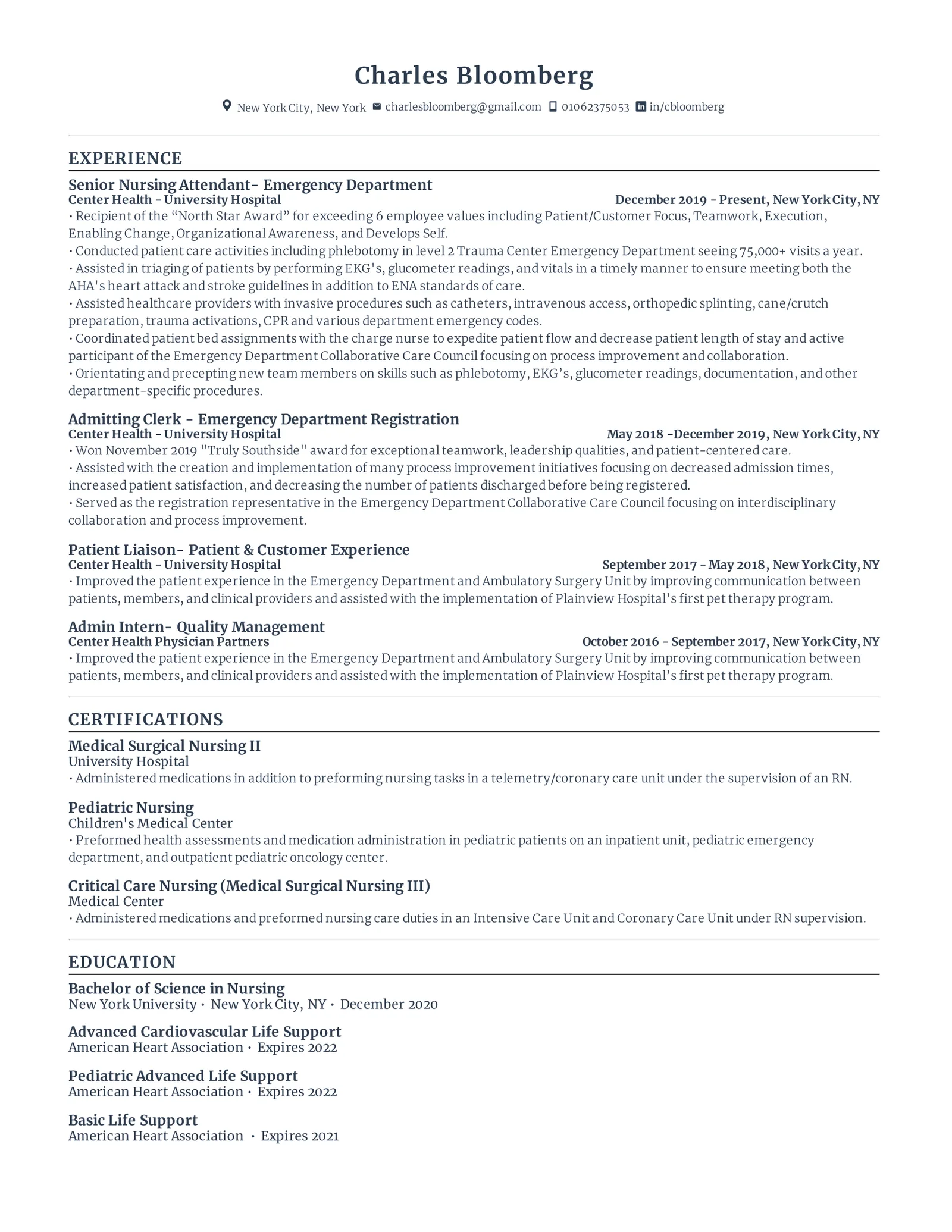
A strong nurse resume shows three things quickly: an active RN license, the certifications the unit requires, and clinical experience described by unit, patient load and results. Hiring managers and recruiters screen for those details first, so they belong near the top and in plain words an applicant tracking system can read.
Below are two complete registered nurse resume examples, one for a new graduate and one for an experienced ICU nurse, followed by how to write each section. The people, facilities and figures in every example on this page are fictional; replace them with your own verified details.
New-grad RN resume example
Start from this layout if you passed the NCLEX recently and your main experience is clinical rotations, a preceptorship, or a support role such as patient care technician. It fits on one page.
Create your own nurse resume.
Summary
Newly licensed registered nurse with a BSN and a 144-hour medical-surgical preceptorship. Managed a four-patient assignment under preceptor supervision, documenting assessments and medication administration in Epic. Seeking a new graduate residency on a medical-surgical or telemetry unit.
Licenses and Certifications
- Registered Nurse (RN), Texas, multistate license (Nurse Licensure Compact), active, issued July 2026
- Basic Life Support (BLS), American Heart Association, expires 06/2028
- Advanced Cardiovascular Life Support (ACLS), American Heart Association, expires 06/2028
Education
Bachelor of Science in Nursing (BSN), Alamo Ridge University School of Nursing, San Antonio, TX, May 2026 GPA 3.7, Dean's List four semesters
Clinical Experience
Medical-Surgical Preceptorship (capstone, 144 hours), Mission Hills Medical Center, 30-bed medical-surgical unit, February–April 2026
- Cared for a four-patient assignment under preceptor supervision by the final three weeks, including post-operative orthopedic and diabetic patients
- Completed head-to-toe assessments, medication administration and intake-and-output documentation in Epic
- Taught insulin self-injection and wound care before discharge, confirming understanding with teach-back
- Recognized new-onset tachycardia during a reassessment and reported it to the preceptor and charge nurse using SBAR
Pediatrics Rotation (90 hours), Hill Country Children's Hospital, general pediatrics unit, Fall 2025
- Cared for two patients per shift, ages 2 to 14, with weight-based dose calculations checked by the clinical instructor
Labor and Delivery Rotation (90 hours), Mission Hills Medical Center, Fall 2025
- Monitored fetal heart rate tracings and maternal vital signs for eight laboring patients and assisted with postpartum assessments
Work Experience
Patient Care Technician (part-time), Mission Hills Medical Center, 28-bed telemetry unit, June 2024–May 2026
- Recorded vital signs, blood glucose and 12-lead ECGs for 10 to 12 patients per shift
- Completed hourly rounding and bed-alarm checks under the unit's falls-prevention protocol
- Oriented three new patient care technicians to the vital-signs workflow in Epic
Skills
- Clinical: head-to-toe assessment, medication administration (PO, IV piggyback, subcutaneous), wound care and dressing changes, Foley catheter insertion, telemetry rhythm recognition, Epic documentation
- Communication: SBAR handoff, patient teaching with teach-back, conversational Spanish
Education sits above clinical experience because the BSN and license are this applicant's strongest qualifications. Each rotation names the facility, unit and hours, which tells a nurse manager what she has seen without a long description. A part-time healthcare job, such as patient care technician or medical assistant, goes under Work Experience after the rotations.
Experienced RN resume example
Start from this layout if you have several years of bedside experience, a specialty certification, or charge and precepting duties. Two pages is normal at this level.
Create your own nurse resume.
Summary
Critical care registered nurse with seven years of hospital experience, including five in a 32-bed medical ICU at a Level I trauma center. Cares for one to two ventilated, septic or post-cardiac-arrest patients per shift, works as relief charge nurse and has precepted nine new graduate nurses. Member of the unit team that reduced central-line infections from five in 2023 to one in 2024.
Licenses and Certifications
- Registered Nurse (RN), Arizona, multistate license (Nurse Licensure Compact), active, expires 2028
- Critical Care Registered Nurse (CCRN, Adult), AACN Certification Corporation, expires 2027
- Advanced Cardiovascular Life Support (ACLS), American Heart Association, expires 2027
- Basic Life Support (BLS), American Heart Association, expires 2027
- NIH Stroke Scale (NIHSS) certification, expires 2027
Work Experience
Staff Nurse, Medical ICU, Desert Valley Medical Center, Phoenix, AZ, June 2021–Present Level I trauma center, Magnet-designated, 32-bed medical ICU, Epic
- Care for one to two critically ill adults per shift, including mechanically ventilated patients, septic shock and post-cardiac-arrest care
- Titrate vasoactive and sedation infusions to protocol and manage arterial lines, central lines and continuous renal replacement therapy (CRRT)
- Work as relief charge nurse two to three shifts a month, making assignments and coordinating admissions and transfers with the house supervisor
- Precepted nine new graduate RNs through a 12-week ICU orientation
- Served on a six-nurse CLABSI prevention team that added daily line-necessity checks and CHG bathing audits; unit central-line infections fell from five in 2023 to one in 2024
- Respond to rapid response calls hospital-wide as a member of the rapid response team
Staff Nurse, Telemetry, Saguaro Regional Hospital, Mesa, AZ, July 2019–May 2021 28-bed telemetry unit, Cerner
- Cared for five telemetry patients per shift, including heart failure, COPD and post-catheterization patients
- Piloted bedside shift report with two colleagues; the unit's HCAHPS nurse-communication top-box score rose from 76% to 84% over two quarters
Education
Bachelor of Science in Nursing (BSN), Sonoran State University, Tempe, AZ, 2019
Skills
- Clinical: ventilator management with respiratory therapy, CRRT, arterial and central line care, vasoactive titration, sepsis bundle, targeted temperature management, Epic and Cerner
- Leadership: charge nurse, precepting, rapid response, family meetings in end-of-life care
Awards and Affiliations
- DAISY Award, Desert Valley Medical Center, 2023
- Member, American Association of Critical-Care Nurses (AACN)
The telemetry job is shorter than the ICU job because it is older and less related to the ICU roles this nurse is applying for. Each result names the team or pilot it came from, so the claim stays accurate in an interview.
How to write the header and license line
Put your name first, followed by credentials in this order: highest nursing degree, license, then national certification. For example, "Daniel Okafor, BSN, RN, CCRN." Add your city and state, phone number and a professional email. Keep this information in the body of the document, not in a header or footer field, because some applicant tracking systems skip those areas.
The license line is the detail a nurse recruiter checks first. Write the license type, the issuing state and whether it is active. A license number is optional, since employers verify licenses through the state board or Nursys.
If your license is a multistate license under the Nurse Licensure Compact (NLC), say so. It tells an employer in another compact state that you can start without applying for a new license. Use these patterns:
- Registered Nurse (RN), Texas, multistate license (Nurse Licensure Compact), active, expires 2028
- Registered Nurse (RN), California, active, license #000000, expires 2027
- Registered Nurse (RN), Ohio, NCLEX passed August 2026, license pending
- Registered Nurse (RN), New York, active; Florida, active (multistate)
New graduates who are still waiting to test can write "NCLEX-RN scheduled for [month year]." Update the line as soon as the license posts.
How to write a nursing resume summary
A summary is two or three sentences under your header. Include your title, unit or specialty, years of experience, your most relevant certification and one specific result or responsibility. Mirror the job title from the posting where it honestly fits.
Compare these. The first line could describe any nurse: "Hardworking, compassionate nurse looking for an opportunity to grow." The examples below each name a unit, a scope of work and a credential, which is what a hiring manager is scanning for.
Emergency department RN
Emergency department RN with four years in a 48-bed Level II trauma center that sees about 150 patients a day. Certified Emergency Nurse (CEN) and TNCC-verified, trained in triage using the Emergency Severity Index (ESI). Serves as night-shift stroke-alert resource nurse and orients new ED hires to triage.
Labor and delivery RN
Labor and delivery RN with three years on a 22-bed unit handling about 2,800 births a year. RNC-OB and NRP certified, with experience in continuous fetal monitoring, induction and epidural care, and circulating for cesarean births. Leads postpartum hemorrhage drills for the unit each quarter.
Med-surg RN moving into pediatrics
Medical-surgical RN with three years of experience managing five adult patients per shift, now applying to pediatric acute care. PALS certified, with a completed 40-hour pediatric nursing fundamentals course in 2026. Brings consistent family teaching skills from discharge education for post-surgical patients and their caregivers.
The third example shows how to handle a specialty change: lead with the experience you have, then name the training and certification that prepare you for the new unit. New graduates can write a summary the same way, using the preceptorship in place of years of experience, as the new-grad resume above does.
How to list nursing certifications
List each certification by its full name with the acronym in parentheses, then the issuing organization and expiration date. "Pediatric Advanced Life Support (PALS), American Heart Association, expires 03/2028" tells a recruiter more than "PALS certified," and the spelled-out name matches either version in a job posting.
Put certifications directly under your license, near the top of the page. Many postings list BLS or ACLS as a requirement, and a reader looks for them there.
| Certification | Full name | Issued by | Units that commonly ask for it |
|---|---|---|---|
| BLS | Basic Life Support | American Heart Association or American Red Cross | Nearly every RN position |
| ACLS | Advanced Cardiovascular Life Support | American Heart Association | ICU, emergency, telemetry, PACU |
| PALS | Pediatric Advanced Life Support | American Heart Association | Pediatrics, PICU, emergency |
| NRP | Neonatal Resuscitation Program | American Academy of Pediatrics | Labor and delivery, NICU, mother-baby |
| TNCC | Trauma Nursing Core Course | Emergency Nurses Association | Emergency, trauma |
| CCRN | Critical Care Registered Nurse | AACN Certification Corporation | Adult, pediatric or neonatal ICU |
| PCCN | Progressive Care Certified Nurse | AACN Certification Corporation | Step-down, progressive care, telemetry |
| CEN | Certified Emergency Nurse | Board of Certification for Emergency Nursing (BCEN) | Emergency |
| RNC-OB | Inpatient Obstetric Nursing | National Certification Corporation (NCC) | Labor and delivery |
| CPN | Certified Pediatric Nurse | Pediatric Nursing Certification Board (PNCB) | Pediatrics |
Specialty certifications such as CCRN and CEN require clinical practice hours before you can sit for the exam, so new graduates normally list BLS, ACLS and any unit-specific card such as PALS or NRP. If you are preparing for a specialty exam, you can write "CCRN exam scheduled, May 2027." Do not list a certification as current after it has expired.
How to write nursing experience bullets
Start each job with a short context line: facility, city, unit type, bed count, trauma level or Magnet designation if relevant, and the EHR you used. That line answers "what kind of nursing was this?" before the bullets begin, as both resume examples above show.
Then write three to six bullets per job. Each bullet should name what you did, for which patients, and what changed. Useful details for nurses include:
- Unit and specialty: ICU, ER, med-surg, telemetry, L&D, pediatrics, OR, PACU
- Patient ratio and acuity: "1:2 ventilated patients," "five telemetry patients per shift"
- EHR systems: Epic, Cerner (Oracle Health), Meditech
- Outcomes your unit tracks: falls, CLABSI, CAUTI or pressure injury rates, HCAHPS scores, door-to-provider times
- Added responsibilities: charge nurse, preceptor, committee member, super-user for a new system
Use numbers you can confirm, such as your ratio, the unit's bed count, how many nurses you precepted, or a quality figure your manager shared. If a result came from a team project, say you were part of the team. For more on ordering jobs and writing bullets, see the guide to the resume work experience section.
These before-and-after pairs show the change from a duty to an achievement.
Patient load and unit context
- Before: Responsible for patient care on a busy unit.
- After: Cared for five patients per shift on a 30-bed medical-surgical unit, including post-operative hip and knee replacements, documenting assessments and medications in Epic.
The ratio, bed count and patient population let a manager compare your workload with their unit.
Patient experience (HCAHPS)
- Before: Provided excellent customer service.
- After: Introduced scripted pain-reassessment rounding on a 24-bed oncology unit with the unit educator; HCAHPS pain-communication scores rose from 68% to 79% top-box over three quarters.
Name the survey measure and your role in the change, not a general claim about service.
Falls reduction
- Before: Followed fall precautions.
- After: Added bed-alarm checks to night-shift hourly rounding on a 36-bed orthopedic unit as a falls committee member; unit falls dropped from 11 to 4 over the next 12 months.
A falls result is credible when it says what you changed and over what period.
Infection prevention
- Before: Performed Foley catheter care.
- After: Reviewed urinary catheter necessity each shift as the unit's CAUTI champion and used the nurse-driven removal protocol; the unit went 10 months without a CAUTI.
Infection bullets carry the most weight when they name the protocol you used.
Clinical rotation (new graduate)
- Before: Completed ER rotation.
- After: Triaged walk-in patients with the triage RN using the Emergency Severity Index during a 72-hour emergency department rotation and obtained 12-lead ECGs for chest-pain arrivals.
A rotation bullet can describe supervised work directly; the setting and hours show its scope.
Travel nurses: list each assignment as its own entry under your agency, with the facility, city, unit, bed count, EHR and dates. Several 13-week assignments in different systems show that you can adapt quickly, and a resume that runs past two pages because of this is acceptable.
Employment gaps: if you stepped away from bedside work, add one line with the dates and reason, such as "Family caregiver, 2023–2024," and list any continuing education or refresher course you completed.
How new grads should list clinical rotations
Title the section "Clinical Experience" and place it after Education and before any non-nursing jobs. Clinical rotations are your nursing experience, so treat each one like a job entry:
- Rotation or course name, with the capstone or preceptorship marked
- Facility name and unit type
- Number of clinical hours and the term or dates
- One to three bullets on the patients you cared for, the skills you performed and anything you initiated, such as patient teaching
Give the preceptorship the most detail, since it is closest to independent practice. Rotations that match the job you are applying for come next. A short observation day in an unrelated unit can be dropped if space is tight.
Nursing skills to list on your resume
Split skills into clinical skills and soft skills, and choose the ones named in the job posting. A skill listed here is stronger when a bullet elsewhere on the resume shows you using it. For general advice on choosing between hard and soft skills, see the guide to resume skills.
Clinical skills
- Head-to-toe and focused patient assessment
- Medication administration and IV therapy
- Telemetry and cardiac rhythm interpretation
- Ventilator, arterial line and central line care
- Wound care and pressure injury prevention
- Sepsis screening and bundle compliance
- Fetal heart rate monitoring
- Blood product administration
- Epic, Cerner or Meditech documentation
- Point-of-care testing and glucose monitoring
Soft skills
- SBAR handoff and interdisciplinary communication
- Patient and family teaching using teach-back
- Prioritization across a full patient assignment
- De-escalation with agitated patients or visitors
- Precepting and peer coaching
- Cultural humility and use of medical interpreters
- Calm decision-making during rapid response and codes
List a language only if you can use it with patients, and say how well, for example "Spanish, conversational."
How to list nursing education
Write the degree first, then the school, city and graduation date: "Bachelor of Science in Nursing (BSN), Sonoran State University, Tempe, AZ, 2019." If you also hold an unrelated degree, list it after your nursing degree.
New graduates should include a GPA of 3.5 or higher, honors and any nursing scholarships. Experienced nurses can drop the GPA. If you graduated many years ago, leaving off the graduation year is acceptable.
If you are enrolled in an RN-to-BSN or MSN program, list it with "expected May 2027." This matters for hospitals that prefer or require a BSN.
How to format a nurse resume for ATS
Applicant tracking systems read the text of your file and match it to the posting. Simple formatting keeps your license, certifications and job titles in the right fields:
- Use a standard font such as Calibri, Arial or Times New Roman at 10.5 to 12 points for body text, so both software and people can read it.
- Keep margins around 0.6 to 1 inch and align text to the left.
- Avoid tables, text boxes, columns, icons and photos. Some systems read these out of order or skip them.
- Keep contact details out of the header and footer for the same reason.
- Use standard section titles such as Licenses and Certifications, Work Experience, Clinical Experience, Education and Skills.
- Spell out each acronym once, for example "Advanced Cardiovascular Life Support (ACLS)," so the resume matches either form in the posting.
- Mirror keywords from the posting where they describe your real experience, such as "progressive care," "Epic" or "telemetry." Repeating a word without context does not help. For a step-by-step method, see how to target a job description.
- Save as PDF or .docx, whichever the application asks for, and name the file clearly, for example "Daniel-Okafor-ICU-RN-Resume.pdf."
On length, aim for one page as a new graduate and up to two pages with several years of experience. Nurse managers, travel nurses and nurses with many assignments can go longer if every entry is relevant.
Resume Build can tailor your nurse resume to a specific job posting and export it as a PDF.
Common nurse resume mistakes
Check your resume against this list before you apply:
- Wrong or expired credentials. A lapsed BLS or a license listed in the wrong state can stop an application at screening. Check every expiration date.
- No unit or setting. "Staff Nurse, Mercy Hospital" leaves the manager guessing whether you worked in an ICU or a clinic. Add the unit, bed count and patient population.
- Duties without results. "Administered medications" describes every nurse. Add the ratio, population or a measurable change.
- Acronyms only. Writing "CCRN, TNCC, NIHSS" with no full names can miss keyword matches and confuse non-clinical recruiters.
- Unexplained gaps. A gap with no dates or reason invites questions. A one-line explanation answers them.
- Personal information. Leave out your date of birth, photo, marital status, religion and salary history. They take up space and can open the door to bias.
- Typos in clinical terms. A misspelled medication or procedure name stands out to a nurse manager. Proofread slowly, or read the resume aloud.
- One resume for every job. An ICU posting and a clinic posting ask for different skills. Adjust your summary, skills and top bullets for each application.
Most nursing applications also ask for a cover letter. These cover letter tips explain how to tailor it to a specific employer.