Operations Manager Resume
Explore Operations Manager Resume with ResumeBuild. Use this resume example as a reference for your own experience, skills, and qualifications.





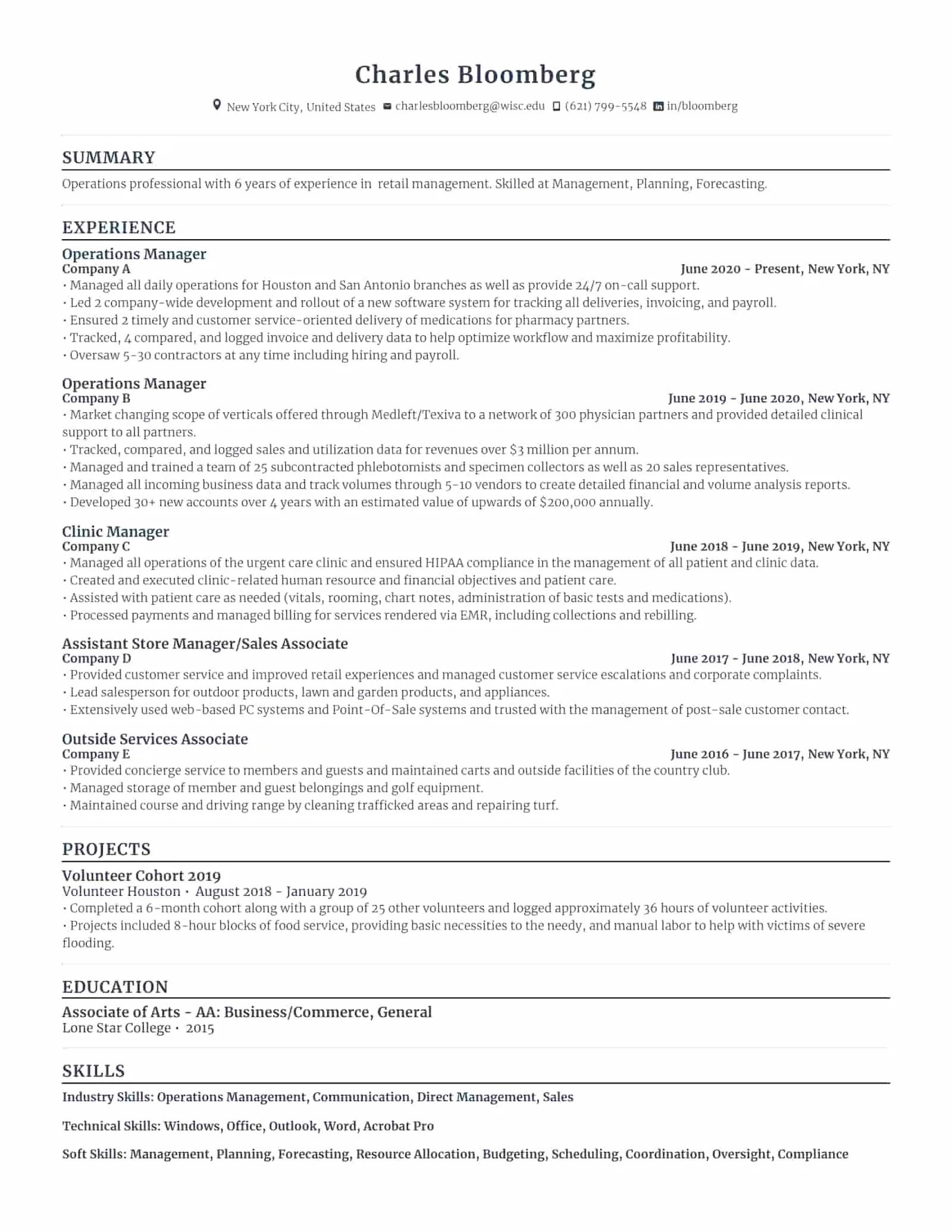
An operations manager resume has to show two things quickly: how much you ran (sites, people and budget) and what changed on the measures operations is judged by, such as cost per unit, throughput, on-time delivery and safety. Below are two complete operations manager resume examples, one for a supervisor applying for a first operations manager job and one for a senior leader running several sites, followed by how to write each section.
The people, employers and figures in every example are fictional. Replace them with your own results, and keep only the numbers you can explain in an interview.
Operations manager resume examples
First-time operations manager resume
Use this sample if you supervise a shift, department or line and are applying for your first job with the operations manager title.
Start your own operations manager resume from this structure.
Operations Supervisor | Distribution and Fulfillment | Six Sigma Green Belt
Summary
Operations supervisor with seven years in grocery distribution, currently running second shift at a 410,000 sq ft distribution center with 3 shift leads and 64 associates. Plans shift labor, carrier departures and the daily KPI review in Manhattan WMS and SAP. Led a Green Belt project that cut mispicks by 41% and served as acting operations manager for 10 weeks in 2024.
Experience
Operations Supervisor, Second Shift, Hartwell Foods Distribution Center, Indianapolis, IN | Mar 2022 – Present
- Supervise 3 shift leads and 64 associates across receiving, picking and outbound loading for 38 grocery stores; the shift ships an average of 21,000 cases a night.
- Served as acting operations manager for 10 weeks in 2024, running the weekly KPI review with the general manager, approving overtime and resolving two carrier service escalations.
- Raised on-time outbound departures from 88% to 96% in nine months by moving to a staggered door schedule agreed with the transportation team.
- Led a Six Sigma Green Belt (DMAIC) project on mispicks; new slotting and a scan-to-confirm step cut mispicks from 17 to 10 per 10,000 cases.
- Lowered shift labor cost per case from $0.62 to $0.55 by building hourly staffing plans from WMS volume forecasts.
- Ran daily safety huddles and monthly forklift audits; the shift recorded no OSHA recordable incidents in its last 14 months.
Shift Lead, Inbound, Hartwell Foods Distribution Center, Indianapolis, IN | Jun 2019 – Feb 2022
- Scheduled 22 receiving associates and coordinated 25 to 40 inbound trailers a shift.
- Built a dock appointment tracker in Excel that cut average trailer wait from 2.5 hours to 1.1 hours; the site used it until the WMS dock module went live.
- Led a 5S reset of the inbound staging area with two associates, freeing 14 pallet positions.
Skills
Manhattan WMS · SAP (MM, delivery processing) · Labor planning and shift scheduling · Excel and Power BI KPI dashboards · Lean and Six Sigma (DMAIC, 5S) · Slotting and pick-path design · Carrier and dock scheduling · OSHA safety programs · Coaching shift leads
Certifications
- Certified Six Sigma Green Belt (CSSGB), ASQ, 2023
- OSHA 10-Hour General Industry, 2020
Education
B.S. Business Administration, Supply Chain Management concentration, Ball State University, Muncie, IN, 2019
The acting-manager bullet sits second, right after scope, because the first question about any supervisor is whether they have done the manager's job. Ten weeks of running the KPI review answers that with a fact rather than a claim of readiness.
The verbs match Danielle's actual role: she supervises shift leads and associates, and the site budget belongs to someone else. Labor cost per case is the cost figure she does control, so it takes the place of a budget line. At this level, keep the resume to one page.
Senior multi-site operations leader resume
Use this sample if you run several sites or plants, manage other managers and own a budget or P&L.
Use this layout for a multi-site or regional operations resume.
Senior Operations Manager | Multi-Site Packaging Manufacturing | P&L Owner | Six Sigma Black Belt
Summary
Operations leader with 17 years in packaging manufacturing, the last six running four plants in the Carolinas and Georgia with 780 employees and a $64M operating budget. Owns the region's $210M revenue P&L, capital plan and supplier contracts. Raised average OEE from 61% to 74% and cut conversion cost per thousand units by 12% while leading the region's move to SAP S/4HANA.
Experience
Senior Operations Manager, Southeast Region, Carrow Packaging, Charlotte, NC | Jan 2020 – Present
- Lead 4 plant managers and a regional staff of 6 (quality, EHS, continuous improvement and planning) across 4 plants, 22 production lines and 780 employees.
- Own the regional P&L ($210M revenue, $64M operating budget); operating margin rose from 11.5% to 14.2% between 2020 and 2025 through the cost, OEE and supplier programs below.
- Raised average OEE across 22 lines from 61% to 74% by standardizing changeovers (SMED) and holding daily tiered performance meetings, adding enough capacity to cancel a planned $9M line purchase.
- Cut conversion cost per thousand units by 12% ($5.8M a year) by scheduling all four plants as one network and moving low-volume SKUs to the two most flexible lines.
- Consolidated resin and corrugate suppliers from 14 to 6 under three-year contracts, saving $3.1M a year and adding on-time delivery terms with service credits.
- Raised inventory turns from 6.8 to 9.5 after introducing monthly S&OP and SKU-level min/max settings in SAP, releasing $7.4M in working capital.
- Served as operations lead for the SAP S/4HANA rollout at all four plants in 2023; on-time, in-full delivery stayed above 95% through cutover.
- Reduced the regional total recordable incident rate (TRIR) from 3.1 to 1.2 with plant EHS audits, lockout/tagout retraining and supervisor-led safety walks.
Plant Manager, Carrow Packaging, Greenville, SC | Mar 2015 – Dec 2019
- Ran a 210-person, three-shift plant with 6 lines and an $18M operating budget.
- Led a Six Sigma Black Belt project on thermoforming scrap; scrap fell from 4.9% to 2.6%, saving $1.1M a year.
- Ran 9 Kaizen events on the bottleneck printing line, raising throughput from 3,100 to 3,650 units an hour.
- Raised customer on-time delivery from 91% to 98% by moving from weekly to daily production scheduling.
Earlier roles: Production Manager and Process Engineer, Linden Plastics, Spartanburg, SC | 2009 – 2015
- Managed production for two molding departments with 70 employees and led the plant's first value stream mapping project.
Skills
P&L and budget ownership · Multi-site operations · Sales and operations planning (S&OP) · OEE and TPM · Lean (SMED, Kaizen, 5S, value stream mapping) · Six Sigma DMAIC · SAP S/4HANA (PP, MM) · Supplier negotiation and contract management · Capital planning · EHS and OSHA compliance
Certifications
- Certified Six Sigma Black Belt (CSSBB), ASQ, 2016
- Certified in Planning and Inventory Management (CPIM), ASCM, 2018
Education
- MBA, University of North Carolina at Charlotte, 2014
- B.S. Industrial Engineering, Clemson University, 2009
Scope and P&L come first because a panel hiring for a multi-site job checks those before anything else. The margin bullet credits "the programs below" instead of claiming Raymond moved the margin alone, and each of those programs has its own bullet and its own number.
Six years at Linden Plastics are collapsed into one line and one bullet. Two pages are reasonable at this level, but the space goes to the roles with the budgets and headcount he will be hired to manage next.
How to write each section of an operations manager resume
Both samples use the same order, which works for most operations managers:
- Header
- Professional summary
- Work experience
- Skills
- Certifications
- Education
If you are a recent graduate with under two years of work experience, move education and certifications above experience so your training is seen first.
Use a reverse-chronological format so your current scope is the first thing a reader sees. Keep the resume to one page if you have under about 10 years of experience at one site, like Danielle. Use two pages if you have 10 or more years, several sites or a series of promotions, like Raymond. Advice on the exact cutoff varies, so let scope decide: if page two only repeats what page one already proves, cut it.
For applicant tracking systems and fast human reading:
- Use standard headings such as "Experience," "Skills" and "Education."
- Keep a single-column layout without text boxes, graphics or tables holding your content.
- Name systems the way the posting does, for example "SAP S/4HANA" or "Manhattan WMS."
- Save as PDF or Word, whichever the posting asks for.
Read the posting for its terms and repeat the ones you can back up with a bullet. Operations postings usually draw on four groups of keywords:
- Process improvement: Lean, Six Sigma (with belt level), Kaizen, DMAIC, value stream mapping, root cause analysis, continuous improvement
- Leadership and planning: team leadership, cross-functional coordination, workforce planning, strategic planning, change management, project management
- Performance and finance: KPI management, P&L, budgeting, cost reduction, vendor management, capacity planning
- Systems: the ERP, WMS, TMS or MES the posting names, plus reporting tools such as Excel, Power BI or Tableau
Header
Your header needs:
- Full name, with a key certification after it if the posting asks for one (Raymond Okafor, CSSBB)
- A headline with your current or target title, industry or setting, and main certification
- City and state, without a street address
- Phone number and a professional email address
- A LinkedIn URL that uses your name
Professional summary
Write three or four sentences that cover your title and years of experience, the type of operation, your scope (sites, headcount and budget) and one result with a number. Add a certification if the posting lists it. Both samples follow this pattern. Here are two more for situations the samples do not cover.
An operations manager in outpatient healthcare applying for a similar role:
Operations manager with nine years in outpatient healthcare, currently running front-desk, scheduling and supply operations for 12 clinics with 140 staff and a $9.5M operating budget. Owns patient-access KPIs, medical supply vendor contracts and the Epic scheduling templates for every site. Cut average patient check-in time from 11 minutes to 6 and reduced supply spend by $420K a year by moving to a single distributor.
An e-commerce fulfillment manager moving into manufacturing operations:
Fulfillment operations manager with eight years in e-commerce, leading a 260-person, two-shift fulfillment center that ships 45,000 orders a day. Runs labor planning, carrier contracts and Lean improvement work in Manhattan WMS and NetSuite. Raised units picked per labor hour by 23% through slotting and pick-path redesign. Holds a Lean Six Sigma Green Belt and is applying to plant operations roles that use the same flow and labor-planning methods.
The second summary names the target industry in its last sentence so the reader knows the move is deliberate. It also names methods that carry over to a plant (Lean, labor planning and flow) instead of terms only an e-commerce team would use.
Use a resume objective instead of a summary only if you have no supervisory experience yet, for example as a graduate applying to an operations trainee program. Keep it to one or two sentences that name the role and the most relevant project or internship.
Work experience
List roles in reverse-chronological order with title, employer, location and dates. Give your current role four to eight bullets and older roles one to three. Start each bullet with a verb that matches your actual role (led, managed, supervised, coordinated, supported), then add the scope and the result.
If you do not have a measured result, describe what you did and what it changed. Do not estimate a percentage you cannot support, because a hiring manager will ask how you calculated it. The guide to the resume work experience section has more general advice on ordering and wording roles.
Show your scope: sites, headcount and budget
Scope tells the reader how large an operation you can run. Put it in the first bullet of each management role.
Sites: Oversaw operations at 3 cross-dock facilities in Ohio and Kentucky handling 1,800 inbound pallets a day.
Headcount: Led 5 department managers and 190 hourly employees across assembly, test and shipping on three shifts.
Budget: Managed a $14M annual operating budget covering labor, maintenance and freight; finished FY2025 within 1.5% of plan.
Prove results on operations KPIs
Pick the KPIs your target posting mentions. Each example below shows a before-and-after figure and the action that changed it.
Cost per unit: Reduced cost per order shipped from $3.40 to $2.85 by switching to right-sized cartons and cutting packing-station overtime.
Throughput: Increased bottling line output from 240 to 290 cases an hour by redesigning the capper changeover and keeping a spare-parts kit at the line.
On-time delivery: Raised on-time, in-full delivery to retail customers from 87% to 97% in one year by adding a daily order-release review with customer service and transportation.
Inventory turns: Increased raw-material inventory turns from 5.2 to 8.1 by setting reorder points from 12 months of usage data and moving 40 slow-moving parts to supplier consignment.
OEE: Raised overall equipment effectiveness on 6 CNC machining cells from 58% to 71% by logging downtime reasons in the MES and fixing the top three causes.
Safety incidents: Cut recordable incidents at a 300-person warehouse from 9 to 2 a year after adding marked pedestrian walkways, forklift speed limiters and weekly near-miss reviews.
Name your process improvement methods: Lean, Six Sigma and Kaizen
"Applied Lean principles" does not tell the reader what you did. Name the method, the process you used it on and the measure that moved.
Lean: Mapped the order-to-ship value stream for a 120-employee kitting operation and removed two handoffs, cutting lead time from 5 days to 2.
Six Sigma (with belt level): Led a Six Sigma Black Belt DMAIC project on shipping-label errors; defects fell from 2.8% to 0.4% of shipments and customer chargebacks dropped by $260K a year.
Kaizen: Facilitated a five-day Kaizen event with operators and maintenance on a packaging line, reducing changeover time from 75 to 32 minutes.
Say what you did in ERP and WMS systems
Name the system and the specific work: a rollout role, rules you configured, reports you built.
ERP: Served as operations lead for an Oracle NetSuite implementation at 2 plants, writing the production and purchasing test scripts and training 45 users before go-live.
WMS: Configured wave planning and replenishment rules in Blue Yonder WMS, raising picks per labor hour from 92 to 118.
Show vendor management and P&L ownership
Vendor and P&L bullets separate a manager who runs the floor from one who also controls the money. State the contract value or revenue, then what you changed.
3PL and supplier contracts: Ran a competitive bid among 4 third-party logistics providers for overflow storage, cutting cost per pallet per month by 18% and adding a 99% inventory accuracy clause.
Carrier management: Renegotiated LTL rates with 5 regional carriers and introduced a quarterly scorecard; freight cost per shipment fell 9% while on-time pickup stayed above 96%.
P&L ownership: Owned the P&L for a $48M contract manufacturing business unit and raised gross margin from 18% to 22% by repricing 30 low-margin SKUs and reducing scrap.
Rewrite duty statements as results
These rewrites show what to add to a duty statement: the size of the operation, the action and the change.
| What it shows | Before | After |
|---|---|---|
| Scope | Managed the warehouse team | Managed 4 supervisors and 85 associates on two shifts at a 250,000 sq ft distribution center |
| Cost | Responsible for reducing costs | Cut labor cost per unit from $1.12 to $0.98 by rebuilding the shift schedule around inbound volume |
| Process improvement | Used Lean principles to improve processes | Led three Kaizen events on the returns line, reducing processing time per return from 9 minutes to 5 |
| Systems | Experienced with SAP | Created SAP production orders and bills of materials for 140 new SKUs during a product launch, with no line stoppages for missing materials |
| Safety | Ensured a safe work environment | Ran weekly safety walks and near-miss reviews; recordable incidents fell from 6 to 1 in a year |
Skills
List 8 to 12 skills that match the posting, and make sure each one also appears in a bullet. Tools and methods belong in the skills section. Soft skills are more convincing in bullets, where the reader can see them used.
Hard skills and what proves each one:
Lean operations: Name the tool (5S, value stream mapping, SMED) and one result it produced.
Six Sigma (DMAIC): Your belt level and the project you led.
Kaizen and continuous improvement: Count the events you ran and name the measure that changed.
ERP systems (SAP, Oracle, NetSuite, Microsoft Dynamics): The modules you used and the work you did in them.
WMS and TMS (Manhattan, Blue Yonder, SAP EWM): Describe the rules, waves or reports you set up.
KPI reporting (Excel, Power BI, Tableau): A dashboard you built and who used it to make decisions.
Budgeting and P&L management: State the budget or revenue you owned and how close you finished to plan.
Inventory control and S&OP: Inventory turns, accuracy or the working capital you released.
Vendor and contract management: Give the number of suppliers or the contract value and what you negotiated.
Safety and quality compliance (OSHA, ISO 9001): Cite incident rates, audit results or certifications held.
Soft skills and what proves each one:
Team leadership: Headcount and direct reports show this best, plus anyone you developed into a promotion.
Cross-functional coordination: Name the departments involved and the launch or decision you coordinated.
Problem-solving under pressure: Describe a specific disruption, such as a carrier failure or line breakdown, and how quickly you restored output.
Communication with senior leaders: The review or report you presented and who it went to.
Coaching and training: How many people you trained and what changed afterward, such as error rate or ramp-up time.
Change management: A rollout you led (new system, layout or shift pattern) and how you measured adoption.
For skills outside operations, see this guide to resume skills.
Certifications and education
List each certification with its full name, issuer and year. For Six Sigma, always give the belt level: Green Belt and Black Belt signal different levels of project responsibility, and "Six Sigma trained" signals neither.
| Certification | Issuer | Best fit | Where to list it |
|---|---|---|---|
| Certified Six Sigma Green Belt (CSSGB) | ASQ | Supervisors and managers who run improvement projects | Certifications section; headline if the posting asks for it |
| Certified Six Sigma Black Belt (CSSBB) | ASQ | Managers who lead DMAIC projects across a site or region | After your name, in the headline and in certifications |
| Project Management Professional (PMP) | PMI | Operations roles built around rollouts, plant launches or system projects | After your name and in certifications |
| Certified in Planning and Inventory Management (CPIM) | ASCM | Manufacturing planning and inventory control | Certifications and skills |
| Certified Supply Chain Professional (CSCP) | ASCM | Logistics, distribution and supply chain operations | Certifications and skills |
| OSHA 10-Hour or 30-Hour | OSHA Outreach Training Program | Warehouse, manufacturing and other industrial sites | Certifications |
Many employers and training providers also award Lean or Six Sigma belts. List the issuer either way so the reader can judge the training. If your operations work is mostly project delivery, the project manager resume examples show how to present PMP and project budgets.
Many operations manager postings ask for a bachelor's degree in business, supply chain management, industrial engineering or a related field. List the degree, school and graduation year. With several years of experience, keep education at the bottom and leave out coursework. As a recent graduate, put it above experience and add relevant coursework such as operations management or supply chain classes, a capstone project or a GPA of 3.5 or higher.
Adjust the resume for your type of operations role
The same structure works across industries, but the KPIs and keywords change. Lead with the measures your target industry uses, and rewrite your strongest bullets in those terms where the comparison is honest.
| Role type | KPIs to lead with | Keywords and tools to include |
|---|---|---|
| Warehouse and distribution | On-time departure, picks per labor hour, inventory accuracy, cost per order, safety incidents | WMS, TMS, slotting, labor planning, carrier management, OSHA |
| Manufacturing | OEE, throughput, scrap rate, cost per unit, inventory turns, TRIR | Lean, Six Sigma, SMED, Kaizen, MES, ERP production modules, ISO 9001 |
| Service and technology operations | SLA compliance, resolution time, uptime, cost per transaction | ITIL, incident management, workforce management, CRM |
| Retail and hospitality | Labor cost as a share of sales, shrink, guest or customer satisfaction scores, staff turnover | Scheduling, inventory control, point-of-sale or property management systems |
| Multi-site and director level | P&L, operating margin, number of sites and headcount, capital projects | Multi-site operations, S&OP, budgeting, site integration |
The bullet examples earlier come from plants and warehouses. If you run service, technology or retail operations, the same pattern of scope, action and before-and-after figure applies to your measures:
SLA compliance (service operations): Raised SLA compliance on 9,000 monthly support tickets from 91% to 98% by splitting the queue by issue type and adding a daily backlog review with team leads.
Resolution time (technology operations): Cut average incident resolution time for a 40-person IT service desk from 4.5 hours to 1.8 hours by writing runbooks for the 15 most frequent incidents and adding an on-call escalation rota.
Labor cost (retail operations): Brought labor cost down from 14.2% to 12.6% of sales across 9 stores by matching staff schedules to hourly traffic counts from the point-of-sale system.
Common operations manager resume mistakes
- Leaving out scope. Without sites, headcount and budget, a reader cannot tell whether you ran a 20-person shift or a 600-person region. Put scope in your summary and in the first bullet of each management role.
- Listing duties instead of results. "Responsible for daily operations" describes the job, not what you did in it. Name what changed: a KPI, a cost or a lead time.
- Naming no systems. Postings often name the ERP or WMS they use, and "experienced with inventory software" will not match it. Name the system and the work you did in it.
- Writing "Six Sigma" without a belt level. Give the belt, the issuer and one project, or the reader cannot judge your experience.
- Using another industry's KPIs. Uptime and SLA bullets do little for a plant job, and OEE means nothing to a contact center. Match the measures to the posting.
- Skipping safety. Warehouse, manufacturing and healthcare employers look for a safety record. Include incident rates or audit results if you have them.
- Overstating your role or numbers. "Managed" for a project you supported, or a percentage you cannot explain, falls apart in the interview. Use the verb that matches your role and keep a note of how you calculated each number.
Send a cover letter with your application when the posting allows one; this cover letter outline covers the structure. If you want help adapting your bullets to a specific posting, Resume Build can tailor your resume to a job description and export it as a PDF.