Real Estate Resume
Explore Real Estate Resume with ResumeBuild. Use this resume example as a reference for your own experience, skills, and qualifications.





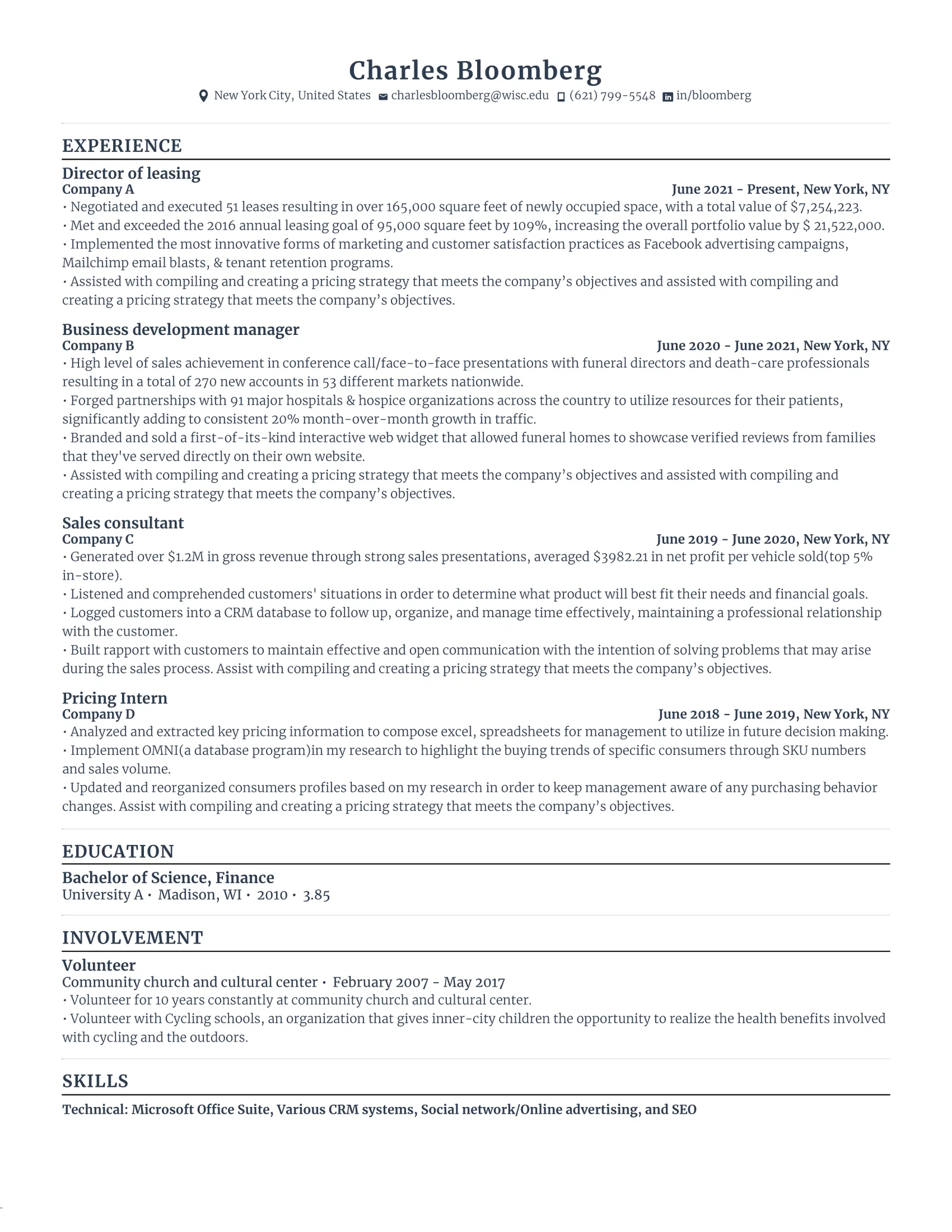
A real estate resume has to prove three things quickly: you hold the right license for the market, you can take transactions to closing, and you know the local market you would work in. The two sample resumes below show how that looks for a newly licensed agent and for an experienced top producer. After them, you will find how to write each section, from the license line to the numbers in your experience bullets.
All names, brokerages, license numbers and figures in the examples on this page are fictional.
Real estate resume example for a newly licensed agent
Priya has nine months of production and four years of leasing work, so her resume leads with the license and states her small numbers exactly.
Start your own real estate resume.
Licensed Real Estate Sales Agent · Texas Real Estate Commission (TREC) · License #0798412 · Sponsored by Hill Country Realty Group
Summary
Licensed Texas sales agent working with first-time and relocating buyers in North and East Austin. Closed 7 transactions totaling $2.6M in the first nine months after licensing: 5 buyer sides and 2 listing sides. Four years as a leasing consultant built the lead follow-up habits and paperwork accuracy that transaction work depends on.
Experience
Real Estate Sales Agent, Hill Country Realty Group, Austin, TX | Jan 2026 – Present
- Closed 7 transactions totaling $2.6M in sales volume (5 buyer sides, 2 listing sides) within nine months of licensing.
- Priced both listings from CMAs reviewed by the managing broker; they sold at 98.6% and 100% of list price and went under contract in 16 and 11 days.
- Hosted 22 open houses on team listings and entered 140 visitor sign-ins into Follow Up Boss; 3 visitors became buyer clients and 2 of them have closed.
- Set up MLS saved searches for 18 active buyers and wrote 14 offers, 5 of which closed.
- Tracked option-period, financing and title deadlines for every file on a shared checklist with the brokerage's transaction coordinator.
Leasing Consultant, The Parkline Apartments, Austin, TX | Jun 2021 – Dec 2025
- Leased an average of 11 units a month at a 310-unit community, giving tours and answering questions about pricing and lease terms.
- Responded to about 60 prospect inquiries a week in Yardi and booked tours within one business day.
- Prepared leases and renewal offers in Yardi Voyager; chosen in 2024 to train two new consultants on lease file checks.
Education
B.A. in Communication Studies, Texas State University, San Marcos, TX | 2021
Texas Sales Agent Pre-License Education | Completed November 2025
Skills and tools
- Buyer consultations, CMAs, offer writing on TREC contract forms, open house lead capture
- Follow Up Boss, MLS saved searches and CMA reports, Yardi Voyager, DocuSign, Canva
- Languages: English (native), Spanish (conversational)
Choices worth copying from this sample:
- The license sits directly under the name. A brokerage can confirm the license type, state and sponsoring broker before reading anything else.
- Small numbers are stated exactly. "7 transactions" with the buyer and listing split is more believable than "multiple successful closings."
- The leasing job is written as sales evidence. Tour volume, inquiry response time and lease paperwork are close to the work of showing homes, following up on leads and managing contract documents.
Real estate resume example for an experienced top producer
Marcus has eleven years of production, a team to lead and four designations, so his resume compares his results with the market and separates his own numbers from the team's.
Start your own real estate resume.
Licensed Real Estate Sales Associate · Florida DBPR · License #SL3291876 · Gulf Coast Realty Partners
Summary
Florida sales associate with 11 years in South Tampa and Westshore residential sales, currently leading a five-agent team. Closed 46 transactions and $21.4M in personal sales volume in 2025, 28 of them on the listing side. Listings sold at 99.1% of list price against a 97.4% MLS average for the same ZIP codes, with a median of 18 days on market.
Experience
Senior Agent and Team Lead, Gulf Coast Realty Partners, Tampa, FL | Mar 2019 – Present
- Closed 46 transactions and $21.4M in personal sales volume in 2025 (28 listing sides, 18 buyer sides); the five-agent team closed 112 transactions in the same year.
- Sold 2025 listings at 99.1% of final list price, compared with 97.4% for single-family homes in the same ZIP codes (Stellar MLS market report).
- Reached a median of 18 days on market for 2025 listings, against 41 days for comparable single-family listings in the same ZIP codes.
- Sourced 62% of 2025 closings from past clients and referrals by sending a quarterly neighborhood market report and hosting two client events a year for a 900-contact sphere managed in kvCORE.
- Wrote the team's listing launch checklist (pre-list CMA, staging consultation, professional photography, MLS input review), now used on every team listing.
- Represented 19 sellers aged 55 and older who were downsizing, coordinating estate sales, movers and closing dates around their move.
- Recruited and mentored 3 newly licensed agents; each closed at least 6 transactions in their first year.
Real Estate Sales Associate, Bayshore Homes Realty, Tampa, FL | Jun 2015 – Feb 2019
- Grew annual closings from 9 in 2016 to 31 in 2018, mostly buyer sides from open houses and online leads.
- Named the brokerage's Rookie of the Year for 2016.
Designations
- Certified Residential Specialist (CRS), 2022
- Seniors Real Estate Specialist (SRES), 2020
- Graduate, REALTOR® Institute (GRI), 2018
- Accredited Buyer's Representative (ABR), 2017
- Member, National Association of REALTORS® and Greater Tampa REALTORS®
Education
B.S. in Finance, University of South Florida, Tampa, FL | 2014
Skills and tools
- Listing presentations, pricing strategy, multiple-offer negotiation, agent coaching
- Stellar MLS (Matrix), kvCORE, dotloop, DocuSign, Google Sheets for team production tracking
Choices worth copying from this sample:
- Each ratio has a comparison. 99.1% of list price means more next to the 97.4% area average from the same MLS data.
- Personal and team production are separate. The 46 closings are his; the 112 belong to the team. A hiring broker will check this, so make the split obvious.
- The older job is shorter. Two bullets are enough for 2015 to 2019 because the recent record carries the application.
How to write the header and license line
Put your name, city and state, phone number and a professional email address at the top. Add a LinkedIn profile or agent website only if it shows current listings, sales or reviews that match the resume.
Directly under your name, add a license line with four parts:
- License title as your state uses it. Texas uses "sales agent," Florida uses "sales associate," and some states license everyone as a broker. Use your state's exact title.
- State and regulator. For example, Texas Real Estate Commission or Florida DBPR.
- License number (optional). Including it lets a broker verify you quickly in the state's public lookup. Leave it off if you post your resume on public job boards and would rather not share it there.
- Sponsoring brokerage. Name the brokerage that currently holds your license, or write "Seeking sponsoring broker" if you are newly licensed and unaffiliated.
Licensed Real Estate Salesperson · Ohio Division of Real Estate and Professional Licensing · License #2021004517 · Sponsored by Northgate Realty
If your license is pending, say so with a date, for example "Ohio salesperson exam passed; license expected December 2026." Do not list a license as active until the state shows it as active.
How to write a real estate resume summary
A real estate summary is three or four lines that answer what a hiring broker or team lead asks first. Build it from three parts:
- Your title, years in the business and market (city, neighborhoods or property type).
- Your strongest transaction evidence, with a number and a time period.
- A specialty, designation or reason you fit this particular brokerage or team.
Leave out adjectives such as "passionate" and "dedicated." A closing count and a market name tell the reader more than a description of your attitude.
Summary example: buyer's agent for first-time buyers
Ohio buyer's agent applying to a buyer-focused team
Buyer's agent with five years in Columbus, Ohio, working mainly with first-time buyers using FHA loans and down payment assistance programs. Represented buyers on 84 closings since 2021, including 31 in 2025, and took 92% of accepted contracts through inspection and appraisal to closing. ABR designee, bilingual in English and Spanish.
The contract-to-close rate matters for buyer work because a team lead wants to know whether your deals survive inspection and appraisal, not only whether you can get an offer accepted.
Summary example: listing specialist applying for a team lead role
Colorado listing agent moving into team leadership
Listing agent with eight years in Denver's south suburbs, applying to lead a listing team. Took 54 listings to closing over the last two years at a median 99% of list price and 12 days on market. Built the listing launch process and weekly seller update template now used by a six-agent team, and coached two agents through their first listings.
For a leadership role, the last sentence carries as much weight as the sales numbers. Name a process you built and the people you trained.
How to write real estate experience bullets
List your roles in reverse chronological order with the brokerage, city, title and dates. Under each role, write bullets that combine an action, the setting, a number and, where you can, a comparison with the market or your own earlier results. Our guide to the resume work experience section covers the general structure; the subsections below cover the numbers specific to real estate.
Give every number a time period ("in 2025," "since 2021") and use figures you can back up with closing records or MLS reports. If you are on a team, report your own production and label any team totals as team totals.
Sales volume and closed transactions
Sales volume is the total sale price of the closed transactions you worked on. Closed transactions (or sides) are the count. Show both, because $10M from 8 luxury sales and $10M from 40 starter homes describe different agents. Some brokerages also ask about GCI (gross commission income); include it only if the posting asks and you are comfortable sharing it.
Closed 31 transactions totaling $11.8M in sales volume in 2025, up from 22 transactions and $7.9M in 2024.
Closed 4 buyer-side transactions totaling $1.3M in the first six months after licensing, while assisting a senior agent on 9 additional closings.
The second bullet shows how a newer agent can count assisted work without claiming it as their own production.
Buyer side vs listing side
A side is one party represented in a transaction. Splitting your closings into listing sides and buyer sides tells an employer what kind of business you bring. Listing-heavy agents are often valued for generating inventory and marketing; buyer-heavy agents for lead conversion and showing volume. If you represented both parties in a deal where your state allows it, say so rather than counting it silently as two sides.
Closed 38 sides in 2025 (24 listing, 14 buyer) and grew listings from 40% to 63% of personal business over two years.
List-to-sale ratio
The list-to-sale ratio is the sale price divided by the list price. State whether you used the original or the final list price, because a ratio based on the original price is harder to achieve and more convincing. Compare it with the average for the same area, property type and period, which you can usually pull from your MLS market reports or ask your broker for.
Sold 2025 listings at an average 98.8% of original list price, compared with 96.9% for comparable single-family homes in the same MLS area.
Went under contract on 17 of 19 listings without a price reduction, pricing each from a CMA built on pending and closed sales within half a mile.
Days on market
Days on market (DOM) shows how quickly your listings sell. Say whether you are reporting a median or an average, and compare it with the market figure for the same ZIP codes or subdivision. If any listing was withdrawn and relisted, use cumulative days on market (CDOM) so the number is not understated.
Brought listings to contract in a median 9 days in 2025, against a 27-day MLS median for the same ZIP codes, by ordering pre-listing inspections and launching with full photography on day one.
Lead generation and sphere work
Brokerages hire agents who can find their own business. Show where your clients come from (sphere of influence, past clients, referrals, open houses, online leads, farming a neighborhood) and the routine that produced them.
Turned a 450-contact sphere into 14 closings in 2025 through monthly market emails, two client appreciation events and quarterly check-in calls.
Converted 6% of online buyer leads into signed buyer agreements by calling every new lead within five minutes and following a 12-step follow-up plan in Follow Up Boss.
CRM and MLS tools
Name the systems you actually use: your MLS or its platform (for example, Matrix or Flexmls), your CRM (Follow Up Boss, kvCORE, Lofty), transaction software (dotloop, SkySlope, DocuSign) and, for commercial or property management roles, CoStar, LoopNet, Argus, Yardi or AppFolio. Then show one result you produced with a tool, so the name is backed by use.
Reorganized the team's Lofty CRM with tags for buying timeline and price range, reducing leads with no contact in 30 or more days from about 400 to under 50.
How to list designations and certifications
Put designations in their own section, below experience or directly under the summary if the posting asks for them. Spell out each one the first time:
- ABR: Accredited Buyer's Representative
- CRS: Certified Residential Specialist
- GRI: Graduate, REALTOR® Institute
- SRES: Seniors Real Estate Specialist
Add the year you earned each one and list only designations that are current. You can place the two most recognized abbreviations after your name, as the top producer sample does, but keep the full list in the section so readers who do not know the acronyms can see what they mean.
Use "REALTOR®" only if you are a member of the National Association of REALTORS®, because the term refers to members. Relevant continuing education, such as a fair housing or contracts course, can go in this section when it supports the job you are applying for.
What to include in the education section
List your degree, field, school and graduation year. A degree in business, finance, marketing or communication is worth a single clear line; you do not need coursework once you have a few years of production.
If you are newly licensed, add your pre-licensing education and the date you completed it, as Priya's resume does. Relevant courses such as real estate law, finance or property valuation can stay on the resume until your transaction record is long enough to replace them.
Skills for a real estate resume
Start with the skills the job posting names and use its wording when it is accurate for you. Then make sure each skill is supported somewhere in your experience bullets. For more on balancing technical and interpersonal skills, see our guide to resume skills.
Hard skills
Comparative market analysis (CMA): Mention how many CMAs or listing presentations you prepared and how close your recommended prices came to sale prices.
Pricing strategy: Back it with your list-to-sale ratio and how many listings needed a price reduction.
Contract preparation: Name the forms you write, such as your state's purchase contract, counteroffers and addenda, and how many offers you wrote in a year.
Offer negotiation: Show results in multiple-offer situations, inspection repair negotiations or appraisal gaps you resolved.
MLS search and listing input: Name your MLS and describe saved searches, listing input or market reports you run.
CRM and lead management: Name the CRM and give a follow-up or conversion result.
Transaction management: List dotloop, SkySlope or DocuSign and mention deadline tracking or file audits.
Listing marketing: Point to open houses, photography and staging coordination, or social media campaigns tied to showings or offers.
Soft skills
Client communication: Show it through a routine, such as weekly seller updates or same-day responses to buyer questions.
Composure under pressure: Describe a deal you kept together after a low appraisal or a difficult inspection.
Follow-through: Repeat business and referral percentages show that clients came back.
Time management: Mention the number of active clients or listings you handled at once.
Relationship building: Name the sphere size, community groups or lender and inspector partners you work with.
Teaching and coaching: For senior roles, give the number of agents you trained and what they went on to close.
Choose a format and match the job posting
Use the reverse chronological format: most recent role first, with dates on every role. Recruiters and brokers expect it, and it shows your production trend year by year. If you are changing careers into real estate, a hybrid format that opens with a short skills section followed by your work history can work better.
Keep a new agent's resume to one page. Two pages are fine for a long production record like Marcus's. Use a common font, 1-inch margins and plain text for your license and contact details rather than putting them inside a graphic.
Many brokerages and real estate companies receive applications through applicant tracking systems, and both the software and recruiters search for terms from the posting. Before you send each application:
- Highlight the posting's requirements: license type, market, specialty (buyers, listings, new construction, luxury, leasing) and named tools.
- Use the posting's exact terms where they are true for you, such as "buyer's agent" instead of "buyer specialist," or the MLS and CRM it names.
- Put the top two requirements in your summary and your first experience bullets.
- Update your skills section to match the tools and skills listed.
- Save as a PDF unless the application asks for a different file type.
Our guide on how to tailor your resume goes through this process in more detail.
Tailor your real estate resume to a specific job description with Resume Build.
How to write a real estate resume with no transaction history
If you are licensed or close to licensing but have not closed a deal, lead with the license line (or the expected license date) and a summary that names the market and type of client you want to serve. Then use these sources of evidence:
- Transferable work. Retail, hospitality, leasing, mortgage, insurance and inside sales all involve lead follow-up, client service or paperwork. If you come from sales, give the target, your result and the period, just as you would for a quota, so a broker can see how you handle a pipeline.
- Work you did at the brokerage. Open houses hosted, buyer showings you assisted with, CMAs drafted for a senior agent and leads you followed up are all real activity. Describe them as assisting, not as closings.
- Pre-licensing education and training. List the coursework, completion date and any brokerage training program.
- Local knowledge. Years living in the area, community involvement or a second language spoken by local buyers can support the market focus in your summary.
Our guide to writing a resume with no experience covers the general approach. A cover letter is also the right place to explain why you moved into real estate; these cover letter tips help with structure and tone.
Common real estate resume mistakes
- Listing duties instead of results. "Showed homes and attended closings" applies to every agent. Replace it with counts, ratios and outcomes.
- Giving numbers without a period or comparison. "Sold $8M" needs a year, and a list-to-sale ratio needs the area average next to it.
- Claiming team production as your own. Report your personal sides and volume, and label team totals separately.
- Using the wrong license title or an inactive license. Match your state's title and list only a license that is currently active.
- Calling yourself a Realtor without NAR membership. Use "real estate agent" or your state license title instead.
- Writing a summary of adjectives. Replace "passionate, hardworking agent" with your market, years and a closing count.
- Leaving out the market. Name the city, neighborhoods or property types you know so a broker can see whether you fit their territory.
- Pasting in your agent marketing bio. Bios written for clients are first person and promotional. A resume needs dated roles and verifiable numbers.
- Listing every app you have used. Keep the tools the posting names and the ones you use daily, and show at least one of them in action.