Recruiter Resume
Explore Recruiter Resume with ResumeBuild. Use this resume example as a reference for your own experience, skills, and qualifications.





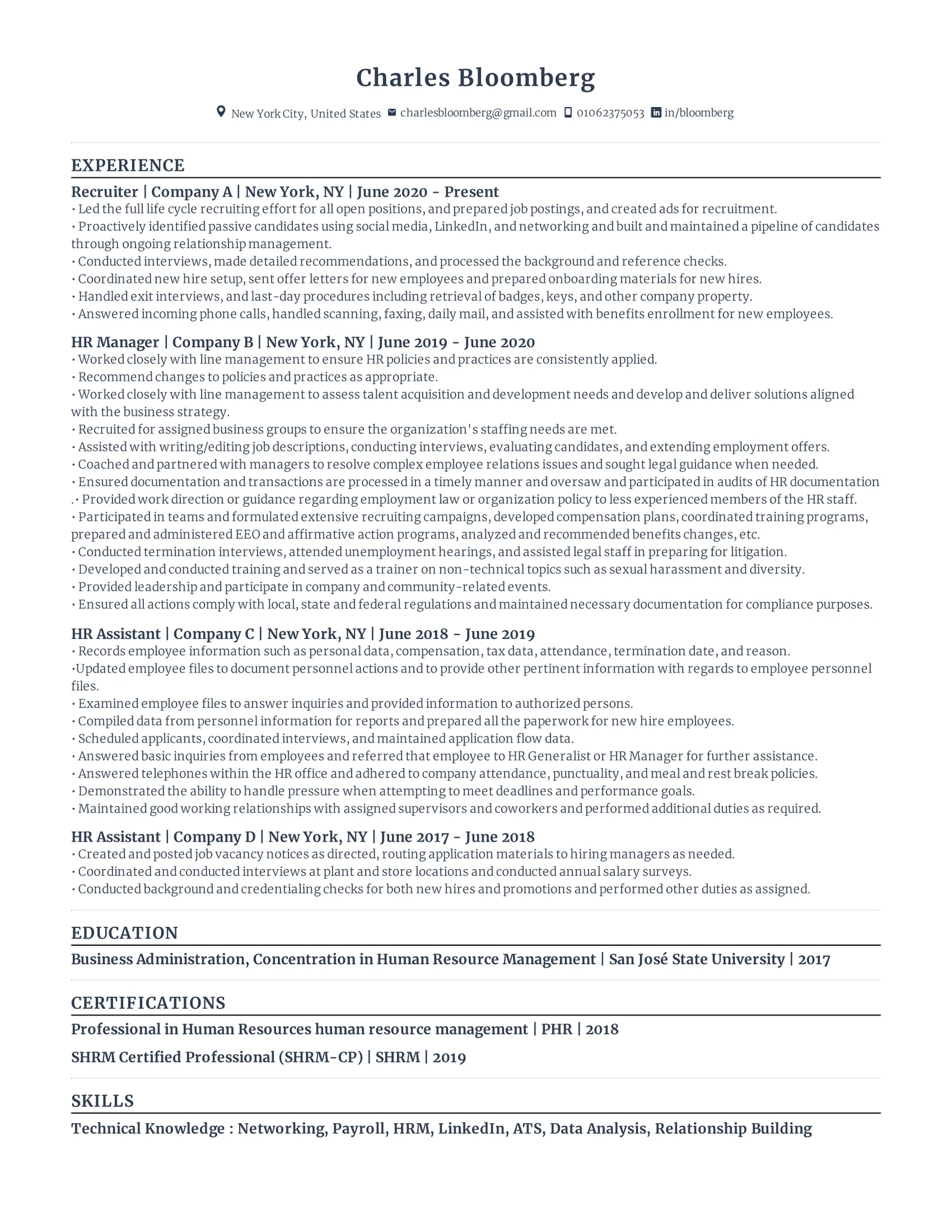
A recruiter resume needs to show the same thing you look for in candidates: evidence. Hiring managers for recruiter roles want to know how many requisitions you carried, how many hires or placements you made in a set period, how quickly you filled roles, how often candidates accepted your offers and, if you work at an agency, how much revenue you brought in. They also want to see which kinds of roles you hire for and which tools you use.
The two resumes below are fictional examples. The names, companies and figures are illustrative, so use them for structure and phrasing, then replace every number with your own.
Recruiter resume examples
Agency recruiter resume example
This example fits recruiters at staffing or search firms and recruiters with two to four years of experience. It leads with placements and gross profit because agencies measure recruiters on those numbers.
Build your own recruiter resume.
Recruiter | High-Volume Light Industrial and Office Staffing
Summary
Agency recruiter with more than three years of full-cycle recruiting for warehouse, light manufacturing and office clients at a regional staffing firm. Carries 25–30 open job orders and placed 142 contract and temp-to-hire workers in 2025, generating $386K in gross profit (112% of target). Builds pipelines through Bullhorn database searches, Indeed, associate referrals and bilingual hiring events.
Experience
Recruiter, Brightpath Staffing, Columbus, OH | March 2024 – Present
- Manage 25–30 open job orders at a time across 9 client accounts in warehouse, light manufacturing and office administration.
- Placed 142 contract and temp-to-hire workers in 2025, an average of 35 per quarter, generating $386K in gross profit (112% of annual target).
- Cut average time to fill for warehouse orders from 9 to 5 business days by keeping a pre-screened bench of 60+ available candidates and texting shift details within an hour of order intake.
- Proposed and ran a $100 associate referral bonus, approved by the branch manager; referrals grew from 8% to 22% of placements in 2025.
- Kept offer acceptance at 91% by confirming pay rate, shift and commute with each candidate before submittal.
- Run two bilingual (English and Spanish) hiring events per quarter with client HR teams, averaging 45 interviews and 18 starts per event.
Associate Recruiter, Brightpath Staffing, Columbus, OH | June 2023 – February 2024
- Phone-screened 40–60 applicants a week for high-volume warehouse orders and logged every contact in Bullhorn.
- Coordinated onboarding for about 35 new associates a month, including I-9 verification, background check orders and first-day orientation.
- Promoted to Recruiter after eight months.
Skills
Bullhorn, Indeed Resume Search, LinkedIn Recruiter Lite, Boolean search, high-volume phone screening, client intake meetings, offer negotiation, Excel pipeline reporting, Spanish (conversational)
Education
B.A. in Communication, The Ohio State University, Columbus, OH, 2023
Certifications
AIRS Certified Internet Recruiter (CIR), 2025
What to copy from this example:
- Workload and output together. "25–30 open job orders" and "142 placements in 2025" tell the reader both how busy the desk was and what it produced.
- Revenue against target. Gross profit with a percentage of target shows commercial value without revealing client billing rates.
- The cause next to the result. The time-to-fill bullet names the bench and the one-hour text, so the improvement is believable.
- A promotion inside one company. Two titles under the same employer show progression without a separate story.
Senior in-house technical recruiter resume example
This example fits corporate recruiters who hire engineers, data specialists or other technical staff and have five or more years of experience. It leads with requisition load, hires, time to fill and offer acceptance, then adds process, DEI and employer brand work.
Build your own recruiter resume.
Senior Technical Recruiter | Software, Data and Infrastructure Engineering
Summary
In-house technical recruiter with nine years of experience hiring software, data and infrastructure engineers, including two director-level searches. Hired 41 engineers in 2025 while carrying 18–22 requisitions, with a 41-day median time to fill and 88% offer acceptance. Greenhouse administrator; previously recruited in Lever and Workday Recruiting.
Experience
Senior Technical Recruiter, Northwind Cloud (SaaS, about 1,200 employees), Seattle, WA | January 2022 – Present
- Carry 18–22 engineering requisitions (backend, data, site reliability and engineering management) and run weekly pipeline reviews with 7 hiring managers.
- Hired 41 engineers in 2025, an average of 10 per quarter, against a team target of 36.
- Reduced median time to fill for senior engineering roles from 58 to 41 days by working with engineering leads to replace a take-home assignment with a 90-minute paired session and cut the onsite loop from six interviews to four.
- Raised offer acceptance from 74% (2023) to 88% (2025) by sharing pay ranges on the first call and involving the Total Rewards team before final interviews.
- Sourced 46% of 2025 hires through outbound LinkedIn Recruiter and GitHub searches; employee referrals added another 21%.
- Led searches for a Director of Platform Engineering and a Director of Data, closing both within 85 days.
- Partnered with the women-in-engineering employee resource group to rebuild Greenhouse interview scorecards and add two coding bootcamp sourcing partners; women made up 31% of onsite slates in 2025, up from 19% in 2023.
- Co-organized four engineering meetups (about 600 RSVPs in total) and wrote the interview-process page on the careers site; 9 hires in 2025 came from meetup attendees.
- Administer Greenhouse for the 6-person recruiting team, including structured scorecards, offer approval workflows and a monthly funnel report for engineering leadership.
- Mentor two recruiters on technical phone screens and Boolean sourcing.
Technical Recruiter, Cascade Analytics, Seattle, WA | June 2019 – December 2021
- Hired 28 software and data engineers in 2021 across 12–15 open requisitions, managed in Lever.
- Wrote a sourcing playbook of Boolean strings and screening questions for six engineering role families, adopted by the three-person recruiting team.
- Worked with the HRIS team to move requisition approvals into Workday, cutting average approval time from 6 days to 2.
IT Recruiter, Summit Tech Staffing (agency), Bellevue, WA | July 2017 – May 2019
- Placed 52 contract developers and QA analysts with 11 client companies; ranked second of eight recruiters in 2018 placements.
Skills
Greenhouse (admin), Lever, Workday Recruiting, LinkedIn Recruiter, GitHub and Stack Overflow sourcing, Boolean search, technical phone screens, structured interviewing, compensation benchmarking, recruiting funnel reporting
Education
B.A. in Business Administration, Human Resources Management concentration, University of Washington, Seattle, WA, 2017
Certifications
SHRM Certified Professional (SHRM-CP), 2023
What to copy from this example:
- A date range on every rate. Offer acceptance "from 74% (2023) to 88% (2025)" can be checked. A bare "88%" leaves the reader guessing.
- Executive work kept separate. The director-level searches get their own bullet, so they are not lost among volume hires.
- DEI described as actions. The bullet names the scorecards, the sourcing partners and the change in slate composition. It does not claim a hiring quota.
- Tools shown in use. Greenhouse appears in a bullet about what was built, not only in the skills list.
- An earlier agency role kept to one line. It explains the start of the career without taking space from current work.
Choose a format and length
Use reverse-chronological order: your current or most recent role first, then earlier roles. Recruiters and hiring managers expect it, and it shows growth in requisition load and seniority clearly. A hybrid format, with a skills summary above a shorter work history, only makes sense if you are moving into recruiting from another field.
For length, one page works for most recruiters with fewer than about seven years of experience. A second page is reasonable for senior or lead recruiters with several employers, executive searches or team leadership to describe. Cut older roles to one or two lines before you add a third page.
Keep the layout simple enough for an applicant tracking system to read:
- Use a single column with standard headings (Summary, Experience, Skills, Education, Certifications).
- Put dates, titles and employers in plain text, not in tables, text boxes or graphics.
- Submit the file type the posting asks for, usually a .docx or a text-based PDF.
For more on layout and keywords, see this guide to building an ATS-optimized resume.
Write the header
Your header should hold these fields:
- Full name
- Target title, with your specialization if you have one
- City and state, plus "Remote" or "Open to relocation" if that applies
- Professional email address
- Phone number
- LinkedIn profile URL, which matters more for recruiters than for most roles because employers will look at your network and activity
Leave out your street address, date of birth, photo and marital status.
Aisha Rahman
Executive Recruiter | Healthcare Leadership Search
Chicago, IL (Open to relocation) | [email protected] | (312) 555-0176 | linkedin.com/in/aisharahman
Write a recruiter resume summary
A summary gives the reader your specialization and best numbers before they reach your work history. Keep it to two or three sentences and include:
- Your recruiter type and the roles you hire for (agency or in-house; technical, executive or high-volume).
- Years of experience.
- One or two numbers: hires or placements in a period, time to fill, offer acceptance or revenue.
- The ATS or sourcing tools named in the job posting.
Skip adjectives like "passionate" or "results-driven". The numbers already show results. The two resumes above each include a summary; the examples below cover two other common situations.
Summary example for an agency healthcare recruiter
Agency recruiter with five years of travel and per diem nurse staffing for hospital and long-term care clients across Texas. Placed 96 RNs and LPNs in 2025, 118% of the annual placement goal, and 87% of travel contracts were completed or extended. Verifies licenses and credentials in Bullhorn and sources through nursing job boards and nurse referrals.
This works for agency roles because it pairs placements against goal with contract completion, which tells a staffing firm both how much you produce and how well your placements hold. Naming license verification shows you know the compliance side of healthcare staffing.
Summary example for an in-house high-volume recruiter
In-house recruiter with six years of high-volume hiring for a retail and distribution employer with 140 stores. Hired 610 hourly and supervisory employees across 22 locations in 2025, with an 11-day average time to fill and 93% offer acceptance. Manages requisitions in Workday Recruiting and trains store managers to run structured interviews.
This works for corporate high-volume roles because it gives scale (hires and locations), speed and offer acceptance in one sentence, then names the ATS and the manager training that keeps hiring consistent across sites.
If you are moving into recruiting from sales, HR or another field, a short objective can be more useful than a summary. Name the recruiting role you want and the transferable result you bring, for example "Sales development representative moving into agency recruiting, with two years of booking 40+ discovery calls a month from cold outreach."
Write work experience bullets that show recruiting results
Your experience section should read like a recruiting scorecard. Each bullet should state what you did, for which roles, and what changed as a result, with a time frame. Fellow recruiters already know what a recruiter does, so describing duties tells them little. For general structure, such as dates, titles and ordering, see this guide to the resume work experience section.
Recruiting metrics to include
Pick the metrics your next employer is likely to track. Pull them from your ATS reports (Greenhouse, Lever, Workday or Bullhorn), your quarterly scorecards or your manager's dashboards.
| Metric | What it shows the reader | Example phrasing |
|---|---|---|
| Requisitions or job orders carried | Workload and how many searches you can run at once | "Carry 18–22 engineering requisitions" |
| Hires or placements per quarter or year | Output | "Hired 41 engineers in 2025, an average of 10 per quarter" |
| Time to fill (or time to hire) | Speed; say which measure you use | "Reduced median time to fill from 58 to 41 days" |
| Offer acceptance rate | How well you calibrate and close offers | "Raised offer acceptance from 74% to 88%" |
| Pipeline and sourcing channel mix | Whether you build pipelines or wait for applicants | "46% of hires came from outbound sourcing; referrals added 21%" |
| Revenue or gross profit (agency) | Commercial value to the firm | "$386K gross profit, 112% of annual target" |
| Retention or assignment completion | Quality of hire | "92% of 2025 hires still employed after 12 months" |
Time to fill and time to hire are measured differently at different companies. Use the term your current employer uses, and use "median" or "average" correctly. If you cannot confirm a number, describe the concrete action instead, such as "ran weekly pipeline reviews with 7 hiring managers". A number you cannot explain in an interview will hurt you with a recruiting audience.
Weak and stronger recruiter bullets
Each pair below rewrites a duty into a result. They cover different metrics so you can find the closest match to your own work.
Requisitions and hires (in-house)
- Weak: "Responsible for full-cycle recruiting for engineering roles."
- Stronger: "Carried 18–22 engineering requisitions and hired 41 engineers in 2025, an average of 10 per quarter."
The stronger version gives workload, output and a time frame in one line.
Time to fill (agency, high-volume)
- Weak: "Filled warehouse job orders quickly."
- Stronger: "Cut average time to fill for warehouse orders from 9 to 5 business days by keeping a pre-screened bench of 60+ candidates."
"Quickly" becomes a before-and-after figure, and the bench explains how it happened.
Offer acceptance (in-house)
- Weak: "Extended offers and negotiated with candidates."
- Stronger: "Raised offer acceptance from 74% to 88% over two years by sharing pay ranges on the first call and flagging compensation gaps before final interviews."
The reader sees a closing skill and the specific habit that produced it.
Pipeline and sourcing channels (agency)
- Weak: "Used referrals and job boards to find candidates."
- Stronger: "Launched a $100 associate referral bonus that grew referrals from 8% to 22% of 2025 placements."
Naming one channel and its share of placements says more than a list of channels.
DEI recruiting (in-house)
- Weak: "Supported diversity initiatives."
- Stronger: "Partnered with the women-in-engineering employee resource group to rebuild interview scorecards and add two bootcamp sourcing partners; women rose from 19% to 31% of onsite slates."
It describes the process changes and a slate measure you can verify, rather than claiming credit for individual hiring decisions.
Employer brand (agency or in-house)
- Weak: "Helped with employer branding."
- Stronger: "Rewrote 30 Indeed job ads to lead with pay, shift times and site photos; applications per posting rose from 14 to 31."
Employer brand work reads as marketing filler unless you connect it to applicant numbers or hires.
Show the roles you hire for
A recruiter who fills 40 warehouse roles a month and one who closes two director searches a year are doing different jobs. Make the type of hiring obvious in your bullets:
- Technical recruiting: name the role families and, where useful, the stack or specialty (backend, data, site reliability, security). Mention technical screens or interview loop design.
- Executive recruiting: give the level (director, VP, C-suite), search length and whether you worked with a retained search partner. Describe confidential clients by industry and size rather than by name.
- High-volume recruiting: give hires per week, month or event, the number of sites or shifts, and how you kept no-show rates down.
Name your ATS and sourcing tools inside bullets
Hiring teams want to know you can use their systems on day one, so list Greenhouse, Lever, Workday Recruiting, Bullhorn or LinkedIn Recruiter by name. Then show one thing you did with the tool, such as building scorecards, running funnel reports or setting up offer approvals. "Greenhouse administrator" with an example says more than "proficient in ATS platforms". Copy the exact tool names from the job posting; this guide on how to tailor your resume covers matching posting keywords.
Show DEI and employer brand work
DEI and employer brand projects are common in corporate recruiting, and they are easy to describe vaguely. Write them like any other project:
- What you changed (scorecards, job ad language, sourcing partners, careers page, events).
- Who you worked with (employee resource groups, marketing, hiring managers).
- What you measured afterward (slate composition, applicant volume, event attendance, hires from events).
Avoid sharing demographic data your employer would not report publicly. Slate and pipeline measures are usually safer to share than hire-level demographics.
What to emphasize on an agency vs in-house recruiter resume
Staffing firms and in-house teams judge recruiters on different numbers. If you are switching between the two, rewrite your bullets around the measures your next employer uses. The two examples above show each approach: Danielle's agency resume leads with placements and gross profit, while Marcus's in-house resume leads with hires, time to fill and offer acceptance.
| Agency or staffing recruiter | In-house or corporate recruiter | |
|---|---|---|
| Who you serve | Client companies; you may also win and keep accounts | Hiring managers inside one company |
| Numbers to lead with | Placements, revenue or gross profit, fill rate, client retention | Hires, time to fill, offer acceptance, quality of hire |
| Tools to name | Bullhorn, JobDiva, job boards, LinkedIn Recruiter | Greenhouse, Lever, Workday Recruiting, LinkedIn Recruiter |
| Extra evidence | Business development, redeploying contractors, desk ranking | Interview process design, hiring manager training, DEI and employer brand projects |
Recruiter skills: hard and soft
Put 8–12 skills in your skills section and choose them from the job posting. Every tool or method you list should also appear in at least one experience bullet. For general advice on choosing and ordering skills, see this guide to resume skills.
Hard skills for a recruiter resume
Full-cycle recruiting: intake, sourcing, screening, interview coordination, offer and close. Show it with a bullet that covers a whole search from intake to start date.
Boolean and X-ray search: building search strings for LinkedIn, Google or job board databases. Mention a playbook you wrote or a hard-to-fill role you found candidates for.
LinkedIn Recruiter: InMail campaigns, projects and talent pools. Give a response rate or the share of hires that came from outbound sourcing.
Greenhouse: scorecards, interview plans, reports and offer approvals. Say whether you were a user or an administrator.
Lever: pipeline stages, nurture campaigns and reporting. Name it separately from Greenhouse so keyword searches find it.
Workday Recruiting: requisitions, approvals and candidate records inside Workday. Useful for large employers; mention any setup or migration work.
Bullhorn or another staffing ATS/CRM: job orders, submittals and placement tracking for agency desks. Pair it with placement or gross profit figures.
Technical screening: first-round screens for engineering, data or IT roles. Name the role families and how many screens you ran each week.
Structured interviewing: designing interview loops, question banks and scorecards with hiring managers. Link it to time to fill or interview-to-offer ratios.
Offer negotiation and compensation benchmarking: using salary data to set ranges and close offers. Prove it with offer acceptance figures.
Recruiting analytics: funnel reports, time-to-fill tracking and source-of-hire analysis. Mention the dashboard or report you built and who used it.
High-volume hiring events: running job fairs and on-site hiring days. Give interviews and starts per event.
Soft skills for a recruiter resume
Hiring manager partnership: running intake meetings and pushing back on unrealistic requirements. Show it through a weekly pipeline review or a changed interview process.
Candidate communication: clear, timely updates at every stage. Point to candidate survey scores or response times if your team tracks them.
Persuasion and closing: moving passive candidates to interviews and accepted offers. Offer acceptance and outbound conversion rates are the evidence.
Organization under volume: keeping dozens of requisitions or job orders moving at once. Your requisition load figure shows this better than the word "organized".
Discretion: handling confidential searches, compensation data and candidate information. Mention confidential executive or replacement searches without naming them.
Judgment in assessing candidates: telling apart candidates who interview well from candidates who will perform. Interview-to-offer ratios or 12-month retention of your hires support it.
Education and certifications
List your highest degree with the field of study, school, location and year. If you graduated more than 10–15 years ago, you can drop the year. A degree in HR, psychology, business or communication is common for recruiters, but any degree is fine to list.
B.A. in Communication, The Ohio State University, Columbus, OH, 2023
AIRS Certified Internet Recruiter (CIR), 2025
Add certifications only if you hold them and they fit the role. Examples recruiters list include AIRS Certified Internet Recruiter (CIR), Professional in Human Resources (PHR) and SHRM Certified Professional (SHRM-CP). Completed LinkedIn Learning recruiting courses can go under a "Training" line if you have no formal certification. Put certifications in their own section, as both examples above do, so they are easy to find.
Moving into recruiting without recruiting experience
If you are coming from sales, customer service, HR coordination or campus roles, lead with work that looks like recruiting: building a pipeline, cold outreach, scheduling interviews, screening applicants or tracking records in a CRM or HRIS. Write it with numbers in the same way an experienced recruiter would.
Recruiting Coordinator, Harbor Health, Tacoma, WA | 2024 – Present
Scheduled 120+ interviews a month for 14 hiring managers in Workday and screened applicants for patient services roles.
A hybrid format can put a short skills section above your work history. Keep the objective or summary focused on the recruiting role you want. If your background is broader HR work, this human resources HR resume example shows how to present HR coordination and generalist experience.
Common recruiter resume mistakes
Recruiters read resumes all day, so they notice these problems quickly in other recruiters' applications:
- Listing duties instead of results. "Sourced and screened candidates" describes the job. Replace it with what you hired, how many and how fast.
- Leaving out numbers. Placements, hires per quarter, time to fill and revenue are how recruiters are evaluated. A recruiter resume without them looks like you either did not track them or did not hit them.
- Numbers with no time frame or definition. "95% offer acceptance" needs a year or period, and "time to fill" should match how your employer measures it.
- Inventing precision. Never make up a figure. If you only know an approximate number, write "about" or describe the action instead.
- Tool lists with no context. "Greenhouse, Lever, Workday" in a skills list is a start. A bullet showing what you did in one of them is stronger.
- Typos and inconsistent formatting. Misspelled company names, mismatched date formats and uneven spacing stand out more on a recruiter's resume than anywhere else. Have someone else proofread it.
- Naming confidential clients or searches. Describe them by industry and size, for example "a 3,000-employee medical device manufacturer".
- Sending one version to every role. Agency and in-house postings value different metrics, so adjust your summary and top bullets for each.
If the posting asks for a cover letter, use it to walk through one search in detail: the role, the challenge and the result. These cover letter tips cover structure and tone.
Tailor your recruiter resume to a specific job description with Resume Build.