Sales Resume
Explore Sales Resume with ResumeBuild. Use this resume example as a reference for your own experience, skills, and qualifications.





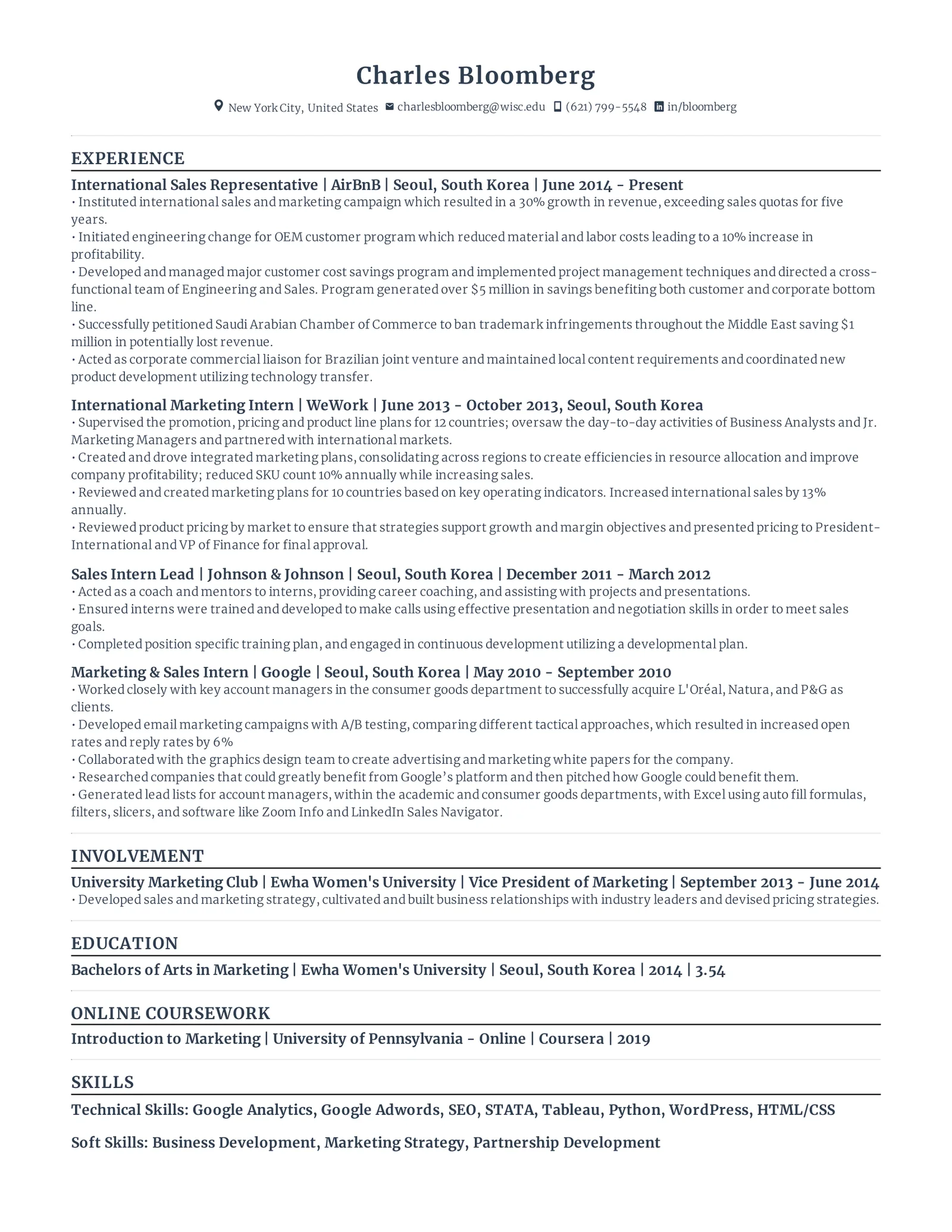
A strong sales resume proves you can sell. Instead of listing duties, it shows the numbers a sales manager uses to judge reps: quota attainment, revenue closed, average deal size, pipeline generated, win rate and where you ranked on the team.
Below are two complete sample resumes, one for an entry-level sales development representative (SDR) and one for an experienced account executive, followed by guidance on writing each section. All names, companies and figures in the examples are fictional, so replace them with your own results.
Sales resume examples
Pick the example closer to your level. The entry-level sample builds its case from an internship and part-time jobs. The experienced sample leads with closed revenue and a multi-year quota record.
Entry-level sales development representative resume example
Build your own sales resume
Summary
Marketing graduate of The Ohio State University (May 2026) applying for full-time sales development roles in B2B software. Booked 23 qualified meetings against an 18-meeting goal as a sales development intern, and ranked in the top 3 of 14 part-time associates at an outdoor retailer in 5 of the last 8 quarters. Works daily in Salesforce, Outreach and LinkedIn Sales Navigator.
Experience
Sales Development Intern, Fieldline Software, Columbus, OH Jan 2026 – May 2026 (20 hours a week)
- Booked 23 qualified meetings for account executives in 18 weeks, 128% of the internship goal of 18
- Sourced $310K in qualified pipeline; account executives had closed $42K of it in first-year contract value by the end of the internship
- Prospected HVAC and plumbing contractors with about 50 calls, emails and LinkedIn messages a day, using Outreach sequences and Sales Navigator searches filtered by trade, region and crew size
- Logged call notes and BANT qualification (budget, authority, need, timeline) in Salesforce for every handoff, so account executives could start discovery without repeating questions
Sales Associate, Trailhead Outfitters, Columbus, OH Aug 2022 – May 2026 (part-time)
- Sold footwear, camping and fitness gear, averaging $1,350 in weekly sales on 20-hour weeks
- Ranked in the top 3 of 14 part-time associates for sales in 5 of the last 8 quarters
- Opened 210 store credit accounts in 2025, 140% of the individual goal of 150
- Trained 4 seasonal hires on the store's boot-fitting process
Student Caller, University Annual Giving Call Center, Columbus, OH Sep 2023 – Dec 2024 (part-time)
- Made 60–80 calls per four-hour shift to alumni and secured 410 pledges totaling $46,000
- Finished in the top 10% of 50 callers for pledge dollars in fall 2024
Skills
Salesforce · Outreach · LinkedIn Sales Navigator · HubSpot CRM · Cold calling · Email prospecting · BANT qualification · Objection handling · Conversational Spanish
Education
B.S. in Business Administration, Marketing, The Ohio State University, May 2026
Member, student sales club; competed in two sales role-play competitions
Certifications
HubSpot Inbound Sales Certification, HubSpot Academy, 2025
Why this example works for an entry-level candidate:
- Every job has a number, including the part-time ones. Store rank and credit-account sign-ups show what an SDR manager checks: activity, conversion and performance against a goal.
- The pipeline bullet separates what Maya sourced ($310K) from what account executives closed ($42K). SDRs who present closed revenue as their own tend to get caught in interviews.
- The fundraising calls get their own entry because phone volume and pledges are direct evidence that she can handle cold calling.
- Education comes after experience because her sales results are stronger evidence than her degree. A graduate without sales-related jobs would move education up.
Experienced account executive resume example
Build your own sales resume
Summary
Mid-market account executive with seven years of closing experience in B2B software, selling finance and payroll tools to CFOs, controllers and business owners. Closed $2.4M in new annual recurring revenue (ARR) in FY2025 at 131% of quota, ranked 1st of 12 mid-market account executives and earned President's Club. Finished above annual quota in each of the last three fiscal years. Runs MEDDICC qualification on multi-stakeholder deals with three- to seven-month cycles.
Experience
Senior Account Executive, Mid-Market, Ledgerwise, Denver, CO Mar 2022 – Present
- Closed $2.4M in new ARR in FY2025, 131% of a $1.83M quota; ranked 1st of 12 mid-market account executives and earned President's Club
- Finished FY2023 at 117% and FY2024 at 108% of annual quota
- Raised average deal size from $38K to $61K in annual contract value by packaging multi-entity accounting for finance teams with three or more subsidiaries
- Lifted win rate on qualified opportunities from 22% to 31% over two years after applying MEDDICC to every deal above $50K and reviewing gaps weekly with the sales manager
- Signed a $410K three-year contract with a regional healthcare network, the company's largest deal at the time, after a seven-month cycle involving the CFO, controller, IT security and procurement
- Coached two account executives hired in 2025 through discovery practice and weekly deal reviews; both met their ramp targets
Account Executive, SMB, Brightcourt Payroll, Denver, CO Jan 2019 – Feb 2022
- Closed $910K in new ARR in 2021, 112% of quota; ranked 2nd of 15 SMB account executives
- Ran 10–12 demos a week from inbound HubSpot leads and closed an average of 9 new customers a month, with a 24-day average sales cycle
- Wrote a discovery checklist based on SPIN questions that the SMB team adopted for new-hire onboarding
Sales Development Representative, Brightcourt Payroll, Denver, CO Dec 2017 – Dec 2018
- Booked 115% of meeting quota in 2018 and was promoted to account executive after 13 months
Skills
Salesforce · HubSpot · Gong · LinkedIn Sales Navigator · MEDDICC · Challenger selling · Multi-threading · Negotiation with procurement · Forecasting
Education
B.S. in Business Administration, Marketing, Colorado State University, 2017
Awards
President's Club, Ledgerwise, FY2025
Why this example works for an experienced closer:
- The quota bullet gives the percentage and the dollar quota, so a reader can judge the size of the result. Together with the next bullet, it shows three years of attainment, which answers the question every sales manager asks: was this a single good year?
- Deal size, win rate and the largest deal show how Daniel sells, not just how much: bigger packages, tighter qualification and a long cycle with several buyers.
- The SDR job gets one line. An early role only needs enough detail to show the promotion.
- MEDDICC appears in the summary, a bullet and the skills list, so the methodology is backed by a result.
For more closing-role variations, see these account executive resume examples.
How to write a sales resume
Work in this order. Gathering your numbers first keeps you from writing vague bullets that you'll have to redo.
- Pull your numbers. For every sales role, collect quota attainment, closed revenue, deal sizes, pipeline and win rates from your CRM, commission statements or performance reviews.
- Read the job posting. Note the sales motion (inbound or outbound, SMB or enterprise, B2B or B2C), the tools it names and the metrics it mentions. These decide which of your numbers go first.
- Use reverse-chronological order, with your most recent job first.
- Write the header: your name, a job title that matches the role you want, city and state, phone, a professional email and your LinkedIn URL. Leave out your street address, photo and date of birth.
- Write a two- or three-sentence summary that includes your two best numbers.
- Write three to six bullets for each recent role, most of them with a number. Older roles need fewer.
- Add six to 10 skills from the posting that you can back up.
- Add education, certifications and awards.
- Edit to one page, or two if you have more than about 10 years of relevant experience. Proofread, then save a PDF named with your name, such as Maya-Delgado-Resume.pdf.
Write a sales resume summary
A summary is two or three sentences under your header that state your sales role, the market you sell into and your best results. Use one if you have sales experience. If you're entry-level or changing careers, write a short objective-style summary that names the role you want and your closest proof, as Maya's resume does.
A weak summary could belong to anyone: "Results-driven sales professional with excellent communication skills seeking a challenging role at a growth-oriented company." It names no market, no product and no result.
A strong summary names what you sell, who you sell to and your best numbers. These two cover situations the sample resumes don't.
Outside B2B sales representative with a field territory
Outside sales representative with five years selling industrial safety equipment to manufacturers in Ohio and Michigan. Grew a 120-account territory from $1.8M to $2.4M in annual revenue and finished 2025 at 114% of quota, 2nd of 9 reps. Runs SPIN-style discovery during plant walk-throughs to tie recommendations to each site's incident records.
Territory growth in dollars matters more to field sales managers than activity counts, and naming the region tells them you already know the accounts.
B2C salesperson moving into inside B2B sales
Automotive sales consultant with four years at a high-volume dealership, averaging 14 vehicles a month and ranking in the top 3 of 16 salespeople in 2025. Qualifies buyers quickly, negotiates price and financing, and tracks every follow-up in the dealership CRM. Applying for inside sales roles where the same skills drive short-cycle B2B deals.
This summary translates retail selling into terms a B2B manager recognizes (qualification, negotiation and CRM follow-up) without pretending the experience was B2B.
Write work experience bullets with sales numbers
Sales managers read your experience section looking for numbers they recognize from their own dashboards. Start each bullet with an action verb, put the number in the first half of the line and add the context that makes it meaningful. A reliable pattern is action + number + context: "Closed $1.4M in new ARR across 23 mid-market accounts in 2025."
These are the numbers that carry the most weight:
- Quota attainment: your percentage of quota, with the quota amount or period.
- Revenue closed: new ARR, bookings or total sales for a stated period.
- Deal size: your average contract value, or your largest deal and who signed it.
- Pipeline generated: the main SDR and BDR measure. State what you sourced and, if you know it, what closed.
- Win rate and sales cycle: how efficiently you turn qualified opportunities into customers.
- Ranking and recognition: your position on the team, such as "2nd of 15," and awards such as President's Club.
- Activity: calls, emails or meetings. These help SDRs, but pair them with an outcome.
Use numbers you could show from a CRM report, commission statement or performance review, because interviewers ask how you got them. Give the base (quota amount, team size or time period) so a percentage means something. Write "sourced," "contributed to" or "co-sold with" when a result was shared. If your employer's revenue figures are confidential, use percentages and rankings instead of dollar amounts.
| Duty-style bullet | Results-style bullet |
|---|---|
| Responsible for prospecting new accounts | Booked 127% of meeting quota by prospecting 80 accounts a week across phone, email and LinkedIn |
| Managed a territory | Grew a 140-account territory in Ohio and Indiana from $2.2M to $2.7M in annual revenue (+23%) in two years |
| Helped customers find products | Helped 40–60 customers per shift and opened 35 loyalty accounts a month, 125% of the store goal |
| Worked with the team to close deals | Co-sold 12 enterprise evaluations with a solutions engineer; closed 5, worth $780K in first-year revenue |
The examples below are grouped by the kind of number they use. Start with the group that matches what you can prove, then swap in your own figures, products and buyers.
Quota attainment and team ranking
Annual quota (account executive)
- Finished FY2025 at 126% of a $1.2M new-business quota, ranked 2nd of 18 account executives in North America
Include the quota amount so a reviewer can judge the size of the result.
Meeting quota (SDR)
- Booked an average of 38 qualified meetings per quarter against a 30-meeting quota (127%) for six consecutive quarters
Several quarters in a row is stronger evidence than one standout month.
President's Club
- Earned President's Club in 2024 (top 8% of a 140-person sales team) after closing $3.1M against a $2.5M quota
Club criteria differ between companies, so say what earned it.
Regional ranking (field sales)
- Ranked 1st of 11 territory managers in the Midwest region for 2025 revenue growth, up 19% year over year
If your team ranks reps by growth rather than total revenue, name the measure.
Team quota (SDR team lead)
- Led a team of 8 SDRs to 112% of combined meeting quota in 2025; three reps were promoted to account executive
First-time managers should show both the team's result and the people they developed.
Revenue closed and deal size
New revenue
- Closed $1.4M in new annual recurring revenue across 23 mid-market accounts in 2025
The account count shows whether the revenue came from steady closing or one large deal.
Average deal size
- Increased average contract value from $18K to $27K by attaching implementation services and a second product to 60% of new deals
Explain how you raised it, so the result reads as your skill rather than a price increase.
Largest deal
- Signed a $340K, three-year agreement with a 1,200-bed hospital system, the largest new-customer deal in the region that year
Describing the buyer tells the reader how complex the deal was.
New territory (outside sales)
- Opened 17 new distributor accounts in a previously uncovered western Pennsylvania territory within 12 months, adding $640K in first-year revenue
For field roles, the starting point ("previously uncovered") is part of the result.
Expansion and renewals
- Grew a book of 45 existing accounts by $620K through upsells and renewals, with 96% gross revenue retention
This fits account management roles; see these account manager resume examples for more.
Pipeline and prospecting activity
Pipeline sourced
- Sourced $2.6M in qualified pipeline in 2025; account executives converted $540K of it to closed-won revenue
Report what closed only if you can find it in the CRM, and keep it separate from what you sourced.
New market prospecting
- Built a 1,500-contact target list in LinkedIn Sales Navigator for a new manufacturing vertical, producing 41 first meetings in 90 days
A new segment shows you can prospect without an established playbook.
Email reply rate
- Raised cold-email reply rate from 3% to 7% by rewriting a five-step Outreach sequence around one industry-specific problem
Before-and-after rates are easy to pull from sales engagement tools.
Meeting show rate
- Held a 78% meeting show rate, against a 65% team average, by sending agendas and confirming each meeting a day ahead
Comparing yourself with the team average works when you don't have a ranking.
Win rate and sales cycle
Win rate
- Improved win rate on qualified opportunities from 24% to 33% over four quarters by adding a mutual close plan to every deal above $40K
Name the stage you measure from, because win rates from first call and from qualified opportunity are very different.
Inbound conversion (inside sales)
- Converted 31% of inbound demo requests to paid accounts in 2025, compared with a team average of 24%
Inside sales managers look for conversion on leads you didn't have to find yourself.
Sales cycle
- Shortened the average sales cycle from 74 to 52 days by starting security review at the second meeting instead of after the proposal
A faster cycle with the cause named shows you understand how your buyers make decisions.
Win-back campaign
- Won back 9 of 20 churned customers in a structured win-back campaign, recovering $180K in annual revenue
Give both numbers (9 of 20) rather than a percentage alone when the group is small.
Retail, hospitality and service jobs
Retail sales against target
- Averaged $2,100 in weekly sales in 2025, 118% of the store's per-associate target, and ranked in the top 3 of 12 associates in 3 of 4 quarters
Store targets and rankings usually appear in weekly sales reports or reviews.
Restaurant upselling
- Raised average check by 14% over six months by recommending pairings and add-ons across a 30-table section
Average check is a sales number, and point-of-sale reports track it by server.
Call center retention and upgrades
- Converted 22% of retention calls into plan upgrades, versus a 15% team average
Upgrades and saves show you can change a customer's decision on the phone.
Car sales (B2C)
- Sold an average of 14 vehicles a month in 2025 with a 4.9 out of 5 customer satisfaction score across 160 surveys
Pairing volume with satisfaction answers the worry that high-volume sellers push too hard.
If you have the numbers but struggle with the wording, Resume Build can suggest role-specific bullet points for you to edit with your own figures.
Frame B2B and B2C sales experience
The same skills read differently depending on who buys. Lead with the metrics that the hiring manager's own team tracks.
B2B sales (selling to businesses): managers look for deal size, sales cycle length, the number and seniority of stakeholders, and recurring revenue. Name the buyer, such as "controllers at companies with 200 to 1,000 employees," and the cycle, such as "four-month average."
B2C sales (selling to consumers): managers look for volume, conversion rate, average transaction value, add-on sales and customer satisfaction scores.
When you move from B2C to B2B, keep your B2C numbers and add the skills that carry over: qualification, negotiation and follow-up tracked in a CRM. When you move from B2B to B2C, put volume and speed first. A B2C manager may care more that you closed nine deals a month than that one deal took seven months.
Turn retail or service experience into sales experience
Retail, restaurant and call-center jobs involve selling, and they produce numbers you can find in point-of-sale reports, shift reports or performance reviews:
- sales per hour, shift or week against a target
- conversion rate, add-on rate, or average ticket or check
- credit card, loyalty or membership sign-ups against a goal
- upgrades, renewals or saves on customer calls
- your rank among associates and any sales awards
Keep your real job title and write the bullets about the selling. "Sales Associate" with a ranked weekly sales figure is more credible than a retitled role. Then add one sign that you've prepared for the new kind of selling, such as a CRM certification, a sales internship or a role-play competition. Maya's resume pairs her retail rank with an SDR internship in this way.
Sales skills to list on your resume
Pick six to 10 skills that appear in the job posting and that you could discuss in an interview. A tool or methodology is more convincing when one of your experience bullets shows it producing a result. For broader advice on hard and soft skills, see our guide to resume skills.
Communication, empathy and persistence matter in sales, but on their own they're claims. Leave them out of the skills list unless the posting names them, and let your bullets show them instead.
CRM and sales tools
Salesforce: the CRM many B2B sales teams use for pipeline tracking and forecasting. To prove it, mention reports or dashboards you built or kept current.
HubSpot: a CRM and marketing platform often used for inbound leads at smaller and mid-size companies. To prove it, give the inbound volume you worked or the sequences you ran.
Outreach or Salesloft: sales engagement tools that run multi-step email and call sequences. To prove it, cite reply or meeting rates from sequences you wrote.
LinkedIn Sales Navigator: LinkedIn's prospecting tool for building account and lead lists. To prove it, count the meetings that came from lists you built.
Gong: conversation intelligence software that records and analyzes sales calls. To prove it, describe a change you made after reviewing calls and what it improved.
Sales methodologies
List a methodology only if your team actually used it. Interviewers often ask you to walk through a recent deal using it.
MEDDICC: a qualification framework for complex B2B deals covering metrics, economic buyer, decision criteria, decision process, paper process, identified pain, champion and competition. To prove it, show forecast accuracy or win rate after you applied it.
SPIN Selling: a discovery approach built on situation, problem, implication and need-payoff questions. To prove it, describe a discovery process you used or taught.
Challenger Sale: an approach in which the rep teaches the buyer something new about their business, tailors the message to each stakeholder and takes control of the conversation. To prove it, name an insight-led pitch that won a deal.
BANT: basic qualification on budget, authority, need and timeline, common in SDR handoffs. To prove it, give the share of your meetings that account executives accepted.
Selling skills
Cold calling and prospecting: show your daily volume and the meetings it produced.
Discovery: show how better questions changed deal size or win rate.
Negotiation: show the discount levels you held, the multi-year terms you secured or the procurement processes you managed.
Pipeline management and forecasting: show your forecast accuracy or pipeline coverage.
Account expansion: show upsell revenue or net revenue retention.
Product demos and presentations: show your demo-to-close rate or the audiences you presented to.
Territory planning: show how you prioritized accounts and which ones grew.
Education, certifications and awards
List your highest degree with the school and graduation year. Most sales roles don't require a particular major, and if you graduated more than about 10 years ago, you can leave off the year. Recent graduates can add a sales club, a sales program or role-play competitions, as in the entry-level example.
Add certifications and training you completed, such as a HubSpot Academy certification or a company-run methodology course. Leave off anything you started but didn't finish.
President's Club, top-performer awards and team rankings can appear twice: in the bullet for the year you earned them and on an Awards line, as in the account executive example.
Format a sales resume for recruiters and applicant tracking systems
- Use reverse-chronological order. It shows your quota record year by year. A functional format groups skills instead of jobs and hides the timeline that sales managers want to check. A hybrid format can help if you're changing careers, as long as your dates stay visible.
- Keep it to one page unless you have more than about 10 years of relevant experience. In that case, two pages is fine. Give older roles one or two lines.
- Use a standard font such as Arial, Calibri or Georgia at 10 to 12 points, with plain section headings such as Summary, Experience, Skills and Education.
- Keep key numbers out of charts, images and text boxes. Text inside a graphic may not be read or searched as text by applicant tracking systems (ATS), so a recruiter's search for your results could miss it.
- Save it as a PDF with your name in the file name, unless the posting asks for a Word document.
If you'd like help with layout, Resume Build offers ATS-aware templates and can tailor a draft to a specific job description before you export it as a PDF.
Common sales resume mistakes
- Listing duties instead of results. "Managed a territory" says what you were assigned, not how you performed.
- Giving percentages without a base. "150% of quota" means little without the quota amount or the period.
- Claiming team results as your own. If revenue came from a team effort, state your share.
- Listing tools or methodologies you can't discuss. You may be asked to walk through a deal using MEDDICC or explain how you built a Sales Navigator list.
- Dropping a weak year without a trace. You don't have to report a year's quota percentage, but keep the job and dates, and use another honest measure such as rank or new customers.
- Writing a generic summary. If it could appear on anyone's resume, replace it with your market and your best numbers.
- Including too many old jobs. Two to four relevant roles are usually enough. Summarize or remove the rest.
- Sending the same resume everywhere. Reorder your bullets and skills so the metrics the posting mentions come first.
Some results need more room than a bullet allows, such as how you won a difficult deal. Put that story in your cover letter, and use these cover letter tips for structure and tone.
Build a sales resume from guided prompts and tailor it to each job posting.