Software Engineer Resume Examples & Templates
A comprehensive guide to writing a software engineer resume that passes ATS filters, impresses hiring managers, and lands interviews — with worked examples for every experience level.





How to Write a Software Engineer Resume That Actually Gets Interviews
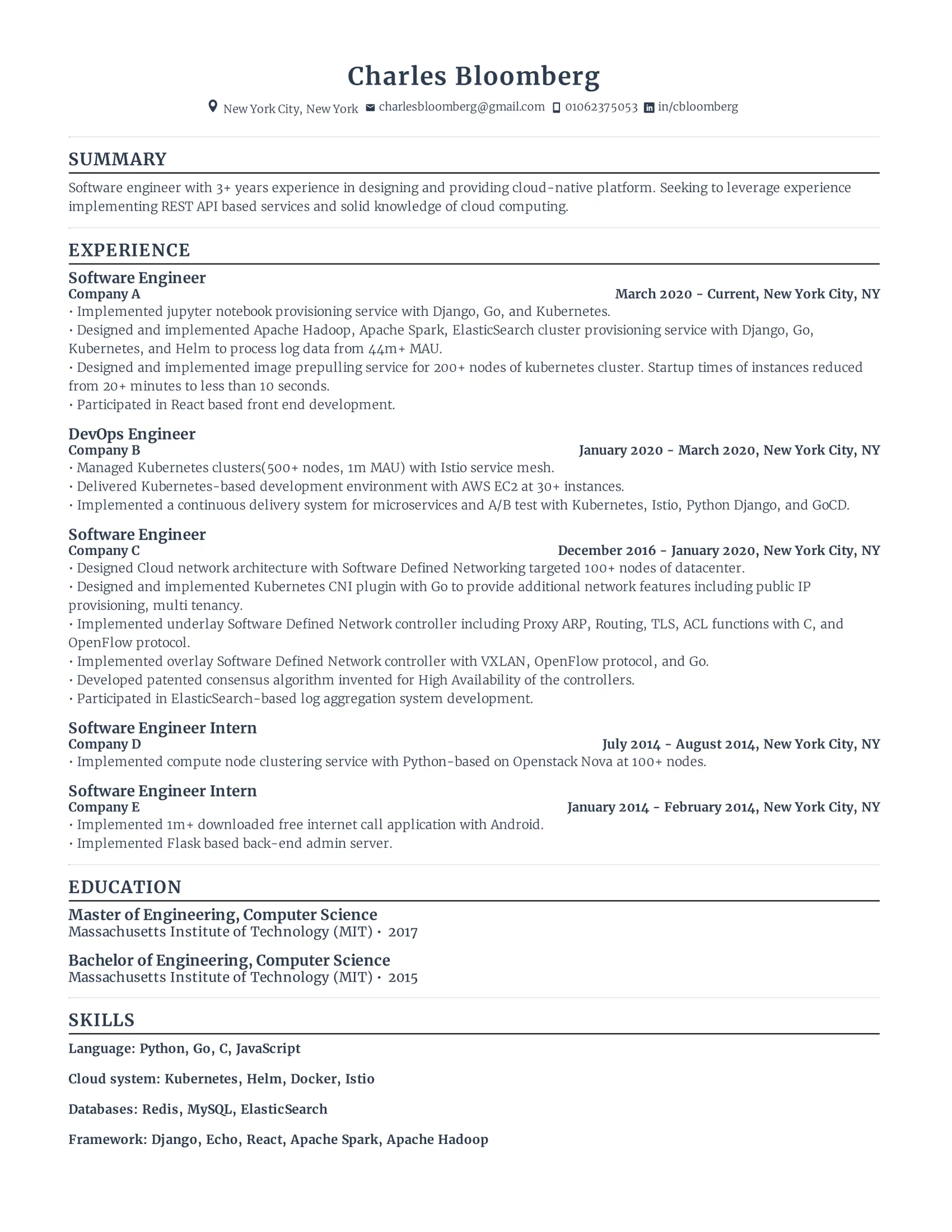
Your software engineer resume is the single most important document in your job search. It has roughly six seconds to convince a recruiter to keep reading — and before it even reaches human eyes, it must survive an Applicant Tracking System (ATS) that scans for keywords, structure, and formatting compliance. Whether you are a new graduate applying to your first role, a mid-level engineer targeting FAANG, or a senior architect looking for a staff-level position, the fundamentals are the same: clarity, specificity, and measurable impact. This guide walks you through every section of a winning software engineer resume, explains how to beat ATS filters, shows you what skills and tools to highlight, and gives you real worked examples at every level so you can see exactly what a strong resume looks like in practice.
Make this resume your own with ResumeBuild.
PROFESSIONAL SUMMARY
Detail-oriented Full-Stack Software Engineer with 5+ years of experience designing and deploying scalable web applications across the entire stack. Proficient in modern JavaScript frameworks, RESTful API architecture, and cloud-based infrastructure with a strong track record of delivering high-performance products in agile environments.
PROFESSIONAL Experience
Software Engineer II | Company A
March 2022 — Present, Austin, USA
- Engineered and deployed 3 major full-stack features using React.js, Node.js, and GraphQL, reducing average page load time by 38% across 12 high-traffic merchant-facing dashboard views.
- Optimized PostgreSQL query performance for 15+ complex relational data models, cutting average API response time from 420ms to 95ms and improving throughput by 2.4x under peak load.
- Developed RESTful microservices in Ruby on Rails consumed by 4 downstream internal teams, processing over 1.2 million daily transactions with 99.97% uptime via AWS ECS and Docker containerization.
- Collaborated within a 9-person agile squad using Jira and GitHub Actions CI/CD pipelines, maintaining a sprint velocity increase of 22% over 6 consecutive quarters through iterative code reviews and pair programming.
- Implemented end-to-end test coverage using Jest and Cypress across 40+ React components, raising overall code coverage from 61% to 94% and reducing production bug reports by 47% within 2 release cycles.
Software Engineer | Company B
July 2019 — February 2022, Boston, USA
- Built and maintained 8 customer-facing web application modules using Vue.js and Java Spring Boot, supporting over 85,000 active CRM users and achieving a 99.9% SLA for uptime across all production environments.
- Designed and integrated 20+ RESTful API endpoints connected to a MySQL database, enabling real-time data synchronization between front-end dashboards and back-end analytics pipelines processing 500K+ records daily.
- Launched a reusable React component library of 30+ UI elements adopted across 5 internal product teams, reducing front-end development time for new feature builds by an average of 35% per sprint.
- Drove migration of legacy monolithic architecture to a containerized microservices model using Docker and Kubernetes, reducing deployment frequency from bi-weekly to daily and decreasing rollback incidents by 60%.
Junior Web Developer | Company C
January 2018 — June 2019, Nashville, USA
- Developed 12 responsive client-facing websites using HTML5, CSS3, JavaScript ES6, and WordPress, reducing average client delivery time by 3 weeks through reusable templating and modular SCSS component architecture.
- Maintained and refactored a PHP/Laravel back-end codebase spanning 18,000+ lines, resolving 60+ legacy bugs and improving application stability scores from 72% to 91% over a 6-month remediation effort.
- Assisted in integrating third-party APIs including Stripe, Twilio, and Google Maps across 5 client projects, enabling automated payment processing and real-time geolocation features for 3,200+ end users.
Web Development Intern | Company D
May 2017 — December 2017, Nashville, USA
- Produced 9 static landing pages using HTML, CSS, and vanilla JavaScript for digital marketing campaigns, contributing to a 21% increase in lead capture conversion rates measured over a 90-day A/B testing period.
- Researched and implemented SEO best practices across 14 web properties, improving average Google Search ranking by 11 positions and increasing organic traffic by 34% within 4 months of deployment.
- Tracked and resolved 35+ front-end UI bugs using Chrome DevTools and cross-browser testing across 6 environments including Chrome, Firefox, Safari, and Edge, ensuring consistent rendering fidelity for all client deliverables.
Education
Bachelor of Science in Computer Science | University of Texas at Austin
May 2017
Expert-Level Skills
JavaScript (ES6+), TypeScript, React.js, Vue.js, Node.js, Ruby on Rails, Java Spring Boot, PHP/Laravel, HTML5, CSS3/SCSS, GraphQL, RESTful API Design, PostgreSQL, MySQL, MongoDB, Docker, Kubernetes, AWS (ECS, S3, Lambda), CI/CD (GitHub Actions, Jenkins), Jest, Cypress, Git, Agile/Scrum, Jira, Problem Solving, Cross-functional Collaboration
A mid-level full-stack software engineer resume showing how to balance technical breadth with quantified impact across both front-end and back-end projects.
Understand the Real Goal of Your Resume
Most engineers approach their resume as a career history document — a chronological list of jobs and responsibilities. That framing is wrong, and it costs interviews. Your resume is a marketing document with one job: earn a 30-minute phone screen. Everything on the page should serve that goal. That means ruthlessly cutting anything that does not signal value to the specific employer you are targeting, and amplifying everything that does.
Before you write a single bullet point, ask yourself three questions: What problem does this company need a software engineer to solve? What evidence in my background proves I can solve it? How do I make that evidence impossible to miss in a six-second scan? The answers shape every decision that follows — which projects to feature, which skills to list first, which metrics to surface, and how much space to give each role.
A secondary goal is passing the ATS. Most companies with more than 50 employees use an ATS (Greenhouse, Lever, Workday, iCIMS, Taleo) to parse and rank applications before a human sees them. A beautifully designed resume with graphics, columns, and custom fonts can score zero in an ATS because the parser cannot read it. We will cover ATS-safe formatting in detail below.
Choose the Right Format and Template
For the vast majority of software engineers, a reverse-chronological single-column layout is the correct choice. It is the most ATS-compatible structure, the most familiar to recruiters, and the easiest to scan. Avoid two-column layouts, tables, text boxes, headers and footers (ATS parsers often skip them), and embedded graphics.
If you want a polished starting point, several formats work well depending on your workflow:
- Software Engineer resume template Word: Microsoft Word's built-in templates are ATS-safe if you choose simple single-column designs. Avoid the fancy "Modern" templates with sidebars.
- Software Engineer resume — Overleaf: LaTeX via Overleaf produces crisp, professional PDFs and is popular in academic and research-adjacent engineering roles. The Jake's Resume template on Overleaf is a community favorite. Export as PDF and confirm the text is selectable (not image-rendered).
- Software Engineer resume PDF: Always submit as PDF unless the job posting explicitly requests .docx. PDF preserves formatting across operating systems and prevents accidental edits. Modern ATS systems parse PDF text reliably as long as you avoid image-based PDFs.
Font choice: use 10–12pt for body text, 14–16pt for your name. Stick to fonts that render cleanly on screen and in print: Calibri, Garamond, Georgia, or Helvetica. Margins of 0.5–1 inch give you breathing room without wasting space. Keep the resume to one page if you have under ten years of experience; two pages are acceptable for senior engineers with genuinely distinct, relevant roles to show.
Writing a Compelling Professional Summary
The professional summary sits at the top of your resume, directly below your contact information, and it is the highest-value real estate on the page. Three to four sentences is the sweet spot. Lead with your title and years of experience, name your core technical domain, and close with one or two concrete achievements or differentiators.
A weak summary reads: "Motivated software engineer with experience in various technologies looking for a challenging role." That sentence could describe 500,000 people and says nothing.
A strong summary reads: "Full-stack software engineer with 5 years of experience building high-traffic consumer applications in React and Node.js. Reduced API response latency by 40% at Acme Corp by migrating a monolithic Express service to a microservices architecture on AWS. Passionate about developer experience and maintainable systems at scale."
Notice the specificity: a number (5 years), named technologies (React, Node.js), a quantified achievement (40% latency reduction), a named employer, and a forward-looking value statement. Every word earns its place. Tailor this section for every application — swap in the job title from the posting, mirror the company's language, and lead with the skills they listed first in the job description.
How to Write Experience Bullets That Stand Out
The work experience section is where most software engineer resumes fail. Engineers tend to write job descriptions ("Responsible for maintaining the backend API") instead of achievement statements ("Refactored the legacy REST API from Flask to FastAPI, cutting average response time from 320ms to 85ms and reducing infrastructure costs by $14K/year"). The difference is the difference between a rejection and a callback.
Use the Action → Technology → Result formula for every bullet:
- Action: Start with a strong past-tense verb — Architected, Engineered, Optimized, Reduced, Shipped, Migrated, Automated, Mentored, Designed.
- Technology: Name the specific tool, language, or framework. "Built a caching layer" is weak. "Implemented a Redis-based caching layer integrated with Django REST Framework" is specific and keyword-rich.
- Result: Quantify wherever possible. Metrics that resonate with engineering hiring managers include: latency (ms, p99), throughput (requests/sec, events/day), uptime/reliability (99.9% SLA), cost savings ($, %), deployment frequency, test coverage (%), team size mentored, or user/revenue impact.
If you genuinely cannot quantify a result, describe the scope and scale: "Maintained authentication service handling 2M daily active users" conveys impact without a percentage. Aim for 4–6 bullets per role for recent positions, 2–3 for older ones.
Real example bullets at different levels:
- Entry-level: "Developed a React dashboard for internal analytics, reducing manual reporting time by 3 hours/week for the data team."
- Mid-level: "Led migration of CI/CD pipeline from Jenkins to GitHub Actions, cutting build times by 35% and eliminating 8 hours/month of manual maintenance."
- Senior: "Architected a distributed event-driven system using Apache Kafka and Kubernetes that processes 50M events/day at sub-100ms p99 latency, enabling real-time fraud detection across 12 product lines."
Make this resume your own with ResumeBuild.
PROFESSIONAL SUMMARY
Detail-oriented backend software engineer with hands-on experience building scalable RESTful APIs, microservices architectures, and cloud-integrated systems using Python, Java, and Node.js. Passionate about writing clean, efficient code and optimizing database performance across relational and NoSQL environments.
PROFESSIONAL Experience
Backend Software Engineer | Company A
March 2023 — Present, Austin, USA
- Engineered 12+ RESTful API endpoints using Python (FastAPI) to support payment processing workflows, reducing average response latency by 34% through async request handling and connection pooling optimization.
- Developed and maintained microservices deployed on AWS Lambda and ECS, processing over 2.5 million daily transactions with 99.97% uptime across production environments.
- Optimized PostgreSQL query performance across 8 high-traffic database tables by implementing composite indexing strategies, reducing query execution time by an average of 47ms per call.
- Collaborated with 4 cross-functional engineering squads to design and document 3 internal gRPC service contracts, standardizing inter-service communication protocols used across 6 backend systems.
- Implemented automated unit and integration test suites using pytest and GitHub Actions CI/CD pipelines, achieving 91% code coverage across 15+ newly deployed backend modules.
Junior Backend Developer | Company B
July 2021 — February 2023, Denver, USA
- Built and deployed 7 Node.js-based microservices on Google Cloud Platform (Cloud Run), handling upwards of 500,000 webhook events per day with sub-200ms processing time.
- Designed MongoDB schema architecture for a messaging metadata system storing over 18 million documents, improving write throughput by 28% through strategic denormalization and indexing.
- Maintained and refactored a legacy Java Spring Boot codebase spanning 40,000+ lines, reducing technical debt by eliminating 3 deprecated API dependencies and improving build times by 22%.
- Tracked and resolved 60+ bug tickets within a 6-month sprint cycle using Jira, consistently maintaining a ticket resolution rate 15% above team average.
Backend Developer Intern | Company C
January 2021 — June 2021, Denver, USA
- Developed a Python Django REST API for an internal employee scheduling tool used by 200+ staff members, reducing manual scheduling conflicts by approximately 40% within the first month of deployment.
- Researched and integrated Redis caching layer into 4 high-frequency data endpoints, decreasing database load by 31% and improving endpoint response times from an average of 620ms to 190ms.
- Assisted senior engineers in migrating 3 on-premise backend services to AWS EC2 instances, contributing to a 20% reduction in monthly infrastructure costs.
Software Development Intern | Company D
May 2020 — December 2020, Austin, USA
- Produced 5 SQL Server stored procedures and 3 scheduled ETL pipeline scripts using Python, automating weekly data aggregation tasks that previously required 6+ hours of manual processing.
- Implemented input validation and JWT-based authentication middleware across 9 API routes in an Express.js application, reducing unauthorized access incidents to zero over a 7-month monitoring period.
- Collaborated with a 3-person development team to launch a client-facing reporting dashboard backed by a Node.js API, delivering the project 2 weeks ahead of a 10-week deadline.
Education
Bachelor of Science in Computer Science | University of Texas at Austin
May 2020
Expert-Level Skills
Python, Java, Node.js, FastAPI, Django, Spring Boot, Express.js, RESTful API Design, gRPC, Microservices Architecture, PostgreSQL, MongoDB, Redis, MySQL, SQL Server, AWS (Lambda, EC2, ECS), Google Cloud Platform (Cloud Run), Docker, Kubernetes, CI/CD (GitHub Actions, Jenkins), Git, Linux/Bash, pytest, JWT Authentication, ETL Pipelines, Agile/Scrum, Jira, Technical Documentation, Cross-functional Collaboration
An entry-level backend software engineer resume demonstrating how to leverage internships, academic projects, and open-source contributions when professional experience is limited.
Software Engineer Resume Skills Section: Be Precise
The skills section serves two purposes: it feeds ATS keyword matching and it gives a recruiter a fast snapshot of your technical stack. The most common mistake is listing every technology you have ever touched, creating a wall of text that signals nothing. The second most common mistake is being so selective that you omit keywords the ATS is scanning for.
Organize skills into logical categories rather than a single comma-separated list:
- Languages: Python, TypeScript, Go, Java, Rust, SQL
- Frameworks & Libraries: React, Next.js, FastAPI, Spring Boot, gRPC
- Cloud & Infrastructure: AWS (EC2, Lambda, RDS, S3), GCP, Terraform, Docker, Kubernetes
- Data & Messaging: PostgreSQL, Redis, Apache Kafka, Elasticsearch
- Tools & Practices: Git, GitHub Actions, Datadog, Jira, Agile/Scrum, TDD
Only list technologies you can speak to in an interview. If you put "Kubernetes" on your resume, expect a question about pod scheduling, resource limits, or Helm charts. A good rule: if you have used it professionally or in a substantial personal project in the last three years, include it. If you did a two-hour tutorial two years ago, leave it off.
Mirror the exact terminology from the job description. If the posting says "React.js" rather than "React," use "React.js" — ATS keyword matching is often literal. If it says "CI/CD pipelines" and you have that experience, use that exact phrase somewhere in your bullets or skills section.
Education, Certifications, and GitHub/LinkedIn
For software engineers, education is typically listed after experience (unless you are a new graduate, in which case it goes first). Include your degree, institution, graduation year, and GPA only if it is 3.5 or above and you graduated within the last three years. Relevant coursework (Distributed Systems, Algorithms, Machine Learning) is worth listing for new graduates; omit it once you have two or more years of professional experience.
Certifications carry real weight in certain domains. AWS Certified Solutions Architect, Google Cloud Professional Data Engineer, CKA (Certified Kubernetes Administrator), and HashiCorp Terraform Associate are all recognized by hiring managers and ATS systems. List them with the issuing body and expiration date if applicable.
Your contact header should include:
- Software Engineer resume GitHub: Link to your GitHub profile, especially if it contains pinned repositories that demonstrate relevant work. A well-maintained GitHub with READMEs, commit history, and live demos is a meaningful signal for engineering roles.
- Software Engineer resume LinkedIn: Include your LinkedIn URL (customize it to linkedin.com/in/yourname). Recruiters will check it; make sure the profile is consistent with your resume and has recommendations from colleagues or managers.
- Personal portfolio or technical blog URL if it demonstrates relevant expertise.
One note on the Software Engineer resume Reddit community (r/cscareerquestions and r/ExperiencedDevs): these communities offer genuine peer feedback on resumes and are worth consulting. Common advice from experienced engineers there aligns with what we cover here — quantify impact, cut the objective statement, and keep it to one page. Take individual feedback with a grain of salt, but patterns across many comments are usually reliable.
Make this resume your own with ResumeBuild.
PROFESSIONAL SUMMARY
Senior Software Engineer with 10+ years of experience architecting and scaling distributed systems and platform infrastructure across high-throughput production environments. Proven track record of designing fault-tolerant, cloud-native platforms that accelerate engineering velocity and reduce operational overhead at scale.
PROFESSIONAL Experience
Senior Software Engineer, Platform Engineering | Company A
March 2021 — Present, San Francisco, USA
- Architected a multi-region distributed task scheduling platform using Apache Kafka and Kubernetes, reducing job latency by 43% across 12 globally distributed nodes serving over 2 billion daily events.
- Engineered a self-service internal developer platform (IDP) leveraging Backstage, Terraform, and ArgoCD, reducing new service onboarding time from 3 weeks to under 2 days for 200+ engineers.
- Spearheaded migration of 35 legacy monolithic services to a microservices architecture on AWS EKS, improving deployment frequency by 5x and reducing mean time to recovery (MTTR) from 47 minutes to under 9 minutes.
- Optimized distributed data pipeline throughput using Apache Flink and gRPC, achieving a 68% reduction in P99 latency for real-time payment fraud detection workflows processing 500K transactions per minute.
- Led a cross-functional team of 8 engineers in designing a service mesh implementation using Istio, enforcing mTLS across 150+ microservices and reducing unauthorized lateral traffic incidents by 91%.
Software Engineer II, Infrastructure | Company B
July 2018 — February 2021, Seattle, USA
- Developed a distributed rate-limiting framework using Redis Cluster and Envoy Proxy, protecting 80+ downstream APIs from traffic spikes exceeding 300K RPS during peak ride-demand windows.
- Implemented a Prometheus and Grafana-based observability stack across 60+ platform services, reducing mean time to detect (MTTD) production anomalies by 55% and cutting on-call alert noise by 38%.
- Designed a horizontally scalable event-sourcing system on Apache Cassandra with CQRS patterns, supporting 99.99% uptime SLAs across a dataset exceeding 4TB of transactional ride history.
- Collaborated with 5 product engineering teams to establish CI/CD pipeline standards using Jenkins and GitHub Actions, increasing deployment throughput from 12 to 60+ deploys per day organization-wide.
Software Engineer, Backend Systems | Company C
January 2016 — June 2018, Denver, USA
- Built a distributed caching layer using Memcached and consistent hashing across 8 nodes, reducing database read load by 72% and improving API response times from 340ms to under 80ms at peak traffic.
- Maintained and refactored a suite of 20+ internal Python and Go microservices, resolving 130+ legacy technical debt tickets over 18 months and improving overall test coverage from 41% to 87%.
- Produced comprehensive internal runbooks and architectural decision records (ADRs) for 15 core platform components, reducing incident escalation time by 30% and accelerating junior engineer ramp-up by 2 weeks.
Junior Software Engineer | Company D
June 2014 — December 2015, Columbus, USA
- Developed RESTful APIs in Java Spring Boot for a B2B SaaS platform serving 40+ enterprise clients, processing an average of 1.2 million API calls per day with sub-200ms response time targets.
- Assisted in provisioning and configuring AWS EC2, RDS, and S3 infrastructure using CloudFormation templates, reducing manual environment setup time by 65% across 3 staging and production environments.
- Tracked and resolved 200+ bug tickets in Jira over a 12-month period, maintaining a 96% on-time resolution rate while collaborating daily with QA and product teams in an Agile/Scrum workflow.
Education
Bachelor of Science in Computer Science | Purdue University
May 2014
Expert-Level Skills
Distributed Systems, Platform Engineering, Apache Kafka, Apache Flink, Apache Cassandra, Kubernetes (EKS/GKE), Docker, Terraform, ArgoCD, Istio, Envoy Proxy, gRPC, Redis Cluster, AWS (EC2, S3, RDS, EKS), GCP, Microservices Architecture, Event-Driven Architecture, CQRS, Event Sourcing, CI/CD (Jenkins, GitHub Actions), Prometheus, Grafana, Go, Python, Java, Spring Boot, Backstage IDP, Service Mesh, Infrastructure as Code (IaC), Site Reliability Engineering (SRE), System Design, Cross-Functional Collaboration, Technical Leadership
A senior software engineer resume focused on distributed systems and platform engineering, illustrating how to convey architectural scope, leadership, and cross-team impact at scale.
ATS Optimization: How to Beat the Bots Without Gaming the System
ATS optimization is not about stuffing keywords into white text or gaming algorithms — modern systems flag that behavior. It is about ensuring your genuine experience is described in the language the system and the hiring manager are looking for.
Practical ATS checklist for your software engineer resume:
- Use a standard section heading hierarchy: "Work Experience" not "Where I've Been," "Skills" not "My Toolkit."
- Avoid headers and footers — many parsers skip them. Put your name and contact info in the main body.
- Do not use tables or text boxes. Use plain bullet points (•) rather than custom Unicode symbols.
- Save as a text-selectable PDF (not a scanned image). Test by copying and pasting the text — if it pastes cleanly, the ATS can read it.
- Include the exact job title from the posting somewhere in your summary or experience section.
- Spell out acronyms at least once: "Continuous Integration/Continuous Deployment (CI/CD)."
- Tailor the skills section to each application by adding keywords from the job description that you genuinely have experience with.
Use tools like Jobscan or Resume Worded to compare your resume against a specific job description and identify missing keywords before you apply. These tools parse your resume the same way an ATS does and give you a match score with specific gaps to address. This takes ten minutes and meaningfully improves your callback rate.
Tailoring Your Resume for Each Application
The single highest-ROI activity in your job search is tailoring your resume for each role rather than sending one generic document everywhere. This does not mean rewriting from scratch — it means making targeted edits in three places:
- Summary: Swap in the company name, the job title, and the top two or three skills from the posting. This takes two minutes and signals genuine interest.
- Skills section: Reorder categories so the most relevant stack appears first. If the role is backend-heavy, lead with languages and frameworks; if it is cloud-infrastructure-focused, lead with cloud and DevOps tools.
- Experience bullets: Identify the two or three bullets in your experience that most directly address the job's core requirements and move them to the top of each role's bullet list. Add any missing keywords that reflect real experience you have not yet surfaced.
For a Senior Software Engineer resume PDF targeting a staff or principal role, also consider adding a brief "Technical Leadership" or "Architecture" subsection under your most recent role to call out system design decisions, cross-team initiatives, or mentorship scope — these signals matter enormously for senior leveling decisions.
Common Mistakes That Kill Software Engineer Resumes
Even strong engineers make these errors repeatedly:
- Responsibilities instead of achievements: "Worked on the payments team" tells a recruiter nothing. "Reduced payment processing failures by 22% by implementing idempotency keys and retry logic in the Stripe integration" tells them everything.
- Listing every language you have ever touched: "HTML, CSS, JavaScript, Python, Java, C++, C, Assembly, MATLAB, R, Bash" suggests you know none of them well. Curate to your genuine strengths.
- Objective statements: "Seeking a challenging role where I can grow" wastes three lines and adds zero value. Replace with a targeted professional summary.
- Inconsistent tense: Use past tense for all previous roles, present tense only for your current position.
- No GitHub or portfolio link: For software engineers, a live GitHub profile with pinned, documented projects is a meaningful differentiator, especially at the entry and mid levels.
- Generic project descriptions: "Built a to-do app in React" is table stakes. "Built a collaborative task management app in React and Firebase with real-time sync, deployed on Vercel, used by 200+ users" shows scale, stack depth, and real-world deployment experience.
- Lying or inflating: Claiming proficiency in a language you barely know will surface immediately in a technical screen. Be honest about your level — "familiar with" versus "proficient in" is a meaningful distinction.
Make this resume your own with ResumeBuild.
PROFESSIONAL SUMMARY
Detail-oriented Machine Learning Engineer with hands-on experience building and deploying supervised and unsupervised learning models using Python, TensorFlow, and PyTorch. Passionate about leveraging data-driven solutions to solve complex, real-world problems at scale.
PROFESSIONAL Experience
Junior Machine Learning Engineer | Company A
March 2023 — Present, Austin, USA
- Engineered a binary text classification pipeline using BERT fine-tuning on a 120,000-sample NLP dataset, achieving a 94.3% F1-score and reducing manual triage time by 40% across 3 internal support teams.
- Developed and deployed 2 production-grade ML models via REST APIs using FastAPI and Docker containers on IBM Cloud, serving over 15,000 inference requests per day with sub-100ms average latency.
- Optimized a gradient-boosted XGBoost model by performing hyperparameter tuning across 200+ configurations using Optuna, improving AUC-ROC by 6.8% over the baseline across a 5-fold cross-validation framework.
- Collaborated with 4 cross-functional data engineering teams to build and maintain ETL pipelines in Apache Spark, processing over 500GB of raw structured and unstructured data weekly for model training workflows.
- Implemented MLflow experiment tracking across 12 active model development projects, standardizing reproducibility protocols and reducing model retraining overhead by approximately 25%.
Machine Learning Intern | Company B
June 2022 — February 2023, Santa Clara, USA
- Built a convolutional neural network (CNN) image classification model using PyTorch on a 60,000-image dataset, achieving 97.1% top-1 accuracy and reducing inference time by 30% through CUDA-accelerated GPU optimization.
- Researched and implemented 3 data augmentation strategies — including random cropping, Mixup, and CutOut — across training pipelines, improving model generalization on held-out test sets by 4.2% on average.
- Designed a feature engineering workflow in Python (Pandas, NumPy, Scikit-learn) that processed 8 million tabular records, reducing dimensionality by 35% via PCA while retaining over 98% of explained variance.
- Produced 6 internal technical documentation reports detailing model architecture decisions, training configurations, and evaluation benchmarks, accelerating onboarding time for 3 incoming intern cohorts.
Data Science Intern | Company C
January 2022 — May 2022, Denver, USA
- Developed an end-to-end regression model using Scikit-learn to forecast monthly customer churn across a 200,000-record CRM dataset, achieving an RMSE 18% lower than the existing rule-based heuristic system.
- Processed and cleaned over 1.2 million rows of raw transactional data using Python and SQL, resolving 14 distinct data quality issues including null imputation, outlier removal, and categorical encoding inconsistencies.
- Assisted in deploying a proof-of-concept recommendation engine using collaborative filtering on 50,000 user interaction records, increasing simulated click-through rate by 22% in A/B testing over a 6-week evaluation period.
Undergraduate Research Assistant | Company D
August 2020 — December 2021, Austin, USA
- Researched reinforcement learning (RL) algorithms including Q-Learning and PPO across 5 OpenAI Gym environments, logging over 300 training experiments and contributing findings to 2 internal lab publications.
- Maintained a shared Python codebase of 4,500+ lines across 3 active research projects using Git version control, enforcing code review standards that reduced integration bugs by approximately 30% over 6 months.
- Formulated and preprocessed a domain-specific sentiment analysis dataset of 18,000 labeled samples using spaCy and NLTK tokenization pipelines, enabling downstream model benchmarking across 4 transformer architectures.
Education
Bachelor of Science in Computer Science, Concentration in Artificial Intelligence | The University of Texas at Austin
May 2022
Expert-Level Skills
Python, PyTorch, TensorFlow, Scikit-learn, XGBoost, LightGBM, Keras, BERT, Transformers (HuggingFace), CNNs, RNNs, LSTMs, Reinforcement Learning, NLP, Computer Vision, MLflow, Apache Spark, SQL, FastAPI, Docker, REST APIs, CUDA, NumPy, Pandas, Optuna, PCA, A/B Testing, Git, IBM Cloud, AWS SageMaker, Data Preprocessing, Feature Engineering, Hyperparameter Tuning, Attention to Detail, Cross-functional Collaboration, Technical Communication
An entry-level ML/AI software engineer resume showing how to present research projects, Kaggle competitions, and relevant coursework alongside internship experience to break into the field.
Writing a Cover Letter That Complements Your Resume
A cover letter is not always required, but when it is, it should do work your resume cannot: explain a career transition, address a gap, or make a direct connection between your specific experience and the company's current technical challenges. Research the company's engineering blog, recent GitHub releases, or job description language and reference something specific — "I noticed your team recently migrated to a service mesh architecture; I led a similar Istio migration at my current employer and would love to discuss the tradeoffs we encountered."
Keep it to three short paragraphs: why this company and role specifically, your single most relevant achievement with a metric, and a clear call to action. Never repeat your resume bullet-for-bullet. The cover letter answers "why you, why us, why now" — the resume provides the evidence.
Frequently Asked Questions
How long should a software engineer resume be?
One page for engineers with fewer than ten years of experience; two pages are acceptable for senior engineers or those with genuinely distinct roles spanning a decade or more. Recruiters at high-volume companies spend an average of six seconds on an initial scan — a dense two-page resume from a mid-level engineer is almost always a mistake. When in doubt, cut it to one page by removing older roles (pre-2015 for most people), trimming bullets to the strongest three per role, and condensing the skills section.
What is the best format for a software engineer resume — PDF or Word?
Submit as a Software Engineer resume PDF unless the application system explicitly requests .docx. PDF preserves your formatting across all operating systems and prevents accidental edits. The one exception: some older ATS systems (particularly Taleo) parse .docx more reliably. If you are applying through an older enterprise portal and it accepts both, try PDF first; if you notice formatting issues in the preview, switch to .docx.
Should I include my GitHub profile on my software engineer resume?
Yes, absolutely — especially if your GitHub has pinned repositories with clean READMEs, meaningful commit history, and projects relevant to the roles you are targeting. A strong GitHub profile is one of the few ways to demonstrate coding ability before a technical screen. Make sure your pinned repos are documented well enough that a non-technical recruiter can understand what each project does and why it matters. A bare GitHub with no activity or private-only repositories adds no value, so either populate it or omit the link.
How do I write a software engineer resume with no experience?
Focus on three categories of experience that substitute for professional employment: academic projects (especially capstone or team projects), internships or co-ops (even short ones), and personal/open-source projects. For each, apply the same Action → Technology → Result formula you would use for a job. "Built a REST API in Flask and PostgreSQL for a course project that simulated a ride-sharing backend, handling concurrent bookings with optimistic locking" is a strong bullet even without a company name attached. Also include relevant coursework, hackathon placements, and any open-source contributions, however small.
What skills should I list on a software engineer resume?
List skills you can genuinely defend in a technical interview, organized into categories: programming languages, frameworks and libraries, cloud and infrastructure tools, databases, and engineering practices (TDD, CI/CD, Agile). Prioritize skills that appear in the job descriptions you are targeting. For software engineer resume skills, the most universally valued in 2024–2025 include: Python, TypeScript/JavaScript, Go or Java for backend roles; React or Vue for front-end; AWS or GCP for cloud; Docker and Kubernetes for infrastructure; and SQL plus at least one NoSQL database. System design knowledge (distributed systems, CAP theorem, caching strategies) is critical for mid-level and above but belongs in your experience bullets rather than a skills list.
How do I tailor my resume for a senior software engineer role?
A Senior Software Engineer resume must demonstrate three things beyond technical execution: scope (systems or teams you influenced, not just features you built), judgment (architectural decisions you made and why), and multiplier effect (how you made other engineers more effective through mentorship, tooling, or process improvements). Reframe bullets to show ownership: instead of "contributed to the API redesign," write "led the API redesign across three teams, defining the contract, driving alignment with product and data stakeholders, and reducing integration incidents by 60% post-launch." Quantify team and organizational impact, not just individual output.
Is it worth using an Overleaf or LaTeX template for a software engineer resume?
A Software Engineer resume on Overleaf using a LaTeX template like Jake's Resume produces a clean, professional PDF that signals technical attention to detail — a subtle but real positive signal in engineering hiring. The main tradeoff is that LaTeX templates require more effort to edit than Word or Google Docs. If you are comfortable with LaTeX and want a polished, ATS-safe PDF, Overleaf is an excellent choice. If you need to iterate quickly or share an editable version with a career coach, a Word or Google Docs template is more practical. Either way, the content matters far more than the tool you used to format it.