DevOps Engineer Resume
Explore DevOps Engineer Resume with ResumeBuild. Use this resume example as a reference for your own experience, skills, and qualifications.





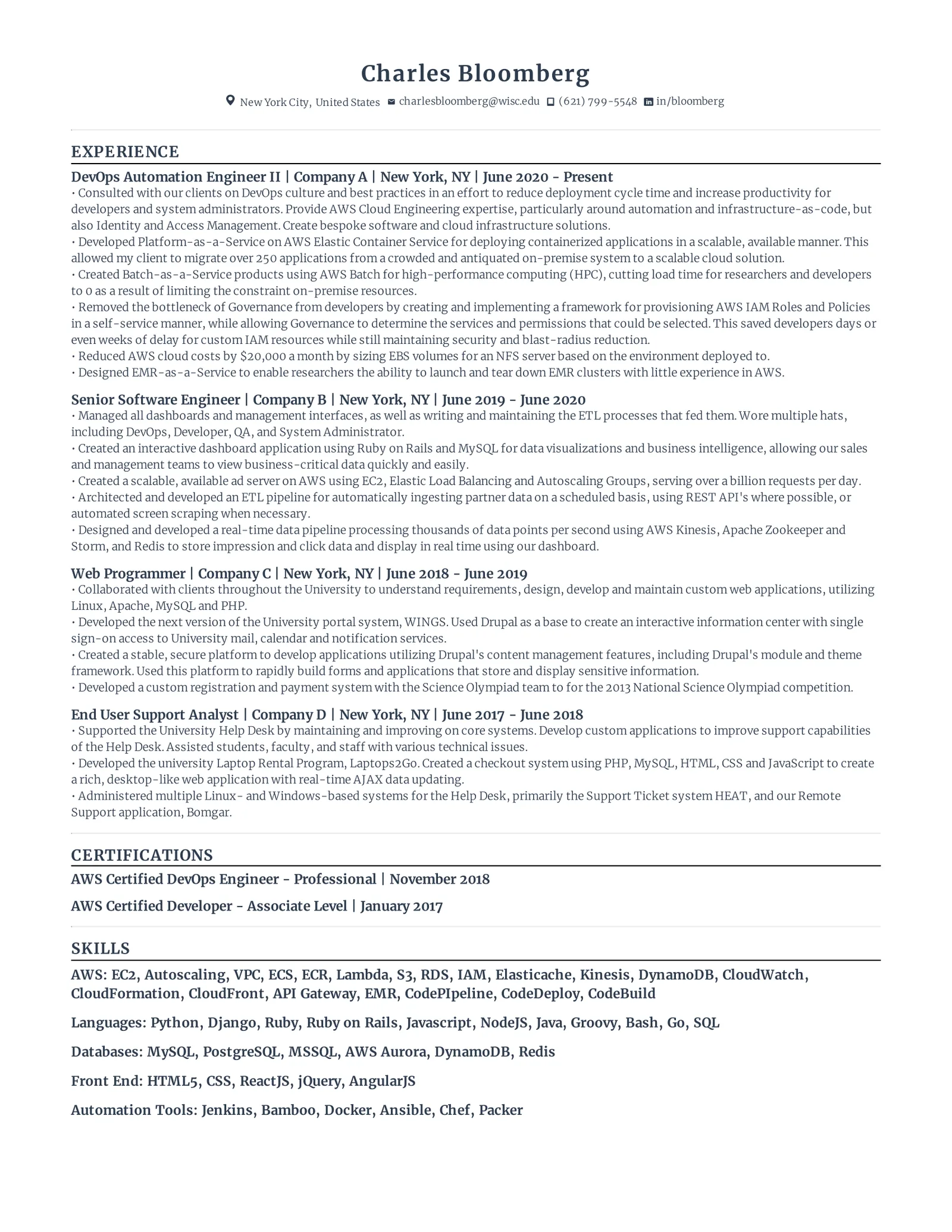
Below are complete DevOps engineer resume samples you can adapt: one for a junior engineer moving toward a mid-level or SRE role, one for a senior platform engineer, and one for a new graduate with projects instead of DevOps jobs. Each has a short summary, technical skills grouped by category, and bullets that tie each tool to a result such as deploy frequency, recovery time or cloud cost.
After the samples come section-by-section advice, summary and bullet examples, certifications, and tips for career changers. The people, companies and figures in every example are fictional, so swap in your own tools, scale and results.
Sample resume for a junior DevOps engineer
Use this layout if you have one to four years of experience, have been promoted once and now want a mid-level DevOps or site reliability engineering (SRE) role.
Start your own resume.
Summary
DevOps engineer with three years at a healthcare SaaS company, promoted from junior after 18 months. Run CI/CD with GitHub Actions and Argo CD for 14 services on Amazon EKS and manage the AWS infrastructure in Terraform. Cut lead time from merge to production from two days to under three hours and share the on-call rotation for the platform's SLOs.
Technical skills
- Cloud: AWS (EKS, EC2, RDS, S3, IAM, VPC)
- Infrastructure as code: Terraform, CloudFormation (read and maintain)
- Containers: Docker, Kubernetes, Helm
- CI/CD: GitHub Actions, Argo CD, Jenkins (migrated away from)
- Observability: Prometheus, Grafana, Alertmanager
- Scripting and version control: Bash, Python, Git
Experience
DevOps Engineer, Brightline Health, Austin, TX
January 2025 – Present
- Moved 14 services from Jenkins freestyle jobs to GitHub Actions and Argo CD, raising production deploys from twice a week to six to eight a day.
- Cut lead time from merge to production from about two days to under three hours by running test stages in parallel and promoting builds from staging automatically.
- Joined the SRE on-call rotation (one week in six) and wrote 9 runbooks with matching Grafana alerts, lowering MTTR for P2 incidents from 52 to 18 minutes over two quarters.
- Rightsized EKS node groups and moved CI runners to Spot Instances, reducing non-production AWS spend by $6,200 a month (24%).
Junior DevOps Engineer, Brightline Health, Austin, TX
June 2023 – December 2024
- Wrote Terraform modules for VPC, RDS and EKS that the team used to build 3 new environments; a new staging environment went from three days of tickets to 40 minutes.
- Containerized 6 legacy Node.js services with Docker multi-stage builds and Helm charts, shrinking images from 1.1 GB to 240 MB.
- Added Prometheus exporters and Grafana dashboards for 14 services, giving the on-call team latency and error-rate views for every service.
IT Operations Intern, Lone Star Credit Union, San Marcos, TX
May 2022 – August 2022
- Wrote Bash and Python scripts that produced the weekly patch report for 120 Linux servers, replacing a manual spreadsheet.
- Ran quarterly backup restore tests with the senior administrator and documented the restore procedure.
Projects
- Homelab GitOps: k3s cluster managed with Argo CD and Terraform, with Prometheus alerts sent to Slack. github.com/mayaokafor/homelab-gitops
Certifications
- Certified Kubernetes Administrator (CKA), The Linux Foundation, 2025
- AWS Certified Solutions Architect – Associate, Amazon Web Services, 2024
Education
B.S. in Computer Science, Texas State University, 2023
What to borrow from this resume:
- Two titles under one employer. Listing "Junior DevOps Engineer" and "DevOps Engineer" separately shows the promotion without a sentence explaining it.
- Numbers at junior scale. Fourteen services and $6,200 a month are modest figures, and they are more believable than claims about company-wide transformation.
- A projects line with a link. Early in your career, a working GitHub repository gives the reader something to check. Leave it off if the repository only holds tutorial code.
Sample resume for a senior platform engineer
This version is for candidates with eight or more years who lead platform or infrastructure work and manage or mentor others.
Start your own resume.
Summary
Platform engineer with 11 years in operations and DevOps, the last five leading a four-person platform team at a freight logistics company. Built the internal developer platform that 60 engineers use to ship 42 services on Kubernetes, and cut AWS spend by $410K a year. Focus areas: multi-cluster Kubernetes, Terraform at scale, GitOps and SLO-based reliability.
Technical skills
- Cloud: AWS (EKS, EC2, RDS, Aurora, IAM Identity Center, Organizations), GCP (GKE)
- Infrastructure as code: Terraform (module registry, remote state, policy checks), Pulumi, CloudFormation
- Containers and platform: Kubernetes, Helm, Karpenter, Backstage
- CI/CD: Argo CD, GitLab CI, GitHub Actions, Jenkins (migrated away from)
- Observability: Prometheus, Grafana, Datadog, OpenTelemetry, PagerDuty
- Languages: Go, Python, Bash
Experience
Senior Platform Engineer, Northwind Freight, Chicago, IL
March 2021 – Present
- Led the design of an internal developer platform (Backstage templates, Argo CD and Terraform modules) that lets 60 engineers create a production-ready service in under an hour, replacing a two-week ticket queue.
- Moved 42 services from weekly release trains to on-demand deploys averaging 35 a day, while keeping change failure rate under 5%.
- Introduced SLOs and error budgets for 18 customer-facing services in Prometheus and Datadog; availability of the shipment-tracking API rose from 99.5% to 99.95% over 12 months.
- Cut AWS spend by $410K a year (22%) through Karpenter autoscaling, Savings Plans and per-team cost reports built from resource tags.
- Manage and mentor 4 platform engineers; ran the hiring loop for two of them and supported one promotion to senior.
DevOps Engineer, later Senior DevOps Engineer, Cobalt Payments, Chicago, IL
June 2017 – February 2021
- Migrated 120 virtual machines from an on-premises data center to AWS with Terraform over nine months, with no customer-facing downtime during cutovers.
- Replaced Jenkins scripted pipelines with GitLab CI templates adopted by 9 teams, reducing lead time for changes from five days to one.
- Set up the PagerDuty incident process and postmortem template; MTTR for Sev-2 incidents fell from 70 to 25 minutes.
Linux Systems Administrator, Lakeshore Hosting, Chicago, IL
August 2015 – May 2017
- Automated patching for 300 RHEL servers with Ansible, shortening the monthly maintenance window from eight hours to two.
Certifications
- AWS Certified DevOps Engineer – Professional, Amazon Web Services, 2023
- Certified Kubernetes Administrator (CKA), The Linux Foundation, 2022
- HashiCorp Certified: Terraform Associate, HashiCorp, 2021
Education
B.S. in Information Technology, Illinois State University, 2015
What to borrow from this resume:
- Platform outcomes first. The top bullet describes what other teams can now do, which is how platform work is judged.
- Team scope stated plainly. "Manage and mentor 4 platform engineers" is clearer than "leadership skills" in a skills list.
- Older roles kept short. The 2015 sysadmin job gets one bullet. It explains the career path without using space the recent work needs.
Sample resume for an entry-level DevOps engineer
If you are a new graduate or bootcamp finisher, your projects do the work that job bullets do on the other two resumes. This one uses an objective instead of a summary and puts projects directly under skills.
Start your own resume.
Objective
Computer engineering graduate (University of Arizona, 2026) seeking a junior DevOps role. Wrote the Terraform for a three-tier AWS capstone app with a GitHub Actions pipeline that tests and deploys on every merge, and set up Prometheus and Grafana dashboards for a Kubernetes lab cluster.
Technical skills
- Cloud: AWS (EC2, VPC, RDS, S3, IAM)
- Infrastructure as code: Terraform
- Containers: Docker, Kubernetes (kind), Helm
- CI/CD: GitHub Actions
- Observability: Prometheus, Grafana
- Scripting and version control: Bash, Python, Git, Linux (Ubuntu)
Projects
Three-tier app on AWS with Terraform (capstone, team of three)
January 2026 – May 2026
- Wrote the Terraform for the VPC, Application Load Balancer and RDS database, kept in remote state so all three teammates could run plans safely.
- Built a GitHub Actions pipeline that runs unit tests, builds the Docker image and deploys on every merge to main. github.com/jordanlee/capstone-infra
Kubernetes monitoring lab
September 2025 – December 2025
- Deployed a sample microservices app to a local kind cluster with Helm and set up Prometheus and Grafana dashboards for latency and error rate.
Experience
Student IT Assistant, University of Arizona College of Engineering, Tucson, AZ
September 2024 – May 2026
- Wrote Bash scripts that set up 40 Linux lab workstations at the start of each semester, replacing a manual checklist.
- Resolved lab and account tickets for engineering students and documented fixes in the department wiki.
Certifications
- HashiCorp Certified: Terraform Associate, HashiCorp, 2026
Education
B.S. in Computer Engineering, University of Arizona, 2026. Relevant coursework: Operating Systems, Computer Networks, Cloud Computing.
What to borrow from this resume:
- Projects written like jobs. Each project has dates, the applicant's part of a team effort, and a link or concrete setup someone can ask about.
- A non-DevOps job that still shows automation. The student IT role earns its place because the first bullet is a script that replaced manual work.
- A short skills list. It names the tools this applicant used in coursework, projects or the lab job, not every tool in the posting.
How to write each section
Choose a format and length
Use reverse-chronological order: most recent job first. All three resumes above use it, and it lets a hiring manager see your current infrastructure work immediately.
If you are moving in from another role, use a combination format. Put the technical skills and a projects section above your work history, but keep the job titles and dates. Avoid a purely functional resume that drops dates; reviewers for technical roles generally want to see when and where you did the work.
Keep the resume to one page if you have under about five years of experience. A second page is reasonable for senior candidates when every bullet on it is recent and relevant to the role.
Put the sections in this order
- Header: name, city and state, email, phone, LinkedIn, and GitHub if it holds real work
- Summary or objective: two or three sentences
- Skills, grouped by category
- Experience, with three to five bullets per recent role (projects come before experience if you have no DevOps jobs yet)
- Projects, for early-career applicants and career changers
- Certifications
- Education
Keep the layout easy to parse
Use standard headings such as "Experience" and "Skills", a single column and a common font. Leave out photos, skill bars, icons and text boxes. Applicant tracking systems can misread those elements, and they take space a recruiter would rather spend on results. Save as PDF unless the posting asks for a Word file.
Use the job posting's keywords
Applicant tracking systems and recruiters both look for the tools and practices named in the posting. To match them without stuffing:
- Highlight every tool, cloud service and practice in the posting, such as "Terraform", "Amazon EKS", "GitOps" or "incident response".
- Use the posting's exact spelling. Write "GitHub Actions", not "GHA", and "Azure DevOps" if that is the product they name.
- Put each keyword you can support in your skills section and in at least one bullet that shows how you used it.
- Write the full term and the acronym once, such as "infrastructure as code (IaC)" or "continuous integration and delivery (CI/CD)", so a search for either form finds it.
- Leave out any keyword you couldn't discuss in an interview, even if the posting lists it.
Terms that show up often in DevOps postings include CI/CD, infrastructure as code, containers and container orchestration, configuration management (Ansible, Chef, Puppet), monitoring and observability, incident response, GitOps, cloud cost optimization and specific AWS services, Azure or GCP products.
Write the summary or objective
State your years of experience, your focus (CI/CD, platform, SRE, a specific cloud), the tools you use most, and one result with a number. Use an objective instead if your current title doesn't match the job yet, as in the entry-level resume. More examples are in the next section.
Write the experience bullets
Start each bullet with what you did, name the tool, give the scale, and end with the result: "Moved 14 services from Jenkins to GitHub Actions, raising deploys from twice a week to six a day." If you were promoted, list each title separately under the employer, as in the junior resume. Bullet examples by metric are further down.
List certifications and education
Give each certification its full name, the issuer and the year earned. For education, list the degree, institution and graduation year. Recent graduates can add relevant coursework; senior candidates can keep education to one line.
Resume summary examples
Pick the example closest to your situation, then replace the tools, scale and result with your own. The three full resumes above already cover junior, senior and new-graduate statements, so these cover other common cases.
Mid-level, AWS and Kubernetes
DevOps engineer with five years of experience running AWS infrastructure for an e-commerce platform. Manage three EKS clusters and all infrastructure in Terraform, and moved 30 services to GitLab CI and Argo CD, taking production deploys from weekly to several times a day. Hold the CKA and AWS Certified Solutions Architect – Associate.
Use this shape when the posting is cloud-specific: name the AWS services and the deploy change, then the certifications the posting asks for.
SRE-focused summary
Site reliability engineer with six years supporting payment APIs through peak holiday traffic. Defined SLOs for 22 services in Prometheus and Grafana and rebuilt the paging policy, cutting pages per on-call week from 60 to 15. Reduced MTTR from 45 to 12 minutes with automated rollbacks and PagerDuty runbooks.
For SRE roles, lead with reliability measures such as SLOs, MTTR and paging load rather than deployment speed.
Objective for a systems administrator moving into DevOps
Systems administrator moving into DevOps after four years running 200 Linux servers for a regional hospital network. Automated server builds with Ansible and built a GitHub Actions pipeline that deploys a personal AWS project with Terraform. Looking for a junior role focused on CI/CD and infrastructure as code.
An objective works when your current title doesn't match the job yet. State the move, prove the overlap with one concrete automation result, and name the kind of role you want.
Objective for a developer moving into DevOps
Backend developer with four years building Java services at an insurance company, now moving into DevOps. Maintain the team's GitLab CI pipelines and Dockerfiles for 8 services and cut pipeline time from 25 to 9 minutes by caching dependencies and splitting test jobs. Looking for a DevOps role focused on CI/CD and Kubernetes.
Developers usually already own some pipeline or container work. Name it, give one measured change, and leave the application features you built for the experience section.
DevOps tools to list in your skills section
Group your skills by category so a reader can scan them in a few seconds. Here is a block you can trim to fit the posting:
- Cloud: AWS, Google Cloud (GCP), Microsoft Azure
- Infrastructure as code: Terraform, AWS CloudFormation, Pulumi
- Containers: Docker, Kubernetes, Helm
- CI/CD: GitHub Actions, GitLab CI, Jenkins, Argo CD
- Observability: Prometheus, Grafana, Datadog
- Scripting and version control: Python, Bash, Go, Git
List only the tools you could discuss in an interview. If you have used a tool only in a course, leave it out or move it to your projects section, where the context is clear.
Add depth where it helps. "AWS (EKS, RDS, IAM, Organizations)" tells a reader more than "AWS", and "Terraform (modules, remote state)" separates you from someone who ran one tutorial.
Reorder the categories for each application so the tools named first in the posting appear first on your resume. For general advice on choosing and proving skills, see this guide to resume skills.
Adjust the samples for Azure or Google Cloud roles
All three resumes above are AWS-centered. For an Azure or GCP posting, keep the same structure and swap in that cloud's equivalents where you have used them:
- Azure: AKS instead of EKS, Bicep or ARM templates alongside Terraform, Azure Pipelines or Azure DevOps for CI/CD, Azure Monitor for metrics and alerts.
- Google Cloud: GKE instead of EKS, Cloud Build for CI, Cloud Monitoring and Cloud Logging for observability.
Change only the tools you have worked with. A bullet about Terraform and Kubernetes usually carries over with the cloud name changed; a bullet about an AWS-specific service such as Savings Plans does not.
Quantified bullet examples by metric
Each bullet follows the same pattern: action, tool, scope, result. They are grouped by metric so you can go straight to the kind of result you can measure. Deployment frequency, lead time and recovery time are among the DORA delivery metrics many engineering teams already track, so check your team's dashboards before estimating anything.
Use numbers you can explain in an interview. If you don't have a before-and-after figure, describe the scale (services, servers, people supported) or the observable change instead of inventing a percentage.
Deployment frequency
- Moved 25 services from a fortnightly release train to trunk-based deploys with GitHub Actions and Argo CD, raising production deploys from 2 a month to about 15 a day.
- Added canary releases with Argo Rollouts for the checkout service, moving four weekend releases a month into normal weekday deploys.
Lead time for changes
- Cut lead time from commit to production from three days to four hours by running GitLab CI test stages in parallel and removing manual QA sign-off for low-risk changes.
- Reduced Docker build times in Jenkins from 22 to 6 minutes with layer caching and a shared build cache, giving 50 developers faster feedback on every pull request.
Mean time to recovery (MTTR)
- Lowered MTTR for Sev-2 incidents from 55 to 14 minutes by linking Datadog alerts to runbooks and adding one-click rollbacks in Argo CD.
- Wrote 20 runbooks and led blameless postmortems for 30 incidents; repeat incidents with the same root cause fell from 9 to 2 per quarter.
Uptime and SLOs
- Raised availability of the public API from 99.7% to 99.95% by moving it across three availability zones behind an AWS Application Load Balancer.
- Defined SLOs and error budgets for 12 services in Prometheus to replace CPU-based alerts, reducing pages per on-call week from 40 to 12.
Cloud cost savings
- Reduced monthly AWS spend by $38K (27%) through EC2 rightsizing, Savings Plans and S3 lifecycle rules for log buckets.
- Moved CI runners and nightly batch jobs on GKE to Spot VMs, cutting compute cost for those workloads by 60%.
When you don't have delivery metrics
- Built a self-service catalog of Terraform modules so product teams could create databases and queues without filing a ticket, removing about 30 platform tickets a week.
- Added Trivy image scanning and OPA Gatekeeper policies to every pipeline, blocking images with critical CVEs from production clusters and closing 140 critical findings in the first quarter.
Rewrite a duty into a result
A duty tells the reader what you were assigned. A result tells them what changed.
Before: Responsible for CI/CD pipelines and monitoring.
After: Rebuilt CI/CD for 8 services in GitHub Actions and added Grafana alerts tied to error rates, cutting failed deployments that reached production from 6 a month to 1.
The rewrite names the tools, gives the scope (8 services) and shows a before-and-after number.
Certifications to list
Certifications matter most when you have little production experience or are moving into a new cloud or specialization. List the ones the posting names first.
| Certification | Issuer | What it shows | Best fit |
|---|---|---|---|
| AWS Certified Solutions Architect – Associate | Amazon Web Services | Broad knowledge of designing on AWS | Entry and mid-level, AWS roles |
| AWS Certified DevOps Engineer – Professional | Amazon Web Services | CI/CD, automation and operations on AWS in depth | Mid-level and senior AWS roles |
| Certified Kubernetes Administrator (CKA) | The Linux Foundation | Hands-on Kubernetes cluster administration | Mid-level and up, Kubernetes-heavy roles |
| Certified Kubernetes Application Developer (CKAD) | The Linux Foundation | Building and deploying applications on Kubernetes | Developers changing careers |
| HashiCorp Certified: Terraform Associate | HashiCorp | Infrastructure-as-code fundamentals across clouds | Entry and mid-level |
| Microsoft Certified: DevOps Engineer Expert | Microsoft | Pipelines and delivery with Azure DevOps and GitHub | Azure-focused roles |
| Google Cloud Professional Cloud DevOps Engineer | Google Cloud | SRE practices and delivery on Google Cloud | GCP-focused roles |
Format each entry on one line with the full name, issuer and year, as in all three resumes: "Certified Kubernetes Administrator (CKA), The Linux Foundation, 2025." If a certification has expired, renew it or remove it rather than listing it without a date.
If you have little or no experience
Start from the entry-level resume above. Put a projects section directly under your skills and give each project dates, your part in it, and the same action, tool and result structure as a work bullet. Name the program and school so the reader knows where you learned the material.
Choose projects that look like DevOps work: a pipeline that deploys something, infrastructure written in Terraform, a cluster with monitoring. A repository a reviewer can open is worth more than a list of courses.
List one entry-level certification, such as the Terraform Associate or AWS Solutions Architect – Associate, only if you have earned it. Unrelated jobs can stay if they show reliability or automation; keep them to one or two bullets.
Moving into DevOps from another role
Many people in these jobs started as system administrators, developers or QA testers. Your resume has to make the connection, because a hiring manager reading "Systems Administrator" won't assume you write pipelines.
- From system administration: rewrite maintenance duties as automation. "Maintained 200 servers" becomes "Automated provisioning and patching for 200 servers with Ansible, cutting setup for a new server from a day to 20 minutes."
- From software development: highlight the infrastructure work you already do, such as writing Dockerfiles, maintaining CI configuration or debugging production issues. Compare with a software engineer resume example to see which parts of a developer resume to keep and which to cut.
- From QA: frame test automation as pipeline work, for example "Added automated integration tests as a required GitHub Actions stage, catching regressions before merge for 12 services."
Use the combination format described above, and add one or two working repositories to a projects section so the reader can see the new skills in use.
Common mistakes to avoid
Listing every tool you have touched
A skills section with 30 tools makes it hard to tell what you know well. Keep the categories from the skills block above and cut tools you couldn't discuss in an interview.
Writing duties instead of results
"Responsible for Kubernetes clusters" says nothing about scale or outcome. Give the number of clusters or services and what improved.
Stuffing keywords instead of using them in context
A long comma-separated keyword line may match a posting, but it doesn't show how you used anything.
Instead of: Skills: CI/CD, Docker, Kubernetes, AWS, Terraform, Jenkins, Ansible, Prometheus, Grafana, Helm, Argo CD, Python, Bash, Linux, microservices, automation
Write: Built Jenkins pipelines that deploy Dockerized microservices to Kubernetes on AWS, with infrastructure managed in Terraform and alerts in Prometheus.
Keep a grouped skills section, and make sure the most important keywords also appear in your bullets.
Sending one resume to every posting
An AWS-focused role, an Azure platform role and an SRE role use different language. Keep a master DevOps resume with all your bullets, then pick and reorder for each job. This guide on targeting a job description walks through the matching step by step.
Using numbers you can't back up
Interviewers for infrastructure roles often ask how a metric was measured. If you can't explain where "40% faster" came from, replace it with scale or a specific change you made.
Choosing a layout that hides your work
Two-column designs, skill bars and icons can scramble when parsed and push results down the page. A plain single-column layout, like the resumes above, is safer.
Once your resume is tailored, write a cover letter that points to one or two of your strongest bullets; this cover letter outline covers the structure. If you keep a master resume, Resume Build can tailor it to a specific job description and export it as a PDF.